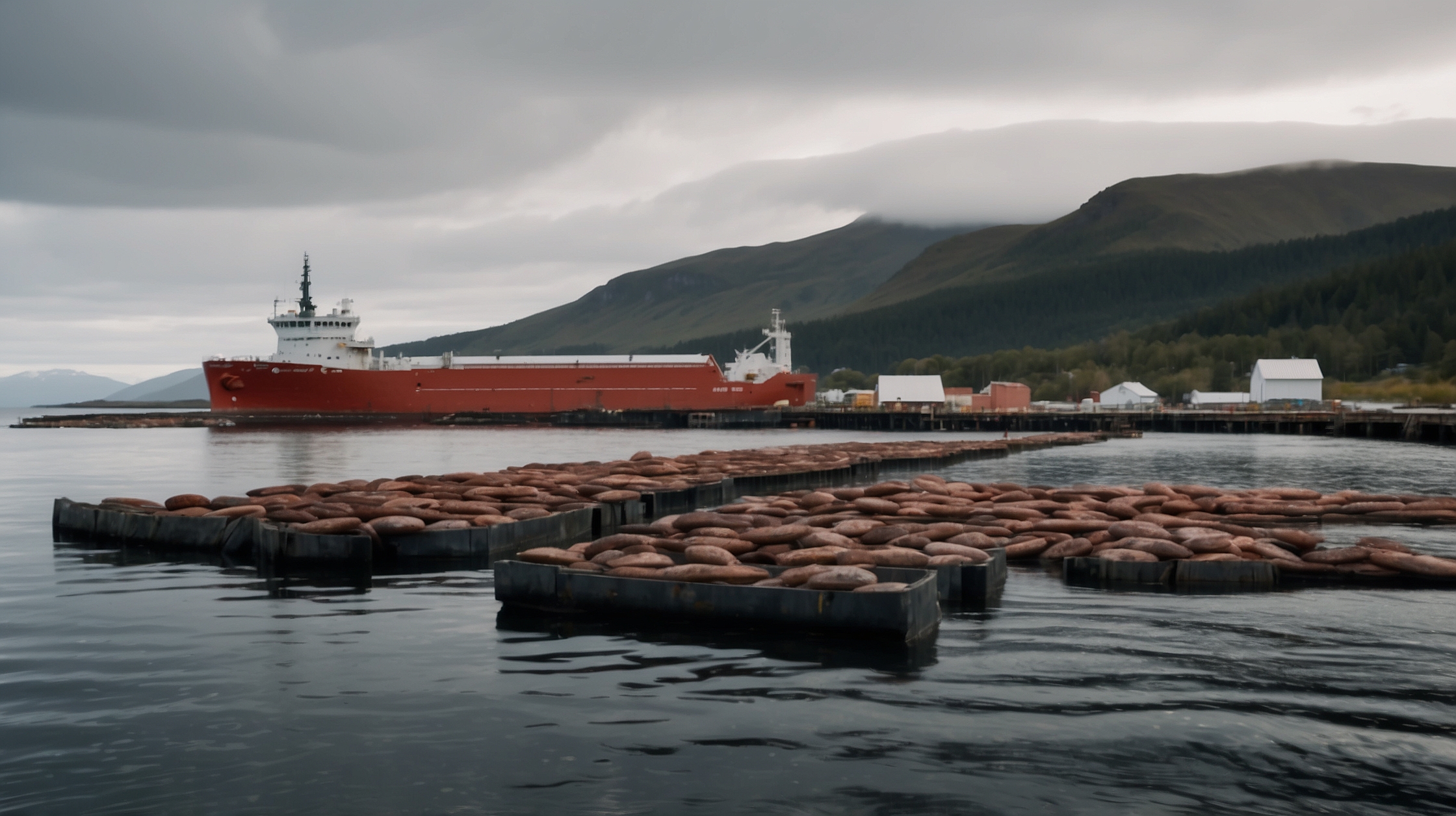
In the misty waters off the Norwegian coast, a ship-like silhouette floats quietly, catching the horizon in a surreal blend of industrial might and natural beauty. But this isn’t a ship, at least not in the traditional sense. Measuring an astounding 385 meters in length—longer than most aircraft carriers—and weighing in at 33,000 tons, this steel giant is revolutionizing the face of aquaculture. It’s called **Havfarm 1**, and it’s the largest offshore salmon farm ever built. Conceptualized by Norwegian aquaculture company Nordlaks, Havfarm 1 is as groundbreaking as it is massive, reshaping what’s possible in fish farming.
For decades, salmon farming has been plagued by challenges—from overcrowded pens to the spread of sea lice and diseases. But Havfarm 1 proposes a bold new solution: take the farm out to sea, far from the fjords and closer to the raw, untamed forces of the Norwegian coastline. The vision is simple, the execution monumental. Developed in partnership with Chinese shipbuilding powerhouse CIMC Raffles, this is more than a floating platform—it’s a floating city for salmon, a technological marvel designed to raise 10,000 tonnes of fish in open-water conditions. And users everywhere—investors, environmentalists, and seafood lovers alike—are watching closely.
So what makes Havfarm 1 different, and why could it represent the future of sustainable aquaculture? Let’s dive into the engineering, economics, and ecological promise behind the world’s biggest offshore fish farm.
Quick snapshot of Havfarm 1 and what it represents
| Name | Havfarm 1 |
| Length | 385 meters |
| Width | 59.5 meters |
| Weight | 33,000 tons |
| Holding capacity | 10,000 tons of salmon |
| Location | Off the coast of Hadsel, northern Norway |
| Developer | Nordlaks in cooperation with CIMC Raffles |
| Technology focus | Offshore aquaculture, environmental sustainability, robust engineering |
Why traditional fish farming faces serious challenges
For years, fish farming near shorelines has been grappling with growing concerns. **Overcrowding**, **pollution**, and **pest infestations** plague traditional sea pens. In coastal regions like Norway’s fjords, sea lice can devastate entire stocks, while overproduction places a heavy burden on marine ecosystems. Moreover, farms located too close to populated or touristic areas often face opposition due to concerns over water contamination, waste disposal, and visual disruption.
To solve these issues, the aquaculture industry needed an out-of-the-box—literally off-the-shore—solution. That’s where Havfarm 1 emerges as a game-changing innovation, moving the pens far away from vulnerable coastal zones and into deeper, cleaner, and more dynamic waters.
What makes Havfarm 1 an engineering breakthrough
In most outward aspects, Havfarm 1 looks like a vessel—but it is anchored to the seafloor, unmoving, with six gigantic net pens hanging beneath its steel frame. Each pen goes more than 10 meters deep, giving salmon room to swim and grow with minimal stress. The entire structure is stabilized to withstand **12-meter ocean swells** and Arctic storms—conditions that would sink less sophisticated fish farms.
These special net pens are made of heavy-duty mesh to ward off predators like seals and to resist the oppressive pressure of rough seas. Additionally, the farm is remotely monitored via sensor-based systems that track oxygen levels, fish health, feed distribution, and water temperatures in real-time. Automation further reduces the need for human presence, improving both safety and operational efficiency.
Building Havfarm 1 was like creating a city on water. Every detail—from hydrodynamics to digital control—required precision.
— Project Engineer, Nordlaks (Name withheld)
Sustainability is the beating heart of this project
At its core, Havfarm 1 is an **environmentally conscious approach to aquaculture**. By moving farming operations farther offshore, the ecological footprint is dramatically reduced. More spacious living conditions decrease the likelihood of fish stress and disease. Ocean currents naturally cleanse the area, reducing the need for antibiotics or aggressive chemical treatments.
Waste management also improves: feces and uneaten feed disperse quickly in deep-sea waters instead of accumulating on seabeds, and the design prevents interactions with wild salmon, thus minimizing the transfer of disease and preserving genetic diversity in wild populations.
Havfarm is a new chapter for aquaculture. It’s sea-friendly, fish-friendly, and future-forward.
— Dr. Lena Eriksen, Marine Biologist
Economic and logistical impact of large-scale offshore farms
At a time when global seafood demand is skyrocketing, the need for scalable, efficient, and clean aquaculture systems is more critical than ever. Havfarm 1 enables **high-volume production**—up to 10,000 tons of healthy salmon annually—without the bottlenecks of space or environmental regulation that challenge inshore farms.
Moreover, its size drastically lowers the cost per kilogram of produced fish by utilizing **economies of scale**. Fewer structures mean less infrastructure and maintenance costs, and automated systems reduce labor expenses. This leads to higher profit margins for producers and lower prices for consumers, all while adhering to strict environmental standards.
Who benefits and what the future may hold
| Winners | Losers |
|---|---|
| Salmon farmers able to scale production | Traditional coastal farms facing stricter rules |
| Consumers gaining better quality fish | Developers unable to transition offshore |
| Environmentalists supporting sustainable methods | Inshore ecosystems still burdened by older farms |
More Havfarms are on the way
Encouraged by Havfarm 1’s success, Nordlaks has announced plans for a second model—**Havfarm 2**. This version is expected to be mobile, able to cruise to different farming zones while carrying massive salmon stocks. By applying similar technology to a floating, dynamic platform, the company aims to push the boundaries of open-ocean farming even further.
With innovation hubs around the world watching closely, especially in Asia and South America, the Havfarm project could signal a **global trend**. Other nations with extensive coastlines could adopt similar structures, ushering in a new wave of **eco-technological food production**.
Short FAQs about Havfarm 1
Is Havfarm 1 a ship or a platform?
Technically, it’s a fixed offshore platform, not a ship, though it resembles a large vessel in size and structure.
How many fish can it hold at a time?
Havfarm 1 can support the growth of up to 10,000 tons of salmon in one production cycle.
Where is Havfarm 1 located?
It is anchored in the sea off Hadsel Island in northern Norway, where ocean conditions are ideal for salmon farming.
Why is this offshore model more sustainable?
By moving away from the shore, it lessens ecological impact, reduces disease spread, and allows for self-cleaning currents.
How are the fish monitored?
Sensors and automated systems continuously track fish health, oxygen levels, and feed usage on the platform.
Can this model be replicated in other countries?
Yes, provided the coastal environment meets operational and regulatory conditions for open-sea aquaculture.
How was Havfarm 1 built?
It was constructed by CIMC Raffles in China and transported to Norway. The project involved cutting-edge marine engineering.
What is the future of offshore aquaculture?
With climate pressures and food demand rising, offshore salmon farms like Havfarm may become the standard model worldwide.