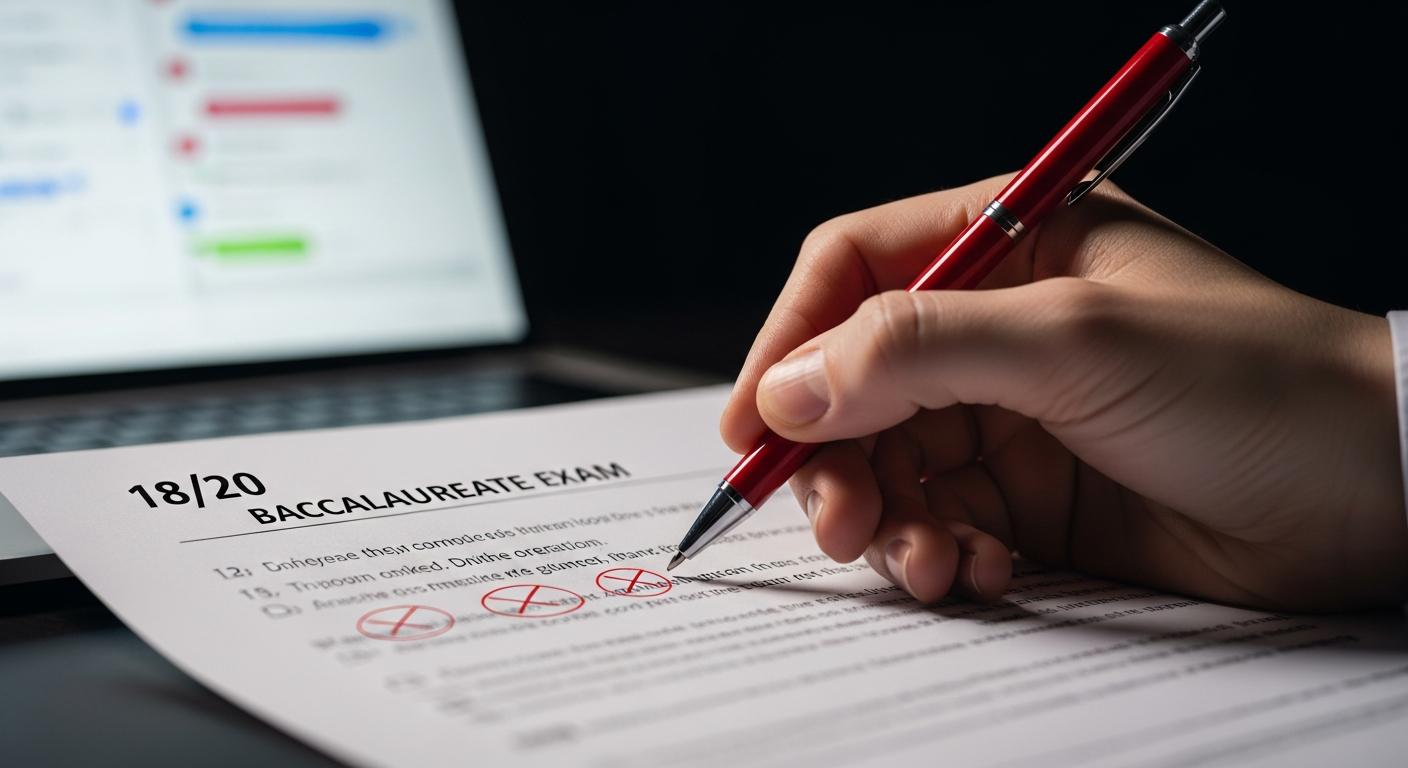
It was a decision born of curiosity and professional skepticism. When a high school teacher in the south of France decided to submit a student essay written entirely by ChatGPT for the French Baccalaureate examination, she likely anticipated a mix of intrigue and controversy. What she did not expect, perhaps, was just how definitive the result would be—a mid-tier grade that speaks volumes about artificial intelligence, education, and the evolving standards of academic performance.
The experiment was simple, yet revelatory: feed a standard baccalaureate essay prompt into ChatGPT, fine-tune the chatbot’s response sparingly, and submit it under a fake student name. The grade it received? A very average 11 out of 20—essentially a passing score, but nothing to write home about. The teacher’s objective wasn’t to deceive bureaucratic evaluators, but to test whether AI could effectively mimic human critical thinking and essay-writing capabilities within the structured expectations of French academia.
As this story continues to circulate, questions are emerging nationwide: How well can AI truly perform in academic settings? Can machines meet the ethical and qualitative criteria teachers value most? And perhaps most importantly, how should educators respond when faced with this rapidly evolving technology in their classrooms?
Key findings from the ChatGPT Baccalaureate experiment
| Aspect | Details |
|---|---|
| Experiment Location | South of France |
| Who Submitted Essay | A high school teacher |
| Who Wrote the Essay | ChatGPT (AI chatbot) |
| Baccalaureate Subject | Philosophy |
| Essay Topic | “Can art be a tool for understanding the world?” |
| Grade Received | 11/20 |
| Teacher’s Evaluation | Passable but clearly lacking depth and structure |
Understanding how the essay was generated and submitted
The teacher behind the act didn’t aim to expose a flaw in the educational system, but began the project as a professional inquiry into how powerful and convincing artificial intelligence has become. By choosing a philosophy prompt—a subject known for its rigorous argumentative structure and demand for nuanced critique—she set a challenging test for ChatGPT. Slight adjustments were made for grammar and phrasing, but the core content remained untouched.
After being submitted anonymously under a fictional student name, the AI-written essay was graded by a peer with no knowledge of the experiment. The result? A rather unremarkable 11 out of 20—indicative, perhaps, of right-brain creativity without the connective tissue of deeper critical thought. In her final feedback, the grading teacher noted the essay’s lack of original insight, poor structure, and robotic articulation.
“The copy wasn’t shocking—it was average, showing neither creativity nor analytical richness. It meets formal expectations without any intellectual soul.”
— Anonymous Philosophy Teacher, Baccalaureate Examiner
Why an average score is more telling than a high one
While an average grade might make this story seem anticlimactic, it reveals something profoundly important: **AI is already capable of producing work** that passes through one of the world’s most rigorous educational evaluations. Yet its weaknesses—lack of emotional resonance, human intuition, and insightful synthesis—are just as crucial as its performance.
Philosophy, a discipline that rewards depth of thought, rhetorical innovation, and personal interpretation, proved to be a worthy challenge for ChatGPT. The AI’s version was grammatically sound and formally relevant but was described as flat, derivative, and ultimately disengaging. While these flaws limited the score to a borderline pass, they also helped underscore what machines still lack in mimicking truly human reasoning and academic discourse.
What educators say about AI’s role in learning
This experiment sparked immediate and impassioned reactions from educators across France. Some warned of an impending crisis in academic integrity, while others maintained that AI could be used constructively in the classroom. Most agreed on one point though: the need for proactive adaptation in teaching strategies.
“Banning AI use is a temporary fix. We need to teach students how to critically engage with these tools—not just fear them.”
— Clara Roux, High School Literature Instructor
One of the main concerns is that students might start outsourcing their thinking—a crucial skill for personal development—to algorithms designed to predict the next statistically probable sentence. While that may produce dramatically coherent answers, it risks hollowing out learning.
How this challenges traditional assessment models
The fact that ChatGPT could ‘pass’ the French Baccalaureate with minimal adjustment calls into question how assessments are structured. Are tests merely evaluating format over thought? Do grading rubrics prioritize phraseology and syntax over creativity and reflection?
This isn’t just a French issue. Educational institutions globally may soon encounter similar dilemmas. As AI advances, many teachers and curriculum developers are asking whether existing assessment models are robust enough to measure deeply human skills—like empathy, intuition, originality, and emotional perception.
Opportunities and ethical questions going forward
While the results were far from alarming, they do indicate we are entering a new academic era. Rather than viewing AI as an existential threat, many educators suggest that it could augment learning when properly integrated. That could mean AI-assisted brainstorming, critical theory modeling, or even personalized tutoring for struggling students.
The real danger, experts warn, lies not in students using tools like ChatGPT, but in **educators failing to understand or adapt to them**. Going forward, ethical guidelines, transparency policies, and AI literacy will likely become standard curriculum components in high schools and universities alike.
“We’re not just talking about cheating. We’re talking about how we define thinking, and who gets to do it.”
— Jean-Paul Lafitte, Educational Ethicist
The line between assistance and authorship
Where does support end and dishonesty begin? This question haunts the intersection of **AI and education**, and there are no obvious answers yet. Even now, opinion varies—some educators tolerate limited AI use for outlining or proofing, while others draw the line at concept generation.
Given how rapidly AI language models have improved, educators are racing to design new pedagogical tools that reward process over product. Oral defenses, interactive assignments, and collaborative group work are just a few methods being explored to maintain academic integrity in an AI-augmented classroom.
Winners and losers in the age of AI in education
| Winners | Losers |
|---|---|
| Tech-savvy students leveraging AI responsibly | Teachers unfamiliar with AI integration tools |
| Educators who adapt their methods | Standardized testing protocols |
| Curricula emphasizing critical thinking | Assessment models focused only on writing format |
Frequently asked questions about AI in academic settings
Can students use ChatGPT ethically for their schoolwork?
Yes, but only to a certain extent. Using AI for brainstorming or editing may be allowed, but submitting AI-written work as your own is generally unethical and often prohibited.
How do teachers detect AI-generated content?
Teachers use detection tools, observe inconsistencies in writing style, and evaluate the depth and originality of the ideas presented.
What risks does AI pose to academic integrity?
AI can facilitate plagiarism, dilute learning objectives, and make it harder for teachers to assess genuine student understanding.
Can AI ever truly replace human thought in subjects like philosophy?
No—at least not yet. Philosophy demands emotional nuance, historical context, and ethical reasoning that AI cannot replicate authentically.
How should schools respond to the rise of AI tools?
Schools should adapt curricula, educate students on responsible tool usage, and redesign assessments that go beyond traditional essays.
Is ChatGPT actually good at academic writing?
It’s competent in structure and grammar but often lacks originality and critical insight, making it suitable only for baseline tasks.
Are AI-written essays identifiable by grading professionals?
Often, yes. As this experiment revealed, trained educators can usually detect the mechanical tone and surface-level analysis of AI-generated work.
What skills should students focus on in the age of AI?
Critical thinking, creativity, and emotional intelligence—these remain core human capabilities that AI cannot easily replicate.