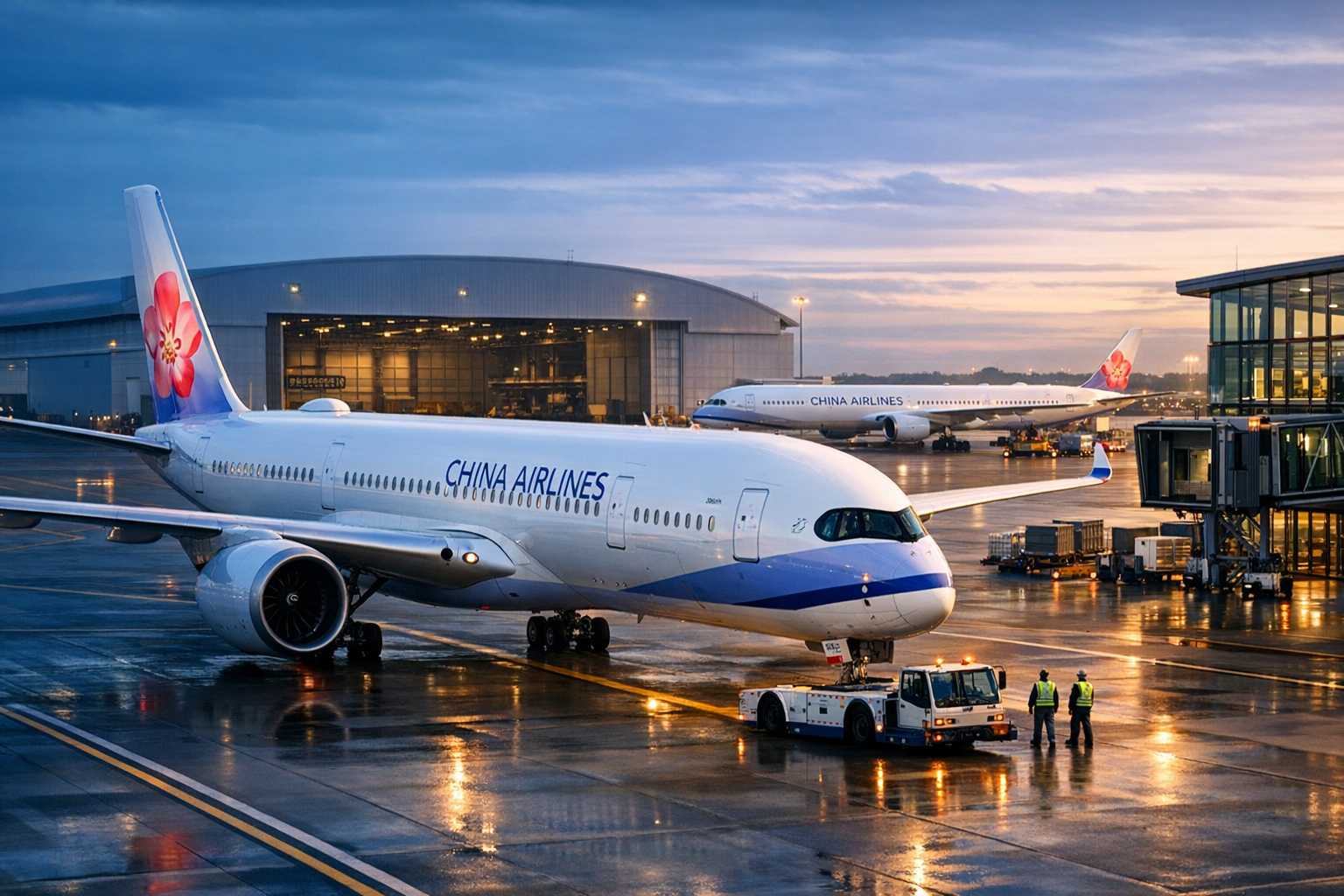
In the high-stakes world of aviation, few deals turn as many heads as a multibillion-dollar aircraft purchase from a major airline. This week, the industry spotlight shone brightly on Asia as **China Airlines**, the flag carrier of Taiwan, finalized a significant deal with aerospace giant **Airbus**. This €1 billion acquisition sees the addition of five more wide-body **Airbus A350-1000s** to its growing long-haul fleet—marking another confident step in its post-pandemic recovery and future aerospace strategy.
The move underscores the airline’s long-term vision to modernize its fleet and cater to booming international travel demand, especially in the Asia-Pacific region. What’s striking isn’t just the scale of the order but also what it signals: an evolving competitive landscape in Asia’s aviation sector, where fuel efficiency, passenger comfort, and global reach are now top priorities. For Airbus, this is more than just a commercial success; it strengthens its foothold in one of the world’s most dynamic markets.
The order also demonstrates China’s continued influence in bolstering commercial aviation despite geopolitical complexities. As airlines in the Asia-Pacific region rebound from the turbulence of the pandemic era, China Airlines is not only banking on a full-throttle travel recovery but doubling down on operational excellence.
Key details of the Airbus and China Airlines agreement
| Detail | Information |
|---|---|
| Airline | China Airlines (Taiwan) |
| Manufacturer | Airbus |
| Aircraft Model | Airbus A350-1000 |
| Number of Planes Ordered | 5 |
| Deal Value | €1 Billion (approx. USD $1.08 Billion) |
| Purpose | Fleet modernization and long-haul route expansion |
| Delivery Timeline | Beginning from 2026 |
Why the Airbus A350-1000 is a game-changer
Known for its **state-of-the-art technology**, fuel efficiency, and customer-centric cabin design, the Airbus A350-1000 is currently one of the most advanced aircraft in the skies. It can fly farther, with less fuel burn and lower emissions than many other wide-body jets. For **long-haul operations**, it’s a preferred choice that combines performance with sustainability—meeting the evolving standards of regulators and consumers alike.
The **A350-1000 seats about 350 to 410 passengers** depending on configuration and is ideal for ultra-long-haul routes such as flights from Taipei to North America or Europe. China Airlines already operates the **A350-900**, and this new order for the longer-bodied version signals a **deep commitment to the Airbus A350 family platform**, a move that could also simplify training, maintenance, and logistical support across its fleet.
“As travel rebounds and routes reopen, aircraft selection becomes a critical differentiator. The A350-1000 is the right aircraft at the right time for carriers looking to elevate their transcontinental offerings.”
— Aviation Analyst, Placeholder Name
Fleet modernization as a strategic pivot
Fleet modernization is no longer just about reducing fuel costs. It’s about **future-proofing operational capability**, maximizing passenger comfort, reducing the environmental footprint, and signaling market strength. China Airlines’ aggressive approach post-pandemic has shown its ambition to not only recover but to outperform regional competitors.
The five A350-1000s are expected to **replace older A330s** and **complement existing A350-900s**, creating a versatile and balanced fleet composition. This strategic mix allows China Airlines to cover short-, medium-, and long-haul networks with maximum efficiency. By 2026, when the first of these units are delivered, China Airlines will have **one of the youngest and most fuel-efficient fleets** in Asia.
Regional significance of the deal
China Airlines’ deal is not just about internal growth—it has **regional implications**. With other Asian carriers, such as Singapore Airlines and Cathay Pacific, aggressively expanding and refreshing their fleets, this deal keeps China Airlines a **competitive force in the international arena**. Moreover, the timing aligns perfectly with rapidly rising passenger demand across Asia-Pacific.
This is a strategic move not just in competition with fellow Asian carriers but also against Middle Eastern giants like Emirates and Qatar Airways, all of whom pursue similar long-haul ambitions with next-gen aircraft.
“Regional fleet upgrades reflect not just market demand shifts, but a deeper focus on transcontinental linkages that define future profitability.”
— Senior Air Transport Consultant, Placeholder Name
Environmental milestones and fuel sustainability
The selection of the **A350-1000** also aligns with the green transitions that airlines across the globe are undertaking. The aircraft is designed with **sustainability** at its core—it burns **25% less fuel** compared to its predecessor models and can be certified to run on up to **50% sustainable aviation fuel (SAF)**. This connection to cleaner aviation supports China Airlines’ commitments under **IATA’s net zero by 2050** goals.
Less fuel consumption means not only reduced costs over time but also **fewer CO2 emissions**, which are essential as airlines look to comply with increasingly stringent environmental standards in Europe, the U.S., and select Asian territories.
Winners and losers in the wake of the deal
| Winners | Losers |
|---|---|
| Airbus (boosts presence and revenue in Asia-Pacific) | Boeing (missed opportunity for wide-body segment share) |
| China Airlines (fleet modernization and strategic growth) | Older aircraft less equipped to meet climate goals |
| Passengers (expect newer, more comfortable aircraft) | Competitor airlines not expanding at similar pace |
What this order means for Airbus’s Asia-Pacific ambitions
For Airbus, this **€1 billion win** is the latest landmark in a series of regional successes. The aircraft maker has been aggressively pushing into the Asia-Pacific market, luring turning points away from Boeing following the latter’s production delays and legal issues. The addition of China Airlines to its growing roster of Pacific clients—including Singapore Airlines, Qantas, and Japan Airlines—cements its **leadership in Asia’s wide-body sector**.
This deal may also springboard further interest from other carriers looking to retool their fleets with fuel-efficient twin-engine options. The A350 rollout continues to be a central part of Airbus’s long-term revenue strategy, especially as the demand for new-generation planes outpaces production timelines.
How the deal reflects broader global fleet trends
This latest order reflects a **worldwide shift in fleet investment priorities**. Airlines aren’t just looking for more planes—they’re looking for better tools. The A350 family fits a broad spectrum of airline strategies from **ultra-long-haul operations** to sustainability alignment.
Strategically, the trend across continents is clear: replace outdated long-haul jets with more efficient wide-bodies. This deal confirms that in the race for **cleaner, more profitable skies**, aircraft like the A350-1000 are becoming the new gold standard.
FAQ: What travelers and aviation professionals are asking
When will China Airlines receive the new Airbus A350-1000s?
The first deliveries are expected to begin in 2026, with a full rollout occurring over the following years.
How does the A350-1000 differ from the A350-900?
The A350-1000 is a longer version and can carry more passengers over similar distances, offering better economies of scale on long-haul routes.
Why did China Airlines choose Airbus over Boeing?
While not explicitly stated, factors likely include Airbus’s fuel efficiency, earlier availability, and existing fleet compatibility with the A350-900 series already in service.
Will older aircraft be retired as a result of this deal?
Yes, older wide-body models, particularly A330s, are expected to be phased out as new A350-1000s enter service.
Is this deal part of China Airlines’ larger growth strategy?
Absolutely. The modern fleet forms a core part of its long-term vision to boost global connectivity and operational efficiency.
How does this impact Airbus’s rivalry with Boeing?
It boosts Airbus’s advantage, particularly in Asia, where Boeing has been slower to recover from production and certification setbacks.
Is there a benefit to passengers with this aircraft update?
Yes. Newer aircraft like the A350-1000 offer a much more comfortable and quieter cabin experience, along with better amenities.
Are other airlines making similar wide-body orders?
Yes. Across Asia and beyond, there’s a trend toward replacing older jets with new-generation aircraft to reduce operating costs and environmental impact.