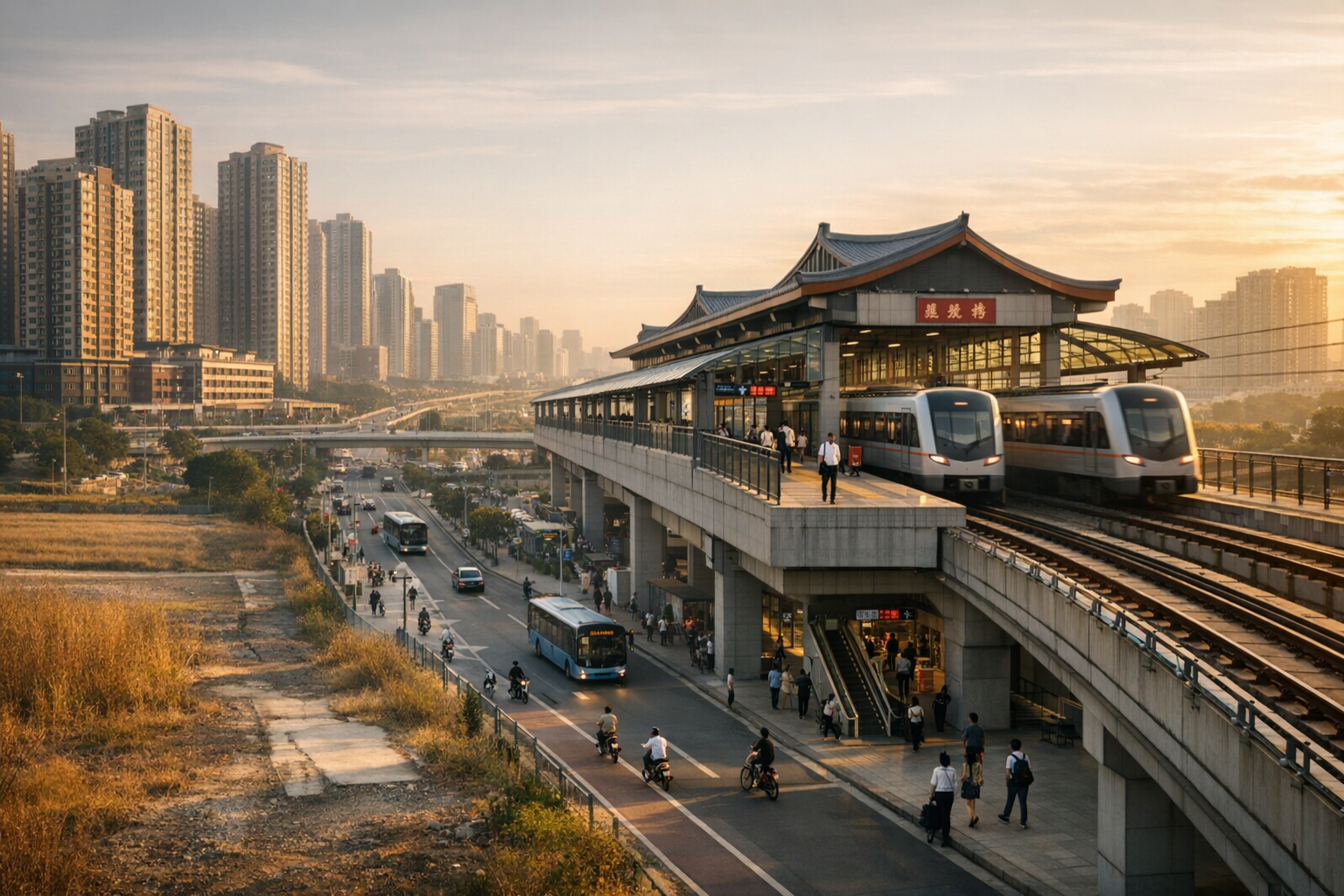
Back in 2008, when China’s high-speed rail and metro transformation was still in its infancy, satellite images captured something perplexing: sprawling metro stations rising in what appeared to be barren fields or ghost towns. Critics questioned the logic—and even sanity—behind constructing multimillion-dollar metro lines in areas with barely any foot traffic or urban demand. “White elephants,” they muttered. “Wasted investment.”
Fast forward to 2025, and the narrative has done a complete reversal. What once seemed like folly now stands as a masterstroke of long-term planning. These stations-in-the-wilderness are now bustling transit hubs, anchoring newly developed urban clusters, tech corridors, and residential neighborhoods. The world learned that China wasn’t just building for the present—it was building 20 years ahead of time.
This foresight-driven investment reflects not just China’s urban planning prowess, but also its capability to catalyze regional growth through infrastructure. As urban centers around the world struggle with transit overloads and housing shortages, China’s metro-in-the-middle-of-nowhere strategy reveals the power of aligning transportation with long-term development visions.
Key facts and highlights from China’s Metro Expansion Strategy
| Year of key developments | 2008 (Initial construction), 2025 (Maturity) |
| Regions covered | Hangzhou, Shenzhen, Chengdu, Zhengzhou, etc. |
| Primary objective | Future-proof urban growth and guide development corridors |
| Initial criticism | Stations built in undeveloped or low-footfall areas |
| Ultimate outcome | Became epicenters for new urban zones and economic activity |
| Funding approach | Combination of government infrastructure investment and land financing |
| Long-term benefit | Transit-oriented development driving housing and employment upsurge |
The vision behind building ahead of the curve
China’s decision to build metro lines in what once seemed like desolate areas was not random—it was strategic. Planners envisioned **urban expansion** reaching these areas within two decades. Rather than retrofit transport after the fact (as seen in Western cities), China’s developers sought to use transit as the spearhead of growth, aligning public transport routes with anticipated urban sprawl and economic zones.
This proactive model allowed for **zoning cities around transit infrastructure**, ensuring that new districts were both connected and attractive from the outset. Government policy designated land corridors for mixed-use development, with subway stations acting as ignition points for real estate, industry, and public facilities. Metro lines became more than transport—they were instruments of social and geographic transformation.
From ghost hubs to growth engines
In 2008, stations such as Hangzhou’s future Line 6 or parts of Chengdu’s outer-line metro served almost no passengers. Locals joked about operators counting more pigeons than people. But alongside these stations, the government released large parcels of land to developers at incentives. Schools followed. Then shopping malls, residential complexes, and hospitals.
By 2025, these so-called ghost hubs have turned into **urban nerve centers**. Remote-looking metro terminals now feature digital headquarters, logistics parks, and smart city pilot zones. Data shows a **300-500% population increase** in such zones over 15 years, as improved accessibility attracted both commercial and residential investment.
“People mocked them as ‘stations to nowhere’—but they were really ‘stations to the future.’ They anchored entire eco-systems of new city life.”
— Li Cheng, Urban Policy Analyst
Winners and losers in China’s metro strategy
| Winners | Losers |
|---|---|
| Commuters in newly developed areas | Critics who underestimated long-term returns |
| Property developers and housing seekers | Uncoordinated urban planners in non-transit zones |
| Municipalities with increased tax revenues | Older urban cores that saw relative investment decrease |
| Startups and tech hubs in emerging districts | Short-term-focused investors |
Infrastructure as the seed of urban life
China’s work underscores a powerful principle: **build it and they will come—if you plan properly**. Unlike reactionary infrastructure builds to match existing population sprawl, China flipped the model. Infrastructure led development.
The so-called “empty” metro stations built in 2008 acted as magnets. Their mere existence made nearby land valuable. Developers rushed in, knowing buyers would value proximity to a metro line. Likewise, citizens chased affordability and convenience, setting off a feedback loop of usage and expansion.
Critically, **government coordination across housing, zoning, and transport** ensured synchronicity. Not just lines, but entire districts blossomed in tandem with ridership. While initial ridership may have fallen short, authorities predicted long timelines—and were proven right.
Case study: Zhengzhou East Station and suburban reinvention
Take Zhengzhou East. In 2008, the bullet train and metro complex stood alone amid vacant plots. Today, it’s a gateway to innovation parks, a university belt, and multiple residential districts. Within a 5 km radius, over 2 million people now live, work, and study. The station catalyzed a **multi-modal hub**, integrating local buses, intercity rail, airports—and even autonomous shuttles.
The result is a deliberate, well-designed mega zone that offers higher living standards and lower congestion than older cities. The region’s GDP, too, reflects the boom—tripling over 15 years, in part due to transit-centered planning.
“Zhengzhou East is a shining example of what early investments in infrastructure can yield—livable cities.”
— Jia Yuheng, Transit Engineer at Central Planning Office
How China made it financially sustainable
One standout feature of China’s aggressive metro strategy was how it largely **paid for itself over time**. By using what is known as “land value capture,” cities sold adjacent parcels at higher valuations once metro construction began. Those windfall gains were reinvested into further expansions.
Moreover, leveraging public-private partnerships enabled a spread of *upfront risk*, while benefiting from *long-term profit*. Developers given station-side land were required to contribute to local infrastructure build-outs and services. In return, they received high footfall exposure and metro advertising rights—creating a win-win scenario.
Comparing China’s approach with global models
Most urban transport systems in North America or Europe expand *after demand*. There is valid logic in not overbuilding. Yet this model often leads to **chronic congestion**, housing shortages near transit hubs, and ballooning retrofitting costs.
China’s anticipatory strategy shows an alternative. Rather than play catch-up, it chooses to **shape the future** through design. This has not only elevated mobility standards, but has also reduced inequality by ensuring peripheral populations get equal infrastructure early on.
“Infrastructure-first can be more equitable. It gives people opportunities where the city is still growing, not just where it’s full.”
— Dr. Wen Sun, Urban Sociologist
What changed this year
2025 marked several key turning points. First, public perception finally shifted. Where once citizens and even foreign observers dismissed the approach as idealistic, now there is broad consensus on its effectiveness. Second, AI-assisted urban modeling has validated long-term forecasts, showing how small changes in infrastructure availability ripple across decades.
Finally, Chinese city models are now serving as templates abroad—in Africa, Southeast Asia, and Latin America—where **next-gen smart cities** are emerging with infrastructure as their kernel, not afterthought.
Short FAQs on China’s Metro Expansion Strategy
Why did China build metro stations in empty areas?
China anticipated future urban sprawl and used metro infrastructure to direct and accelerate it.
Were these stations profitable from the start?
No, most had low ridership early on, but long-term returns through land value and development have been substantial.
How did the government fund these metro projects?
Through land value capture, public funds, and public-private partnerships with developers.
What are the benefits to local citizens?
Improved connectivity, shorter commutes, modern housing, and economic opportunities near their homes.
Could this model work in other countries?
Yes, though it requires strong central planning, land policy alignment, and upfront investment capability.
What cities are examples of this success?
Hangzhou, Zhengzhou, Chengdu, and parts of Shenzhen are key examples of stations built ahead of urban growth.
Did this approach reduce traffic congestion?
Yes, pre-built metro access decreased car dependency in newly urbanized zones.
Will China continue this approach in the future?
Yes, planners are already eyeing close-in rural areas as hubs for next-stage, sustainable city building.