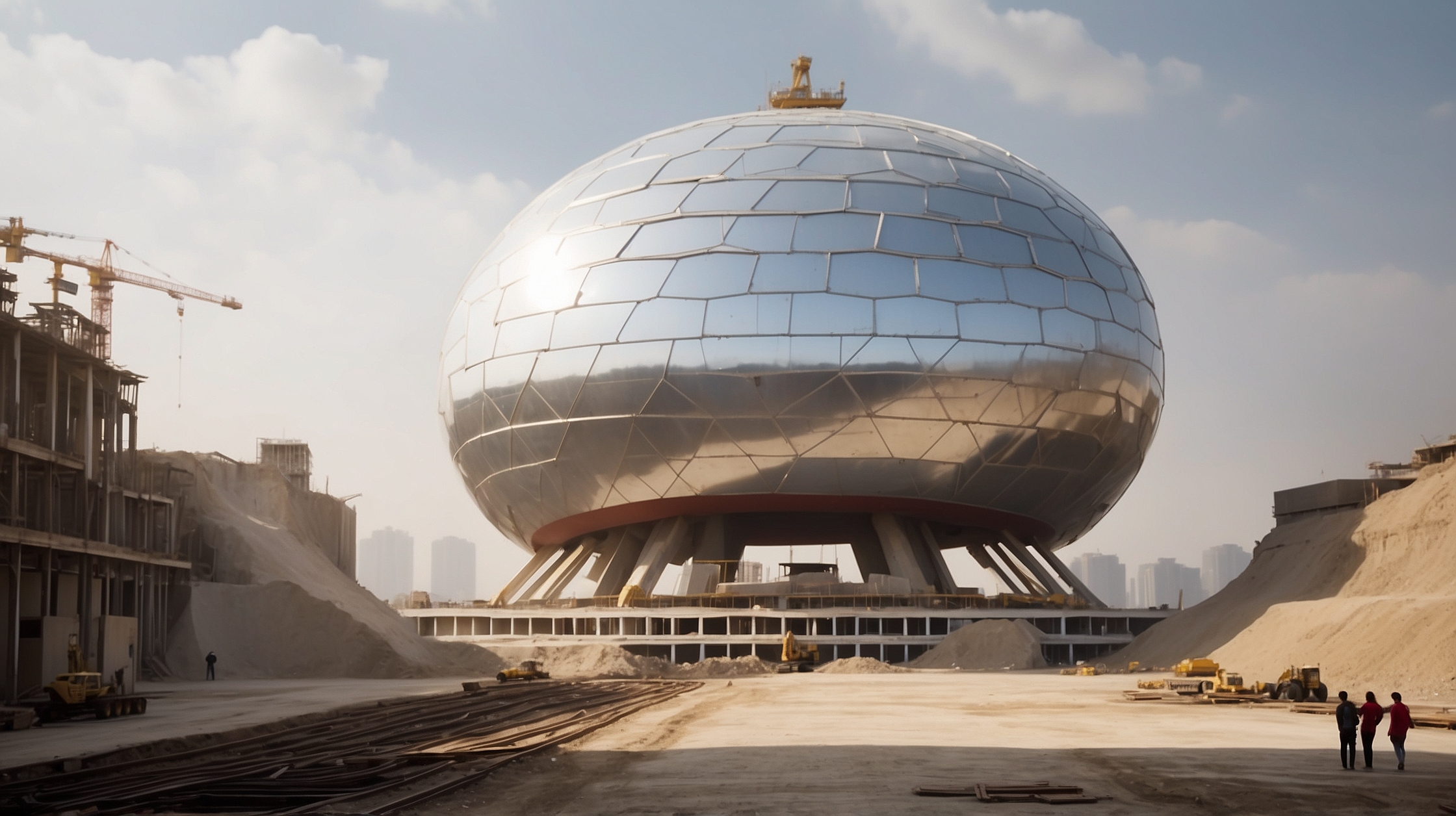
In a dramatic feat of modern engineering, China has once again showcased its prowess in large-scale construction and infrastructure innovation. Towering over Yantai, a coastal city in eastern China’s Shandong Province, a staggering 261-tonne spherical dome was lifted and precisely positioned atop an under-construction reactor building for the Zhangzhou Unit 2 Nuclear Power Station. This record-breaking lift—completed in just 94 minutes—not only broke previous records but also demonstrated the nation’s increasingly sophisticated construction methodologies.
The scale and precision of the dome-lift operation reflect a growing confidence in advanced industrial technologies, especially those centered around nuclear energy infrastructure. Such developments are part of China’s broader strategy to increase its domestic energy independence while reducing carbon emissions. Of particular note is the commitment to domestic design and manufacture, signaling a reduced reliance on foreign technologies for high-stakes infrastructure projects.
At the heart of this achievement lies nuclear innovation and national ambition. As countries around the globe grapple with energy challenges and climate commitments, China’s ability to perform such complex engineering feats at speed is a message of both industrial strength and strategic intent. But how exactly did this megastructure operation unfold, and what does it mean for China’s energy future?
Key facts about the Zhangzhou Unit 2 dome lift
| Project | Zhangzhou Nuclear Power Plant Unit 2 |
| Location | Yantai, Shandong Province, China |
| Event | Dome lift for reactor building |
| Weight of dome | 261 tonnes (approx. 575,000 lbs) |
| Diameter | 46.8 meters |
| Time taken for lift | 94 minutes |
| Reactor Type | Hualong One (HPR1000), domestically designed |
| Completion timeline | Reactor expected to be operational by 2025 |
A record-setting feat of engineering
The recent accomplishment eclipses all prior milestones within the construction of nuclear power infrastructure—by speed, scale, and precision. The 261-tonne spherical dome required not only significant material handling capabilities but also complex coordination among several engineering teams across structural, mechanical, and safety domains.
Standing 46.8 meters in diameter, the dome had to be raised several stories high and gradually placed atop the cylindrical core structure that will house the reactor itself. This isn’t just steel and bolts—this dome signifies a crucial stage in a facility that will eventually generate vast amounts of low-carbon electricity for millions of households.
What really stands out is the time factor. From lift-off to final placement, the operation lasted only 94 minutes. By comparison, similar lifts in other countries have taken upwards of a day and sometimes more due to stringent safety checks and recurring design complications. China’s streamlined protocol, honed over previous builds, allowed it to dramatically compress the timeline without compromising safety.
“Executing a lift of this magnitude in under two hours is virtually unprecedented in the nuclear power sector. It highlights superior logistical planning and state-of-the-art lifting technology.”
— Dr. Liang Wu, Nuclear Systems Engineer
The science behind reactor domes
In the world of nuclear plant engineering, the dome serves more than just an architectural function. It is a critical component in the containment structure, designed to prevent any radioactive materials from escaping into the environment in the case of an emergency. The shape minimizes stress points and allows greater resistance to internal and external pressure surges.
The dome also functions as a secondary radiation shield. Sitting above the reactor’s primary pressure vessel, it reinforces a multi-layered defense mechanism. The structural integrity and perfect alignment of the dome are vital—it cannot afford imperfections or misalignments, even on a millimeter scale. This is what makes fast, precise lifts as seen in Zhangzhou particularly impressive.
Why the Hualong One reactor design is pivotal
The Zhangzhou facility utilizes the Hualong One—a third-generation pressurized water reactor that exemplifies China’s commitment to technological self-reliance. Jointly developed by China National Nuclear Corporation (CNNC) and China General Nuclear Power Group (CGN), Hualong One is fully domestically designed and represents years of research, iteration, and pilot-scale implementation.
The reactor boasts numerous safety advancements, including a double containment wall, passive safety systems that work without external power sources, and modular construction features that allow for faster onsite assembly and alignment. With a design lifespan of 60 years, it also accommodates future upgrading and digitalization, including remote diagnostics and AI-based monitoring systems.
“What we’re witnessing is not just infrastructure—it’s a declaration of technology development. China has matured its design-and-build capacity to a level that matches, and in some areas surpasses, global counterparts.”
— Prof. Jiahui Tan, Energy Policy Analyst
What this means for China’s energy strategy
The ability to accelerate construction timelines for nuclear power stations is strategically significant. China has committed to peaking its carbon emissions by 2030 and achieving carbon neutrality by 2060. That roadmap requires scaling up non-fossil fuel energy options, including hydro, solar, wind—and critically—nuclear energy.
With Hualong One becoming the backbone of domestic nuclear expansion, China is charting a course toward having over 70 nuclear reactors in operation by 2035. Faster build times with innovations like this dome lift allow for more consistent rollout and reduced initial capital expenditure, as shorter construction periods mean quicker returns.
Global implications of rapid construction methods
| Winners | Losers |
|---|---|
| China’s domestic nuclear manufacturing sector | Countries dependent on foreign nuclear tech import |
| Global clean energy goals (via modeled success) | Traditional coal-based power industries |
| Modular construction technology companies | Slow-to-adapt nuclear nations |
The speed and quality of this recent build set new benchmarks not just for China but for the entire global nuclear industry. Countries currently revisiting their nuclear agendas amid energy price volatility may turn to the Hualong One model as a reliable, scalable template.
By internalizing so much of the construction and technology supply chain, China also reduces geopolitical risk. This model insulates large-scale projects from foreign sanctions or trade limitations—strengthening national infrastructure autonomously.
The road ahead for Zhangzhou Power Station
With Unit 1 already well underway and Unit 2’s dome successfully installed, the Zhangzhou station is expected to begin operations between 2025 and 2026. Once complete, each unit will offer about 1,200 MW of power. This means not only millions of homes electrified but significant reductions in reliance on coal-fired plants in surrounding regions.
Other construction stages will include integration of internal containment structures, turbine building installations, and full safety simulations before fuel loading. If timelines hold, Zhangzhou could act as a turbo-charged prototype for future Chinese nuclear builds—pushing the boundaries even further.
Frequently asked questions about the dome lift at Zhangzhou
How heavy was the dome lifted at Zhangzhou Unit 2?
The dome weighed approximately 261 tonnes, or around 575,000 pounds.
How long did the lifting operation take?
The entire operation took only 94 minutes, setting a new speed benchmark for such scales.
What type of reactor is being built at Zhangzhou?
The site is constructing Hualong One (HPR1000) reactors, designed domestically in China.
Why is the dome important in nuclear reactor buildings?
The containment dome is critical for safety, helping to ensure radiation is contained even under extreme conditions.
When will the Zhangzhou plant become operational?
Units 1 and 2 are expected to be operational by 2025, depending on remaining construction phases.
What does this achievement mean for China’s energy goals?
It reinforces China’s plan for energy independence and reduced carbon emissions by expanding nuclear power capacity.
Is this the first time China has set such a record?
No, but this is the fastest and heaviest dome lift to date in China’s nuclear power history.