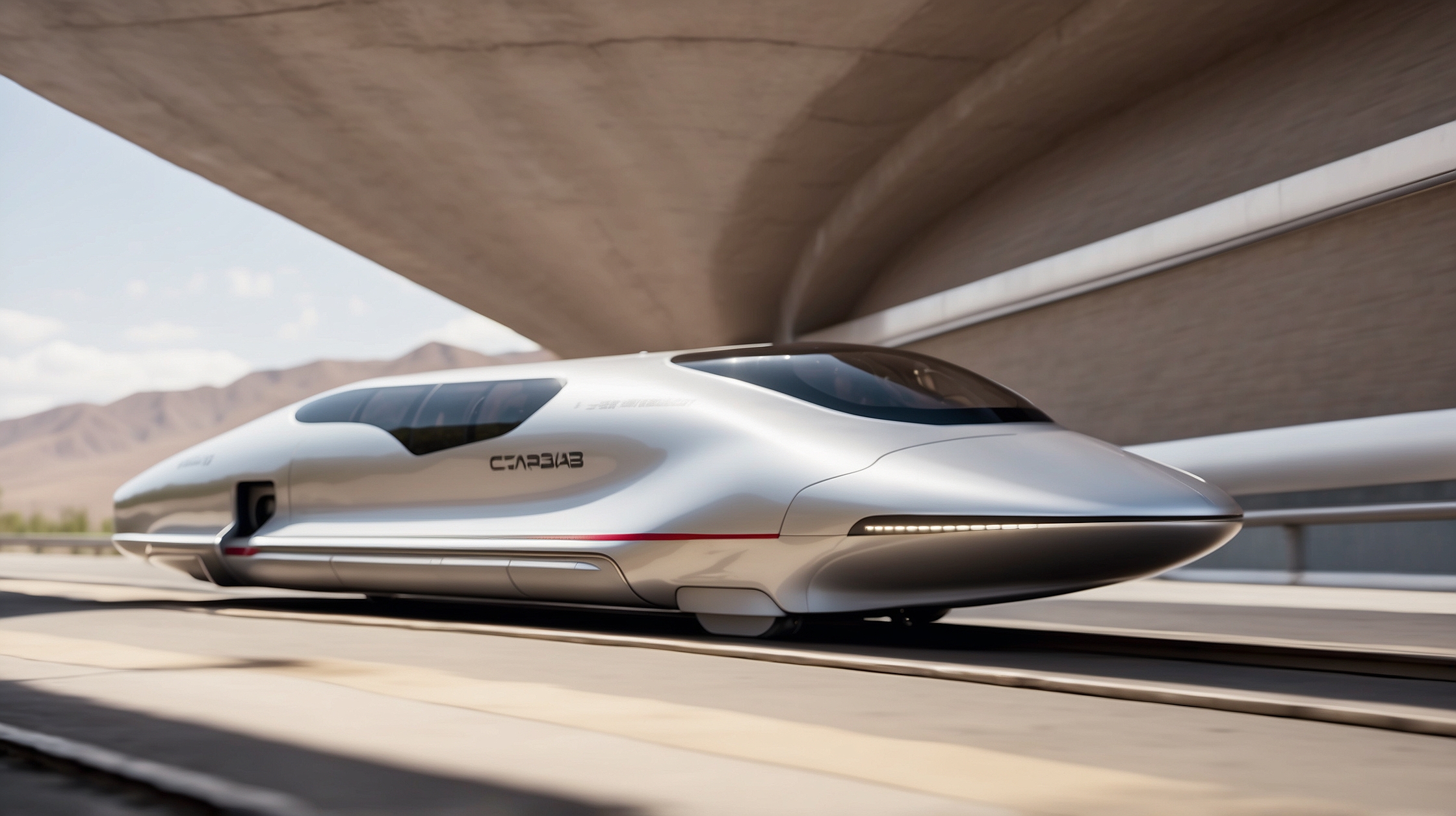
On an otherwise ordinary day in China, a breathtaking technological feat reshaped the possibilities of modern transportation. In just **two seconds**, a new hyperloop train prototype reached a speed of **623 kilometers per hour**, instantly making headlines around the world. This moment wasn’t just about breaking a world record—it was a glimpse into the future of how humanity may soon travel from one city to another in a matter of minutes rather than hours.
For years, high-speed rail has been dominated by countries like Japan and France, but China has quietly and methodically built up the most extensive and technologically advanced high-speed rail infrastructure on the planet. This milestone, achieved with a near-frictionless maglev train in a vacuum tube, may represent the next evolutionary step in transportation. Engineers, investors, and transit authorities around the globe are now turning their eyes to China’s latest breakthrough.
But what exactly enabled this rapid leap forward? What does it mean for international competition, environmental impact, and the millions who commute daily? Let’s dig deeper into China’s world-record-breaking hyperloop and explore how this moment may trigger a new global race for train-based transport supremacy.
Overview of China’s Hyperloop Record
| Milestone | Hyperloop reached 623 km/h |
| Time to reach speed | Just 2 seconds |
| Test Facility | Datong City, Shanxi Province, China |
| Technology Used | Magnetic levitation (maglev) in vacuum tube |
| Project Partners | North University of China, China Aerospace Science and Industry Corporation |
| Length of Test Tube | 2 kilometers (short-term goal: 60 km) |
| Current Record Holder | China’s ultra-high-speed maglev hyperloop |
Engineering marvel inside a vacuum tube
The train achieved its mind-boggling speed using **magnetic levitation (maglev)** inside a specially designed vacuum tube. Unlike traditional rail systems, this eliminates almost all friction from wheels or air resistance—allowing unprecedented acceleration and energy efficiency. This particular prototype, created by a coalition of Chinese engineers from **North University of China** and **China Aerospace Science and Industry Corporation**, is part of a national effort to lead the next generation of transportation.
While the two-second burst to 623 km/h is amazing in itself, what many experts are lauding is the integration of scalable infrastructure. The team used a **2-kilometer-long sealed tube** in Datong City to conduct the trial, but that’s just the beginning. Plans are already underway to construct a 60-kilometer test tube that could potentially host longer runs with passenger-ready prototypes.
“This achievement goes beyond setting a new speed record. It’s a statement that the future of transportation could arrive sooner than anyone expected.”
— Dr. Liu Jianhua, Transportation Technology Analyst
The competitive landscape of hyperloop development
Until now, hyperloop initiatives have largely been dominated by American and European companies, many of whom have struggled with regulatory hurdles, testing limitations, and physical infrastructure costs. China’s approach has quickly leapfrogged these issues by combining **state-backed planning** with military-grade engineering resources.
This represents a seismic shift. Whereas other nations have excelled at theoretical models and scale demos, China has managed to execute large-scale testing with remarkable speed and coherence. Public investment into this field has mirrored the early days of China’s expansive high-speed rail undertakings—ambitious, well-coordinated, and relentless in pursuit.
| Winners | Losers |
|---|---|
| China’s tech and railway sectors | Western hyperloop startups facing delays |
| State-backed research institutions | Airlines losing short-haul travelers |
| Domestic commuters in China | Low-speed conventional rail routes |
Environmental impact and sustainability promise
One of the major benefits of hyperloop technology is its **sustainability potential**. Operating with **minimal energy losses**, hyperloops require less electricity per kilometer than any existing form of mechanized passenger transport, especially airplanes and diesel-powered rail. Combined with China’s push to **decarbonize its industrial sectors**, this transport innovation could play a pivotal role in helping meet its climate goals.
“The vacuum maglev system drastically reduces drag and power consumption. If scaled, it could revolutionize sustainable intercity travel.”
— Yan Mei, Energy and Transport Researcher
Furthermore, unlike traditional bridges, highways, or tunnels, a hyperloop tube has a significantly lower **environmental footprint** when prefabricated parts are used, thus reducing land disruption and construction emissions. These benefits are particularly appealing in densely populated areas where land acquisition is expensive and politically sensitive.
Challenges facing mass deployment
Despite its breakthrough success during testing, the path to commercial hyperloop applications is far from clear. Among the leading challenges are **safety concerns**, high construction costs, and the need for **universal regulatory frameworks**. Unlike traditional trains, hyperloop systems require brand-new infrastructure from scratch—a costly barrier even for wealthier nations.
China’s unique governance system allows for **rapid infrastructure deployment**, which could help circumvent some of these challenges. However, even within the country, questions remain about **scalability**, affordability, and **public acceptance** for being the early adopters of such high-speed travel in enclosed tunnels.
A glimpse of the future
The 623 km/h hyperloop trial wasn’t just a speed record—it was a powerful signal to the entire world. High-speed rail may no longer be the pinnacle of land-based travel. As trial tubes grow longer and safety systems advance, **intercity travel could one day be measured not in hours but in minutes.** Imagine commuting from Beijing to Shanghai in under 30 minutes—the economic and social implications are staggering.
Major Chinese cities already benefit from world-class conventional high-speed rail networks. The integration of vacuum hyperloop systems could further consolidate urban clusters into **mega-regional economies**, unleash an era of “hypermobility,” and set China decades ahead in the global race for mobility innovation.
“This is the dawn of a new era. What we’re witnessing is not just fast transport—it’s time travel at ground level.”
— Professor Han Wei, Futurist and Tech Author
As the international community watches closely, it becomes evident: **the future is arriving fast—and it’s coming through a tube in China.**
Frequently Asked Questions (FAQs)
How fast did the Chinese hyperloop train travel?
The prototype reached a top speed of **623 kilometers per hour** during a test conducted in China.
How long did it take to reach top speed?
Amazingly, the train accelerated to 623 km/h in **just 2 seconds**.
Where did this test take place?
The record-setting test was conducted in a **sealed 2-kilometer vacuum tube** located in Datong City, Shanxi Province.
What technology is used in China’s hyperloop?
The system uses **magnetic levitation (maglev)** in combination with vacuum tube design to minimize friction and air resistance.
Is this hyperloop version ready for commercial use?
Not yet. While the technology is promising, it is still in the **prototype and testing phase**, with plans for longer test tracks underway.
How does this compare to traditional high-speed rail?
Hyperloop trains are potentially **faster and more energy-efficient** than high-speed rail but currently lack the established operational infrastructure.
What agencies are behind this project?
Key players include **North University of China** and the **China Aerospace Science and Industry Corporation**, under government support.
What’s next for hyperloop development in China?
Expansion of the trial tube to **60 kilometers** is planned, with future goals of real-world intercity deployment.