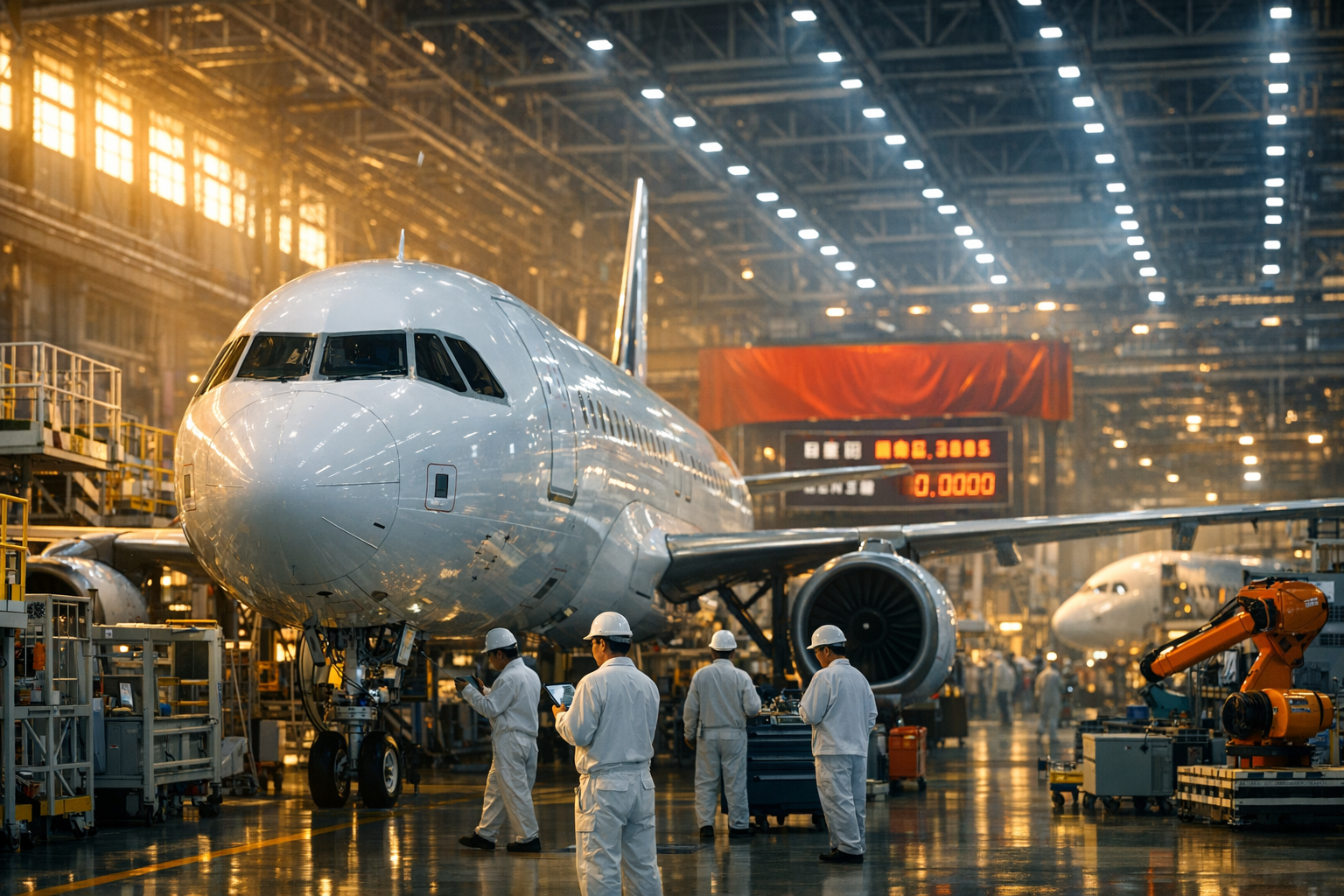
As the aerospace sector looks toward recovery and growth following global disruptions, one significant milestone has taken center stage—Airbus has celebrated a landmark in its cooperation with China, highlighting how international partnerships continue to fuel innovation and global supply chain resilience. In a striking move that comes just ahead of the holiday season, China’s Tianjin final assembly line (FAL) delivered its 600th A320 family aircraft, further cementing the country’s critical role in Airbus’s global manufacturing network.
This achievement is more than just a numerical milestone. It marks a new chapter in a transcontinental relationship that started 15 years ago, positioning China not only as a major aviation market but also as a significant player in the commercial aircraft manufacturing industry. The significance of this production indicator extends beyond Airbus’s balance sheet—it points to broader trends in the global aviation industry, including rising demand from Asia, greater localization of manufacturing, and geopolitical adaptation.
It’s no secret that Airbus has been leaning into its partnership with China, especially amid rising tensions between Western powers and as supply chain logistics become increasingly regionalized. In this context, China’s role as a hub for aircraft assembly serves multiple strategic functions: reducing delivery bottlenecks, supporting the local economy, and responding to customer demand across Asia-Pacific more rapidly. Here’s why the 600th aircraft rollout in Tianjin is making headlines worldwide and what it foretells for the future of aircraft production.
Key milestone in Airbus-China cooperation
| Category | Details |
|---|---|
| Event | 600th A320 family aircraft delivered at Tianjin Final Assembly Line |
| Significance | Symbolic benchmark in Airbus’s 15-year cooperation with China |
| Aircraft Model | A320neo |
| Recipient Airline | China Eastern Airlines |
| First Delivery From Tianjin | 2009 |
| Initial Agreement Signed | 2008 |
| Expected Annual Output by 2026 | 75 aircraft per year from both Tianjin lines |
| Strategic Goals | Boost output, enhance localization, support Asia-Pacific market |
What changed this year for Airbus and China
China’s Tianjin FAL was not always the powerhouse it is today. When Airbus inaugurated the plant in 2008, it was viewed as a symbolic gesture towards China’s emerging industrial capabilities. Today, it has become a vital cog in Airbus’s global production strategy, accounting for a significant share of the A320 family’s output globally.
This year, a few key developments reaffirmed Airbus’s commitment to China. In April 2023, Airbus announced the construction of a second A320-family final assembly line at Tianjin—a decision that will double the factory’s capacity and bring it closer to producing 75 aircraft per year by 2026. This move came after a state visit by French President Emmanuel Macron to China, spotlighting the diplomatic dimension of the expansion.
Crucially, the 600th aircraft delivered from Tianjin was an A320neo, showing how the facility is now handling the latest-generation single-aisle aircraft. Manufactured with improved fuel efficiency and reduced noise levels, the A320neo variant responds to rising environmental concerns and aligns with both Chinese and international aviation sustainability goals.
Why China matters to Airbus like never before
The importance of the Chinese market to Airbus is multi-faceted. With an expanding middle class, growing tourism sector, and strong government support for aviation development, China is on track to become the world’s largest aviation market within the next decade. Airbus projects that China alone will require over 9,000 new passenger and cargo aircraft over the next two decades, a forecast that explains the strategic need for local production capabilities.
Moreover, China’s capability to manage pandemic-era disruptions faster than many Western markets made it a reliable partner in navigating turbulent supply chains. Airbus’s long-term investment in the Tianjin facility also serves as a hedge against geopolitical risk and logistical delays that emerged during the global COVID-19 pandemic.
“The Tianjin FAL is a cornerstone of our global industrial footprint. Delivering the 600th aircraft symbolizes not just quantity, but the quality and consistency of this partnership.”
— George Xu, CEO of Airbus China
Ripple effects for the global aviation industry
Beyond Airbus and China, the Tianjin progress resonates across the global aviation sector. As American rival Boeing continues to face certification and delivery challenges, Airbus has seized the opportunity to assert dominance in Asia-Pacific markets. This symbiotic relationship is pivotal as airlines seek updated fleets with better fuel economy and flexibility for regional routes.
China’s active participation in assembling advanced aircraft also enhances its own domestic capabilities in aeronautical engineering—skills that may feed into the nation’s ambitions to grow homegrown aviation giants like COMAC. While Airbus and Boeing still dominate, the long-term impact of such partnerships could stimulate broader competition in aircraft manufacturing.
Technology transfers and industrial localization
One of the less discussed, but crucial, aspects of the Airbus-China relationship is the element of technology sharing. Though Airbus maintains proprietary control over its most sensitive technologies, the Tianjin facility has enabled a selective but impactful transfer of skills and processes to local teams, advancing China’s position in global aviation manufacturing rankings.
Local suppliers have also benefited. By integrating into Airbus’s international supply chain, Chinese parts manufacturers have improved quality controls and adopted global best practices. This local involvement feeds back into the country’s broader industrial ecosystem, enhancing its ability to co-develop complex, high-precision technologies.
Who the winners and losers are
| Winners | Losers |
|---|---|
| Airbus – gains production resilience and market access | Boeing – remains constrained by regulatory and delivery delays |
| China Eastern Airlines – receives next-gen aircraft ahead of schedule | Western assembly hubs – may face redirected investment from Europe |
| Chinese manufacturing firms – integrated into global aviation supply chains | Environmental critics – still concerned despite efficiency enhancements |
Future outlook: scaling up with sustainability
Looking ahead, Airbus’s vision includes not just expanding production but doing so sustainably. The company has committed to reducing its carbon footprint, with the A320neo family being a flagship of its fuel-efficiency ambitions. Further, the Tianjin FAL is expected to integrate more renewable energy resources and employ smart manufacturing technologies to reduce waste.
There’s also a growing focus on synthetic aviation fuels and the eventual integration of hydrogen-powered technologies. Though still in the research phase, these initiatives could find pilot programs within facilities like Tianjin which can adapt quickly thanks to their more recent construction and modular infrastructure.
“The Tianjin facility shows how international collaboration can support sustainable aviation growth at scale.”
— Placeholder, Aviation Industry Analyst
FAQs about Airbus and the Tianjin milestone
What is the Tianjin Final Assembly Line?
It is Airbus’s aircraft production facility in Tianjin, China, primarily assembling A320 family aircraft for Asia-Pacific delivery.
When did Tianjin start aircraft deliveries?
The first A320 assembled in Tianjin was delivered in 2009.
What type of aircraft is primarily produced there?
The Tianjin FAL focuses on the A320 family, including the fuel-efficient A320neo models.
How many aircraft has Tianjin delivered so far?
As of December 2023, the facility has delivered 600 aircraft.
What is Airbus’s expansion plan for Tianjin?
Airbus is adding a second assembly line to double capacity and reach up to 75 aircraft per year by 2026.
Why is Airbus increasing its production in China?
To address rising demand in Asia-Pacific, reduce supply chain risks, and strengthen bilateral industrial cooperation.
Who received the 600th aircraft?
China Eastern Airlines was the recipient of the 600th A320 family aircraft from Tianjin.
Will other Airbus models be produced in China?
Currently, only A320 family aircraft are assembled in Tianjin, but future expansion may consider other models if demand aligns.