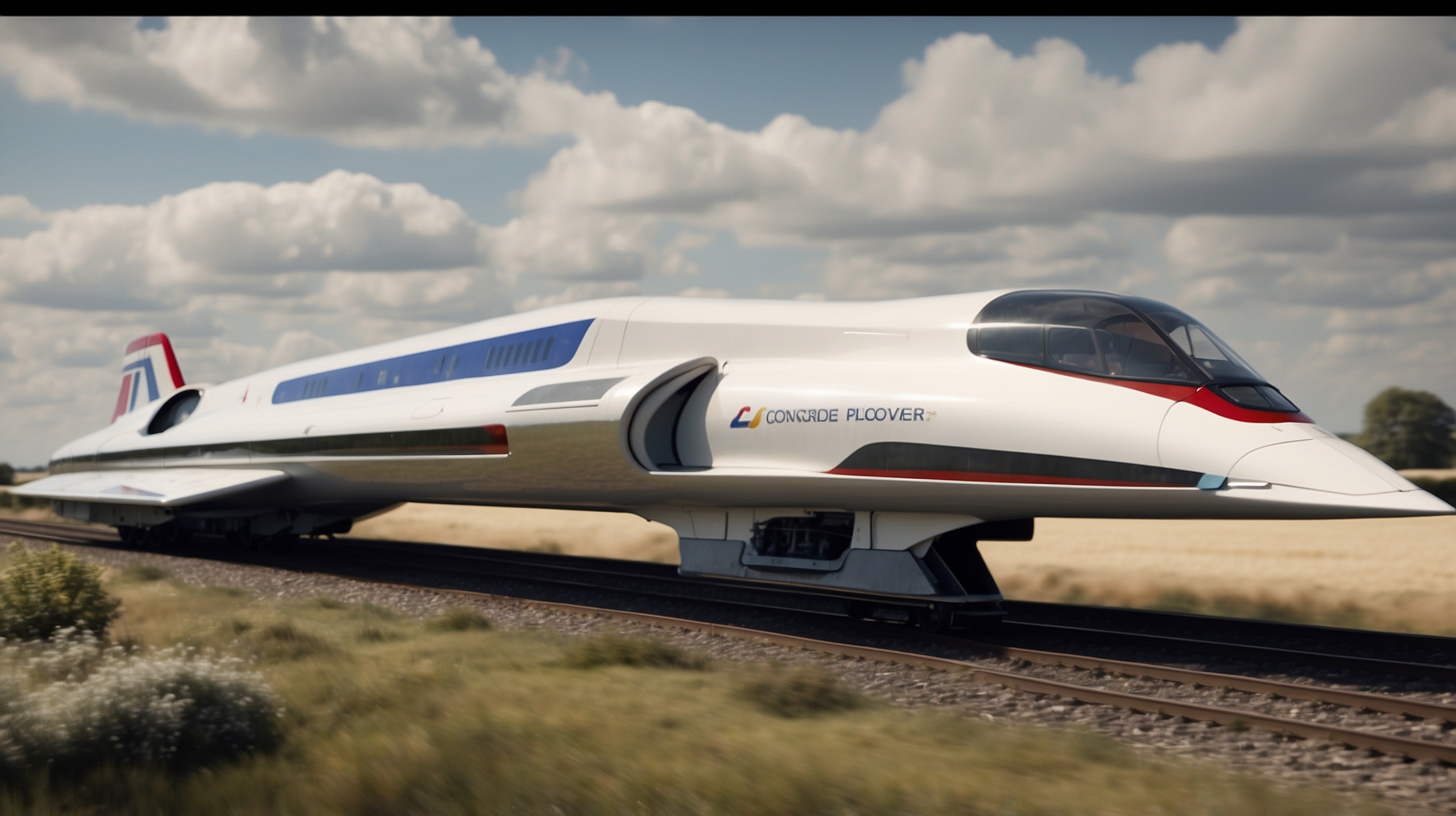
When most people think of supersonic transport, the Concorde immediately springs to mind—a beautiful, fast, but economically doomed marvel of engineering. Yet, few realize that Concorde had a lesser-known cousin, an ambitious aviation project that promised to revolutionize European travel even more dramatically. This awe-inspiring concept wasn’t just theoretical—it was nearly airborne. Imagine traveling from Paris to London in just 22 minutes, not through the air as we know it, but skimming above the earth at speeds that would make even Concorde blush. This was La Aérotrain, the fantastic vision of 1960s France that came tantalizingly close to transforming not just aviation, but ground-based travel itself.
Long before Elon Musk’s Hyperloop proposals, the French dreamed up a passenger transport vehicle that traveled on a cushion of air along concrete tracks—no friction, no limits, only raw speed. At nearly 265 tons in its final iterations, the project was utterly audacious, blending jet engines, magnetic levitation ideas, and a visionary’s fervor. And yet, despite early successes, breathtaking demonstrations, and considerable public attention, it was resigned to the scrapheap of forgotten ambition. What went wrong—and why are we not boarding the Aérotrain today?
Overview of the Aérotrain Project
| Project Name | Aérotrain |
| Designer | Jean Bertin, French engineer |
| Top Speed Demonstrated | 430 km/h (267 mph) |
| Technology | Air cushion transport, Jet engine propulsion, Monorail guideway |
| First Test | 1965 |
| Final Cancellation | 1977 |
| Reason for Failure | Political interference, rise of TGV, and lack of commercial backing |
How a dream was born out of post-war innovation
Post-WWII France was a hotbed of technological ambition. The war had devastated infrastructure, but it had also ignited a passion for futuristic mobility. In this environment rose Jean Bertin, a graduate of École Polytechnique and former aerospace engineer. Convinced that traditional rails had reached their limits, Bertin envisioned a hovercraft-style train powered by jet engines rushing along elevated concrete tracks.
This was not a far-fetched idea in the era of the space race and atomic promise. Suddenly the impossible seemed feasible, and governments worldwide poured money and attention into experimental transportation projects. France, seeking to leap ahead in tech prestige and revive cross-channel travel, found Bertin’s concept irresistible.
The audacity of engineering: Building the Aérotrain
Construction of the first Aérotrain prototype began in the early 1960s, with multiple versions being developed and tested over the following years. These vehicles glided using air cushions generated by powerful fans and were initially propelled by aircraft-style propellers, later transitioning to actual jet engines. A test track was built outside Orléans, running 18 kilometers, specifically for high-speed trials.
One of the most iconic versions of the train, the Aérotrain I80-HV, set a speed record of 430 km/h in 1974, a record for air-cushion vehicles that still stands today. Made from cutting-edge materials and flaunting a futuristic design, it looked like something out of a sci-fi novel reimagined into reality.
“The Aérotrain was not only faster than any existing train; it was a showcase of what France could accomplish in engineering brilliance.”
— Jacques Chadeau, Transportation Historian
Plans for cross-Channel travel: Paris to London in 22 minutes
Among the most ambitious proposals was linking Paris and London via an overland rail route and a somehow-airborne tunnel. The Aérotrain was to stitch together these cities with unparalleled efficiency, bypassing conventional rail constraints. Hyper-speed terminals in each city would provide rapid boarding processes, with infrastructure designed around speed and capacity.
The 22-minute travel dream captured global imagination. The Cold War era’s obsession with speed and techno-domination made this seem plausible, even inevitable. For a shining moment in the 1970s, it looked like France had found the transport of the future.
The politics of failure: TGV vs. Aérotrain
Despite promising innovations and successful trials, the Aérotrain was ultimately derailed—literally and figuratively. By the early 1970s, political winds shifted. French state-run railway service SNCF had begun developing what would become the TGV (Train à Grande Vitesse), a high-speed electric train designed to work on specially built regular tracks. The government had to choose which horse to back—and chose the conventional route.
The reasons were both economic and political. The TGV could integrate with existing rail infrastructure with fewer modifications and was perceived as more adaptable and less radical. Though not as fast as the Aérotrain, it was considered “fast enough.
“Choosing TGV over Aérotrain wasn’t just about technology—it was a battle of ideologies. One promoted revolution, the other evolution.”
— Muriel Lecomte, Railway Policy Analyst
The legacy that shouldn’t be forgotten
While the concrete guideways still stand outside Orléans—ghostly reminders of grand ambitions—the Aérotrain’s legacy is far from irrelevant. It stands as a testament to what can happen when engineering, vision, and public imagination align. Today, in an age now welcoming vacuum trains and Hyperloops, the Aérotrain feels shockingly modern again.
Though the project was shelved in 1977, many of its technologies and learnings contributed to modern high-speed rail systems and magnetic levitation trains in Japan and Germany. Jean Bertin died just a year after the project’s cancellation, his dream unfulfilled but far from forgotten.
Winners and losers of the Aérotrain era
| Winners | Losers |
|---|---|
| Conventional rail systems like the TGV | Jean Bertin and Aérotrain developers |
| SNCF (French National Rail) | Advocates of radical transport revolution |
| Rail manufacturers geared for existing infrastructure | Technological diversity in French transport policy |
Could the Aérotrain make a comeback in modern times?
With climate concerns and the push for ultra-fast commuting between megacities, interest in long-lost technologies is resurging. The original Aérotrain technology would need adaptation to modern eco-standards and energy processes, but its foundational principles remain appealing—frictionless movement, reduced wear-and-tear, and phenomenal speed.
New generations of engineers are revisiting early blueprints and prototypes. However, implementing such systems today would require massive investment and, more importantly, a willingness to challenge the status quo once again.
“We’re revisiting old dreams with new tools. Aérotrain might have been ahead of its time—but its time could still come.”
— Dr. Léo Marchal, Professor of Future Mobility Systems
FAQs about the Aérotrain
What was the top speed of the Aérotrain?
The fastest version, the I80-HV, reached a record speed of 430 km/h (267 mph), making it the fastest air cushion vehicle recorded.
How did the Aérotrain work?
It floated on a cushion of air generated by onboard compressors and was propelled by jet engines or aircraft-style props, running along a concrete monorail.
Why was the Aérotrain canceled?
Multiple factors, including political decisions, funding limitations, and preference for the TGV system, led to its cancellation in 1977.
Could the Aérotrain be revived today?
Technologically, yes—with updates—but it would require substantial political and financial commitment in a world dominated by established rail systems.
Who invented the Aérotrain?
The Aérotrain was invented by French engineer Jean Bertin in the 1960s as a new mode of high-speed ground transportation.
Is the Aérotrain the same as maglev?
No. While both aim for frictionless motion, the Aérotrain used air cushions, whereas maglev uses magnetic levitation to hover and propel.
Did any country adopt the Aérotrain?
Despite international interest, no country adopted it commercially. France came closest but ultimately opted for the TGV.