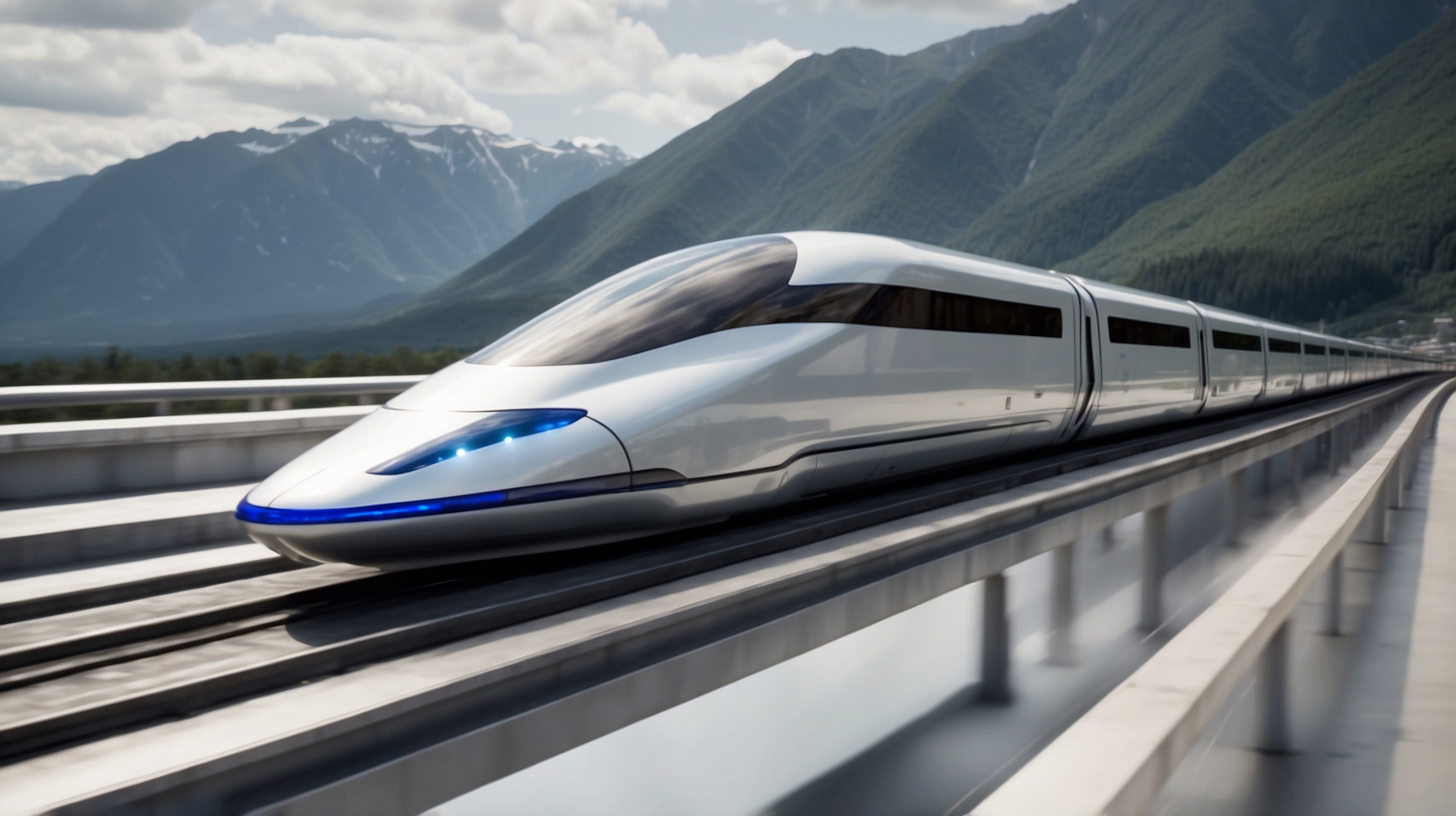
In the race to redefine the future of high-speed transportation, China has once again seized the global spotlight. With the unveiling of its **latest maglev train**, the country edges closer to becoming the pacesetter for what tomorrow’s transit could look like. Manufactured entirely in China using domestically produced components, this maglev train has achieved an astounding design speed of **650 kilometers per hour** — making it the *fastest land vehicle globally* when not including aircraft.
Beyond the shiny exteriors and mind-boggling numbers lies a strategic push by China to elevate itself as the epicenter of magnetic levitation-based travel. The train’s development is a masterstroke in both engineering ingenuity and political willpower. It is not just a marvel of technology; it is a symbol of **national ambition**, tethered tightly to China’s long-term vision of inter-city travel – ultra-fast, environmentally efficient, and globally competitive.
But how did this breakthrough come to fruition? Who were the key players behind this machine? And more importantly, what does it mean for passengers, economies, and transport planners around the world? Let’s dive into the details of this extraordinary transportation leap.
Fastest maglev train in the world: Overview
| Model Name | CRRC 650km/h Maglev Prototype |
| Top Design Speed | 650 km/h |
| Manufacturer | CRRC (China Railway Rolling Stock Corporation) |
| Track Type | Superconducting Magnetic Levitation (Maglev) |
| Primary Technology | High-Temperature Superconducting (HTS) Maglev |
| Construction Components | 100% domestically developed in China |
| Primary Use | Ultra-high speed intercity travel |
| Development Period | Over 21 years of dedicated R&D |
The innovation behind the speed
The number 650 km/h may seem arbitrary at first glance. But there’s a reason CRRC and Chinese engineers targeted that mark — because it’s well above traditional high-speed rail limits and pushes the boundaries of maglev potential. The train utilizes a **superconducting magnetic levitation system** developed indigenously using cutting-edge HTS (High-Temperature Superconducting) technology.
What makes HTS different? In contrast to traditional electromagnetic suspension, HTS levitation requires fewer active control systems and is inherently stable. This means fewer mechanical moving parts and **a significantly smoother, quieter ride**. Engineers have been refining this technique in China for over two decades, with the ultimate goal of streamlining rail-based transportation in far-reaching, fast-paced urban economies.
Developing this system isn’t just about speed — it’s about creating a stable, scalable, and sustainable way to bridge large geographical distances in record time.
— Liu Zhuo, Lead Engineer at CRRC
Why maglev marks a pivotal shift in transportation
Maglev trains, while not a brand-new concept, remain elusive in global infrastructure due to high costs and complex track requirements. What China is attempting could spark a **domino effect** in future transport investment strategies. The magnetic levitation concept sidesteps limitations of conventional wheel-on-track based rails — no friction between wheel and rail means **less maintenance, higher energy efficiency**, and exponentially faster travel times.
China’s ambition is clearly not just to build a single maglev line but to **lay the groundwork for a national maglev network**. Routes between major cities like Beijing and Shanghai could see travel time cut from five to under two hours, reshaping the very concept of commuting across provinces.
The long road to technological maturity
The road to creating this marvel wasn’t paved overnight. Development began in earnest more than **21 years ago**, with hundreds of engineers, scientists, and universities collaborating under state initiatives. This continuous evolution led to the unveiling and test operation of this 650 km/h prototype at Tongji University in Shanghai, heralding a new phase of full-system testing and safety validations.
Unlike other nations that have long relied on Japanese or German maglev systems, China’s maglev train is **entirely independent in design and production**, embracing a vertical integration model that leverages national research expertise, local manufacturing, and advanced AI-based control diagnostics.
After years of study and iteration, we are now at the cusp of commercial application potential. This train is not just a prototype—it’s a promise.
— Zhang Weitao, CRRC Deputy Director of Research
Potential routes and commercial application
While no commercial line is operational yet with the 650 km/h maglev, the most likely candidate for rollout is the **Beijing-Shanghai corridor**, which is already one of the most lucrative and high-traffic rail routes in the world. Other routes connecting regional economic hubs could also be prioritized, particularly where geographical bottlenecks limit current high-speed rail functionality.
The maglev blueprint is as much about **long-term infrastructure planning** as it is about technology. Urban planners are now considering how airports, metro systems, and other intermodal transport can be integrated with this future-forward transit solution.
Environmental and social implications
A key driver of the maglev push is not just to impress with tech, but to serve **green mobility goals**. Since maglevs don’t emit direct carbon emissions and require less energy when traveling at top speeds (due to low friction and aerodynamic efficiency), their implementation offers China another opportunity to align with international climate targets.
Moreover, faster travel times could **significantly redistribute population density**, allowing smaller cities to participate in economic corridors and reducing overcrowding in mega-cities like Beijing and Shanghai. It’s not just about moving people faster — it’s about transforming socio-economic patterns through accessible infrastructure.
Winners and losers from this breakthrough
| Winners | Losers |
|---|---|
| Commuters between major cities | Traditional short-haul airlines |
| Manufacturers and suppliers in Chinese rail industry | Conventional high-speed rail competitors |
| Urban planners and regional developers | Private car-based intercity transit services |
What this means for the future of global transport
As this trailblazing prototype shifts from test tracks to commercial corridors, the global transport community is taking notes. Countries with sprawling geographies like the United States, India, and Brazil may see China’s success as **a scalable model** to follow. The key lies in balancing cost with return — in both monetary and social terms.
Even if other countries tread slowly toward maglev networks, the fact that a fully-functioning 650km/h train is now operational shows that **speed barriers are being smashed** and that maglev is no longer a dream — it’s reality.
As more tests come in and as China opens its doors to view the results, the world might just be stepping onto a brand-new track — one that floats above the rest, both literally and metaphorically.
Frequently Asked Questions
How fast is the new Chinese maglev train?
The maglev train can reach a **top design speed of 650 km/h**, currently making it the fastest land vehicle on Earth.
What technology powers the maglev train?
It uses **high-temperature superconducting (HTS) magnetic levitation**, providing stable and frictionless operation at high speeds.
Is this train already in service?
No, the train is currently in its **testing and developmental stages**, though commercial application is expected in coming years.
Will passengers notice the speed in terms of comfort?
Thanks to advanced levitation, the train offers a **very smooth, quiet, and low-vibration ride**, even at ultra-high speeds.
What are the environmental impacts of maglev trains?
Maglev trains are considered **more energy-efficient and environmentally friendly** than airplanes or even conventional high-speed trains.
How does maglev compare to air travel?
Maglev offers shorter check-ins, similar travel times for distances under 1,000 km, and **lower carbon emissions**, making it a viable competitor to domestic air travel.
Where might this train first be used commercially?
The **Beijing-Shanghai route** is a strong contender for the first commercial application of the 650 km/h maglev due to its high traffic volume.
Who builds the train and its parts?
The train is **fully manufactured by CRRC** using exclusively Chinese-developed technology and components.