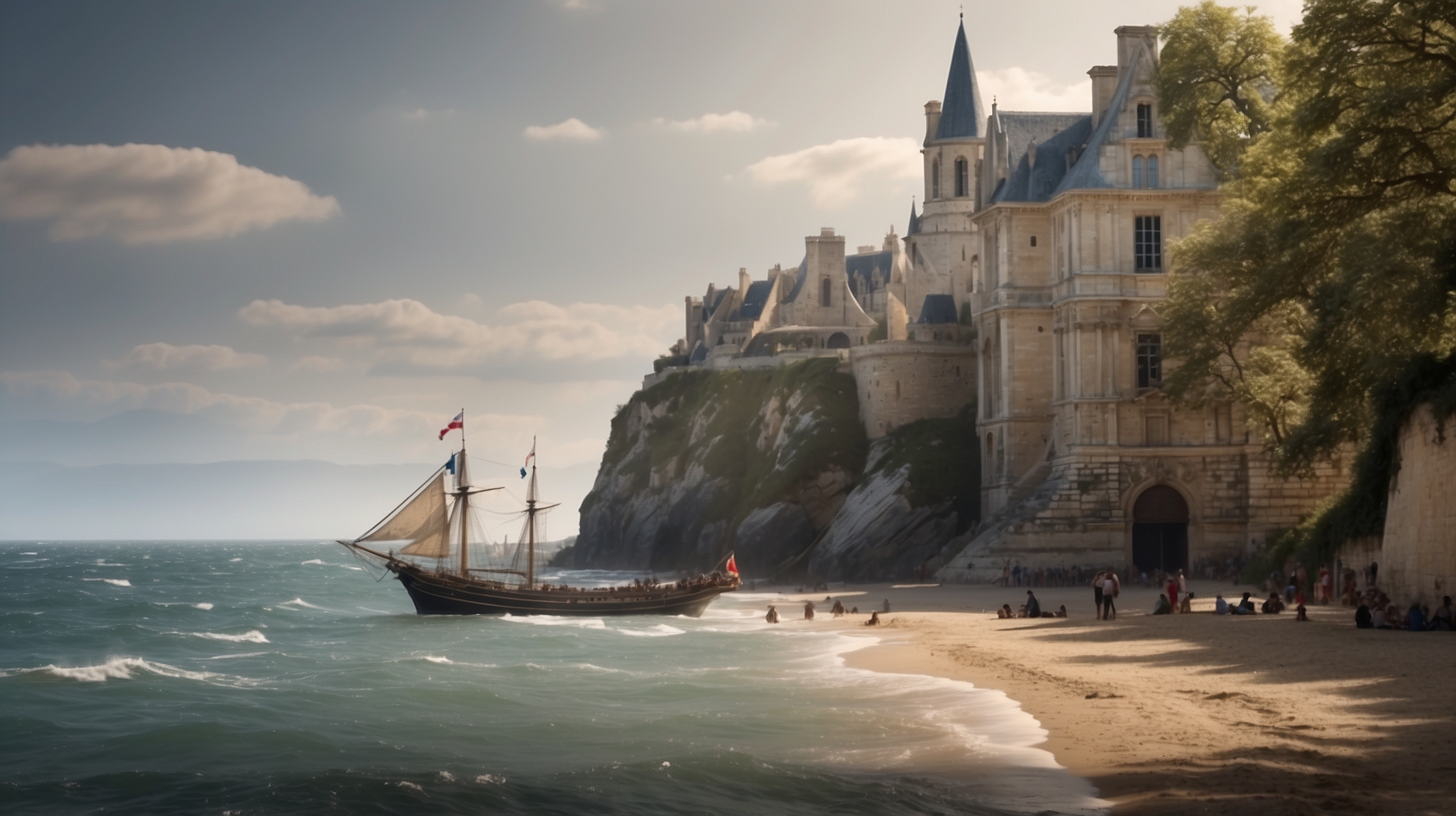
In the perennial rivalry between France and the United Kingdom, attention is often lavished on food, culture, or sporting victories. But behind the scenes, there exists a quieter, longer-standing competition—one tied to the seas that separate and connect the two nations. For over three centuries, France has quietly led in one of the most technically challenging and strategically vital domains: **hydrography**. While few outside of maritime or military circles may recognize it, France’s National Hydrographic Service, known as SHOM, has been the silent navigator of French supremacy at sea since the reign of Louis XV. It is a feat of enduring excellence, strategy, and science that has outpaced its British equivalent for over **305 years**.
In 1720, while Europe was entangled in shifting alliances and colonial ambitions, France established the world’s oldest continuously-operating hydrographic office. This marked the beginning of their institutional obsession with *mapping the seas*. Today, in the age of GPS and AI-enhanced oceanography, SHOM remains the gold standard—serving naval defense, commercial shipping, environmental stewardship, and even climate science. Meanwhile, the UK’s hydrographic efforts, though significant, came a few years too late, always trailing the French innovators on the timeline of history.
This remarkable supremacy is far more than a bureaucratic oddity. It’s a testament to France’s vision for maritime mastery—a legacy sculpted through centuries of data, exploration, and oceanic ambition. As the world grapples with rising oceans and the new geopolitics of the Arctic and Pacific, understanding this quiet French victory helps explain just how integral hydrography has become to **national power and global navigational safety**.
France’s hydrographic leadership at a glance
| Institution Name | Service Hydrographique et Océanographique de la Marine (SHOM) |
| Founded | 1720 |
| Function | Collect, analyze, and disseminate marine and submarine geographical data |
| Key Areas | Navigation safety, naval operations, climate science, maritime defense |
| Headquarters | Brest, France |
| International Ranking | Oldest continuously operated hydrographic service in the world |
How the world’s oldest hydrographic service was born
In 1720, 35 years earlier than the UK’s founding of its Admiralty Hydrographic Office, the French Navy formalized a mission: *to chart the vast and uncharted oceans for both military and commercial utility*. The French monarch recognized that maritime intelligence was not just helpful—it was essential.
This mission was institutionalized under the Ministry of the Navy, transforming scattered surveys into a coordinated national enterprise. The resulting bureau that would evolve into SHOM represented one of Europe’s earliest examples of state-sponsored geoscience. Utilizing rudimentary instruments and extreme human effort, surveyors ventured across the seas, hand-charting coastlines, measuring depths, and establishing reference maps without modern technology.
“SHOM was not just about mapping coasts—it was about understanding the entire oceanic system. That vision started in the Age of Sail, and it’s what sets France apart even today.”
— Dr. Claire Montreaux, Oceanographer (placeholder)
Why hydrography became a quiet pillar of global dominance
The utility of precise maritime mapping soon became clear. Safer navigation allowed naval fleets to explore, conquer and defend; commercial ships to avoid reefs and optimize trade routes. Over centuries, hydrography proved critical not only to battlefield victory and mercantile expansion, but also to the very *definition of economic zones* and national borders.
When other countries were still commissioning local maps piece by piece, France had already established global reach—dispatching surveyors from the Pacific to the Caribbean, from the Indian Ocean to the Arctic. These missions often supported colonial interests, but they also accumulated enormous banks of oceanographic intel, building what is arguably the richest historical marine dataset on Earth.
Modern SHOM: A data-driven oceanic powerhouse
In the 21st century, SHOM has expanded beyond paper charts. It now serves as one of France’s premier data-driven institutions, integrating satellite imagery, sonar mapping, AI analysis and real-time tide prediction models. Its responsibilities span three domains: *defense support*, *maritime accessibility*, and *environmental data services*.
With a fleet of specialized oceanographic vessels, airborne scanning technology, and partnerships with universities and industrial agencies, SHOM is on the frontier of modern marine science. A major arm of the French Ministry of the Armed Forces, it produces vital intelligence for naval deploying units and contributes actively to international maritime boundary resolutions.
“SHOM’s data supports more than 1,000 operations each year, protecting maritime navigation and responding to climate threats.”
— Adm. J.P. Rochefort, French Navy Hydrographer General (placeholder)
How France stayed ahead of the UK
Despite Britain’s storied naval history, it wasn’t until 1795—decades after France’s initiative—that the UK launched its Admiralty Hydrographic Office. By then, France had already compiled voluminous charts and established methodologies recognized as best practices.
That time lag has mattered. France’s early institutional lead enabled innovations in **tidal modeling**, **coastal dynamics**, and **multi-scale sonar integration** well ahead of competitors. Over time, this bolstered not only French maritime safety but strengthened commercial shipping and deepened impact on international maritime law.
Simply put: they had a head-start, and they never slowed down.
SHOM’s role in geopolitics, climate change, and global shipping
Today’s oceans are not just trade routes—they are battlefronts, climate indicators, and international legal arenas. SHOM’s repositories and real-time measurements now help define Economic Exclusive Zones (EEZs), monitor coastal erosion, and map sea-level rise. This makes SHOM an unsung player in both **climate diplomacy** and **international maritime litigation**.
French shipping and energy companies lean heavily on SHOM’s precise modeling to prevent accidents, streamline voyages, and ensure compliance. From GPS-corrected navigation charts to 3D seabed simulation, SHOM is no longer merely a cartographer—it’s a **strategic partner** across dozens of scientific and industrial sectors.
Winners and those trailing behind
| Winners | Losers |
|---|---|
| French Navy and maritime industry | UK Hydrographic Office (in historical origins) |
| Global shipping partners using SHOM data | Countries with underfunded or absent hydrographic services |
| Environmental agencies leveraging marine data | Commercial fleets with outdated navigational charts |
What’s next for hydrography in the AI era
The future of hydrography is taking shape not just in field surveys, but in massive data sets, autonomous underwater vehicles, and predictive ocean simulation models. SHOM is investing heavily in AI and machine-learning for real-time decision-making regarding tides, natural disasters, and shipping safety.
Furthermore, as polar routes open and marine biodiversity becomes a flashpoint in international agreements, hydrographic intelligence will become as central as satellite surveillance. France, aided by its unbroken 305-year trajectory of expertise, may again find itself leading where others are only beginning to look.
Frequently asked questions about France’s hydrographic leadership
What is hydrography?
Hydrography is the science of measuring and describing the physical features of oceans, seas, coastal areas, lakes, and rivers. It supports safe navigation, oceanographic research, and national defense operations.
When was SHOM founded?
SHOM was founded in 1720, making it the oldest continually operating hydrographic service in the world.
What does SHOM do today?
Today, SHOM supports navigation safety, naval operations, environmental modeling, and climate science through advanced tools like sonar mapping, satellite data, and AI-based ocean simulation.
How is SHOM different from the UK Hydrographic Office?
While both institutions serve similar purposes, SHOM was founded decades earlier and had a significant head start in global mapping and marine data collection. It remains a leading authority in hydrographic science.
Why is hydrography important for modern countries?
Hydrography affects everything from commerce and transportation to climate change monitoring, naval defense, and international law on maritime borders.
Is SHOM involved in climate science?
Yes, SHOM provides essential data for tracking sea-level rise, coastal erosion, and marine biodiversity, contributing to national and global climate research.
Where is SHOM headquartered?
SHOM is headquartered in Brest, France—a key naval port and oceanographic research hub.
Can civilians access SHOM data?
Some datasets and navigation charts are publicly available, especially those aiding maritime traffic and environmental monitoring, while others remain classified for defense use.