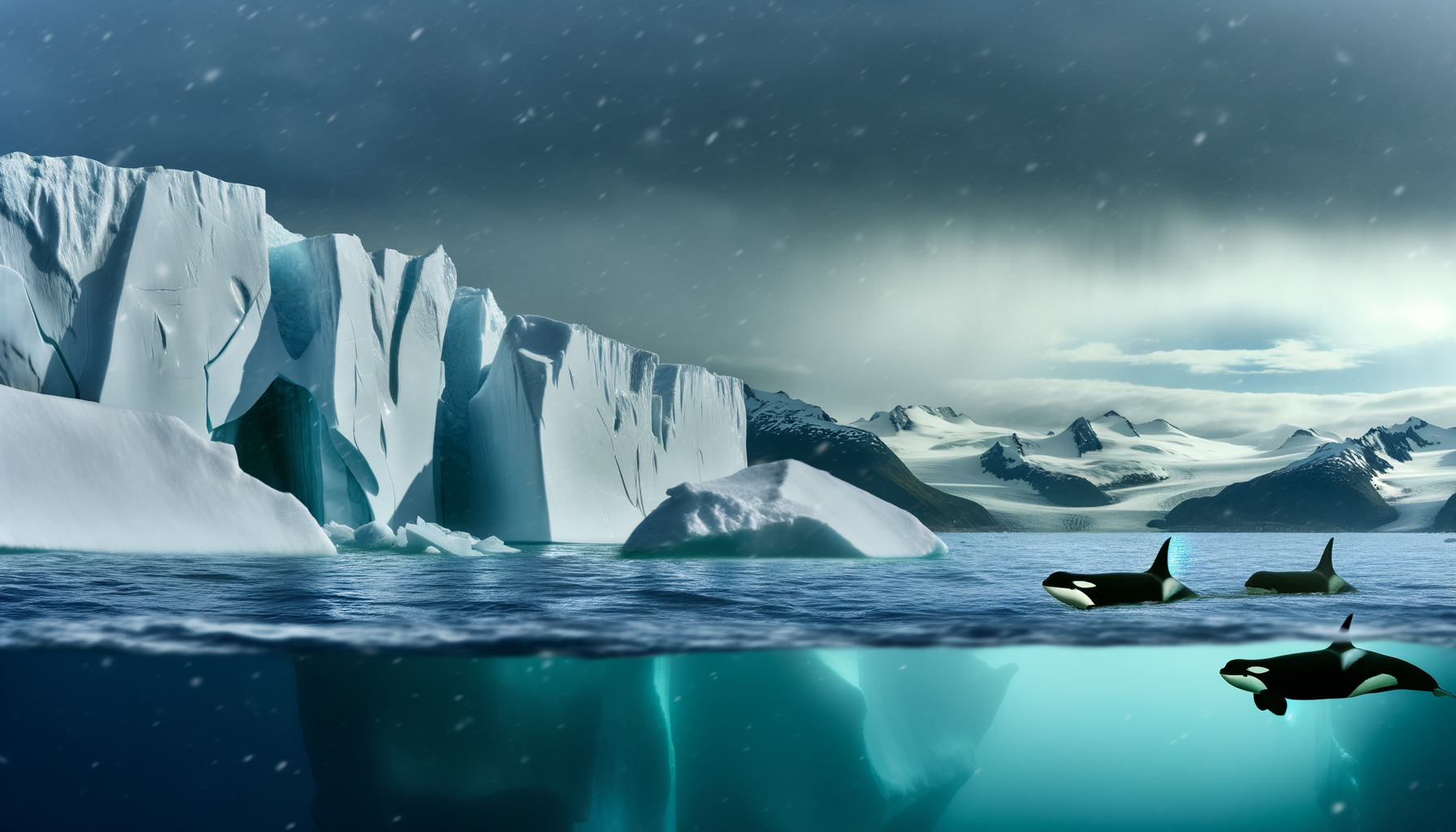
Amid the haunting silence of Greenland’s icy wilderness, researchers recently encountered a chilling and unexpected sight — a pod of orcas breaching the frigid waters just feet away from melting ice shelves. The presence of these apex predators so close to the frozen edges of the Arctic has triggered a red alert among climate scientists, raising fears that drastic ecological and planetary changes are accelerating faster than predicted.
Orcas, or killer whales, are not uncommon in the North Atlantic and Arctic regions during certain times of the year. But this particular encounter marked a disturbing shift. The whales were seen in territory traditionally too frozen for their passage, signaling catastrophic melt levels and widening navigable waters that could have far-reaching consequences not only for marine ecosystems, but also for the planet’s broader climate stability.
Amid mounting alarm, Greenland authorities issued an environmental emergency declaration — an increasingly common public announcement in recent years as the Arctic undergoes sweeping changes. This incident reflects a deeper world issue: the rapid deterioration of one of Earth’s most vital climate regulators.
Quick look at what happened in Greenland
| Aspect | Details |
|---|---|
| Event | Environmental emergency declared in Greenland |
| Trigger | Orcas seen unusually close to melting ice shelves |
| Date reported | June 2024 |
| Significance | Orcas’ presence indicates severe ice melt and changing marine ecosystems |
| Response | Greenland institutes emergency measures for climate monitoring and marine safety |
| Global relevance | Signals critical acceleration in ice loss, contributing to global sea-level rise |
Why are scientists so concerned
To the untrained eye, orcas breaching the surface near Greenland’s coast may sound like a mesmerizing marvel of nature. But for glaciologists and marine ecologists, it’s a dire sign. These whales are typically limited in how far north they can travel due to thick sea ice coverage — ice that now appears to be vanishing at an alarming pace.
Warmer ocean currents have begun infiltrating previously frozen zones, giving orcas — who prefer ice-free, accessible water for hunting — open maritime corridors to regions of the Arctic that were once impenetrable. This reflects not only a biological shift but a geophysical one, where the very foundations of the Arctic biosphere are beginning to rearrange themselves.
According to researchers based in Nuuk and affiliated with various global climate institutes, many Arctic marine species are at risk of being displaced or hunted by the newly arriving orcas. These whales are opportunistic predators, and their movement signals dramatic ecological imbalance.
“This is not just a wildlife issue. It’s a climate alarm bell. Seeing orcas this close to ice shelves shows how quickly the Arctic is losing its most protective and reflective surface.”
— Dr. Lena Karlsdóttir, Arctic Climate Researcher
What changed this year
While Greenland’s ice loss has been documented for decades, 2024 set a harsher precedent. Unusually high global temperatures — driven by persistent emissions and record-breaking ocean warmth — drastically weakened the ice shelves along Greenland’s southern and western coasts. Satellite imagery captured in May showed fractures and collapses across several key glacial formations, opening marine pathways to deeper interior zones.
This melting has occurred both from above, due to higher air temperatures, and from below, as warmer Atlantic currents penetrate the ocean’s deeper layers. The compounded effect is one of thinning ice shelves, less seasonal regrowth, and longer summer melt seasons — a combination perfectly aligning with recent orca sightings.
“We’re watching ecosystems collapse in slow motion, with apex predators now venturing into climates where they were once absent. This year is stunning — and not in a good way.”
— Nikolaj Strauss, Marine Biodiversity Specialist
How orcas are changing the Arctic food chain
Orcas entering previously unreachable Arctic waters are not just casual visitors; they are skilled, intelligent hunters disrupting native food webs. Their presence places local species like narwhals, beluga whales, and seals in dire jeopardy. Many of these Arctic-dwelling animals do not possess the escape mechanisms or group defences that southern predators like orcas do.
There’s empirical evidence that some native populations are already altering their migration routes or gathering patterns in response. The downstream impacts may be devastating — from population crashes to genetic isolation and behavioral stress. This isn’t just biodiversity loss — it’s ecological collapse in real time.
Emergency measures being taken
Greenland’s government, in collaboration with marine biologists and polar researchers, has initiated a rapid-response climate and biodiversity surveillance program. Measuring everything from sea temperature trends to sonar tracking of marine mammals, the aim is to build a real-time dashboard of Arctic changes.
Special coastal drone patrols and ice shelf monitoring aircrafts are now being deployed more regularly. Local fishing economies — many of which depend on predictable ice thaw and regrowth cycles — are being advised and compensated where disruptions have already begun. Emergency conservation zones are set to be expanded, and international calls for limiting marine traffic through sensitive straits are increasing.
“Our immediate focus is understanding how quickly these changes are occurring and how deeply they’re impacting Arctic life. Time is tight.”
— Kristoff Magnus, Greenlandic Climate Advisor
Global implications that we can’t ignore
The Greenland ice sheet plays a critical role in maintaining Earth’s thermal balance. Its massive reflectivity, called albedo, helps bounce solar radiation back into space. As the ice melts, darker ocean water replaces it, absorbing heat and accelerating further warming — a feedback loop known as the ‘albedo effect.’
Additionally, Greenland holds enough ice to raise global sea levels by over 7 meters if melted entirely. While such a scenario could take centuries, current melt trends suggest that multiple meters of sea-level rise may happen within this century, especially if emissions remain uncontrolled.
Beyond physical oceanic effects, this situation is a geopolitical wake-up call. Arctic shipping lanes are likely to expand, leading to new economic frictions, indigenous displacement, and contested territorial claims. Countries are already gearing up militarily and diplomatically as the Arctic becomes a fully navigable ocean during summer months.
Winners and losers in this climate shift
| Winners | Losers |
|---|---|
| Global shipping corporations (due to shorter routes) | Arctic-dwelling marine animals (due to predation and habitat loss) |
| Energy companies lobbying for polar resource access | Traditional subsistence fishing communities |
| International sea cargo networks | Delicate marine environments and coral ecosystems |
FAQs about the Greenland orca emergency
Why is the presence of orcas near ice shelves a concern?
Orcas appearing so far north indicates rapid Arctic ice melt. Orcas tend to avoid icy waters, so their arrival means previously frozen areas are now accessible, suggesting more profound climate-driven changes.
Is the Greenland emergency declaration common?
No, such declarations are rare and typically reserved for serious environmental disruptions or threats. This declaration emphasizes the urgency of the threat faced across Greenland’s marine and ice landscapes.
Could orcas become permanent Arctic inhabitants?
It’s possible. If warming continues and sea ice recedes even further, suitable conditions for orca habitation could become semi-permanent. This would upend existing predator-prey relationships in the Arctic.
How does this affect global sea levels?
Melting Greenland ice contributes significantly to global sea-level rise. The loss of reflective ice also speeds up warming, creating a cascading effect with drastic consequences worldwide.
What role does climate change play in this event?
This event is a direct result of climate change. Warmer temperatures and ocean currents are breaking down ice faster than anticipated, allowing species to migrate into previously inhospitable regions.
Can anything be done to reverse this trend?
Limiting global carbon emissions, enforcing marine protection zones, and investing in climate adaptation strategies are essential. However, some changes in the Arctic may already be irreversible in the near term.
Are local communities being affected?
Yes. Coastal and indigenous communities that rely on predictable seasonal cycles for hunting and fishing are seeing disruptions and food insecurity as animal patterns shift or disappear.
What happens next in Greenland?
Researchers and authorities are expanding surveillance and conservation efforts. The hope is that increased data will bring better understanding and allow for proactive global policy response.