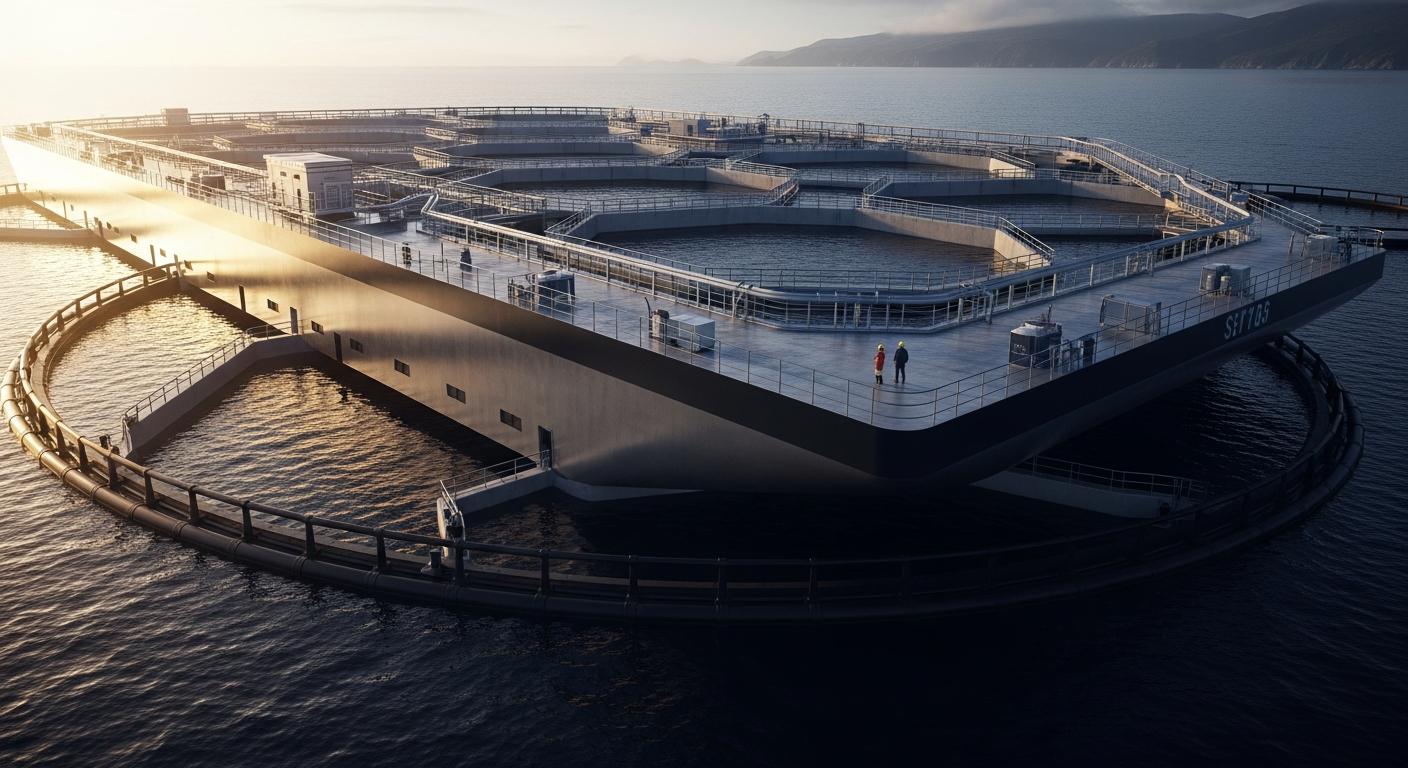
At first glance, it looks like a sci-fi spaceship floating on the ocean. But this colossal steel structure, stretching an astonishing 385 meters long—longer than some of the world’s largest cruise ships—is not a vessel of intergalactic travel. It is Havfarm, the world’s largest offshore salmon farm, revolutionizing aquaculture and tipping the scales toward a more sustainable way of feeding an ever-growing global population.
Constructed by Norwegian aquaculture company Nordlaks, this mind-boggling fish farm represents not just innovation in fish farming, but an evolution in how humanity can live with, rather than just harvest from, the ocean. By moving fish farming offshore and scaling it to unprecedented size, Havfarm aims to solve persistent challenges like disease, pollution, and overcrowding that have plagued traditional coastal farms. And with its unique design and positioning between wild ocean currents, it allows for more ethical and environmentally sensitive salmon farming practices.
Key features and key data at a glance
| Structure Name | Havfarm |
| Length | 385 meters |
| Developed by | Nordlaks, Norway |
| Launch Year | 2020 |
| Fish Capacity | Up to 10,000 tonnes of salmon |
| Location | Off coast of Hadsel island, Northern Norway |
| Purpose | Offshore salmon farming |
Why Havfarm is shaped like a ship but isn’t one
The most visually striking aspect of Havfarm is its resemblance to a traditional ship. At 385 meters in length and 60 meters wide, it dwarfs even the Titanic. It’s anchored to the sea floor with moorings strong enough to hold against some of the toughest ocean conditions. But make no mistake—it doesn’t have an engine, propeller, or the capacity to sail. Its ship-like exterior serves a different function: to create an expansive open-water fish farm that harmonizes with the dynamics of the ocean.
Havfarm houses six enormous net pens built directly into the structure, each capable of accommodating hundreds of thousands of fish. This approach allows for natural water flow, which helps maintain fish health and dilutes waste. Unlike traditional pens near the coast, which can cause environmental stress on ecosystems through concentrated waste and escaped fish, Havfarm minimizes ecological damage by its very design and location.
The environmental benefits of going offshore
One of the critical innovations of Havfarm is its contribution to redefining sustainability in aquaculture. Coastal farms often face issues like algal blooms, fish lice, and contaminants due to overuse and proximity to land-based pollutants. Furthermore, confined spaces make fish more susceptible to diseases and stress. Operating offshore, far from coastal influences, Havfarm allows salmon to live in more spacious and natural conditions.
The waters surrounding Havfarm are rich with oxygen and cleaner due to stronger ocean currents. These currents carry waste away, reducing the impact on marine floors and allowing nature to better process byproducts. In turn, disease and parasitic outbreaks are less frequent, which cuts down on antibiotic use, benefiting both consumers and the environment.
The engineering marvel behind its construction
Constructing Havfarm was no ordinary feat. It was developed in collaboration with Chinese state-owned shipbuilding corporation CIMC Raffles Shipyard and transported halfway around the world to its operational location off the coast of Hadsel island. The entire unit is made of marine-grade steel and designed to endure harsh arctic conditions including extreme waves, high winds, and shifting currents.
Each of the six cages attached to the hull is 50 meters deep and 50 meters in diameter. These are rigid, not floating nets, which keeps the structure stable and more resilient than its coastal counterparts. These pens can be lowered into deeper water to avoid surface disturbances or harmful sea lice, demonstrating a new level of control in aquaculture systems.
“With Havfarm, we’re taking aquaculture out into the deep sea, where the ocean can help maintain the balance. It’s a cleaner, more responsible way of farming fish.”
— Anniken Hauglie, Norwegian Seafood Council (placeholder quote)
Impact on global food systems and sustainability
As the global population continues to rise, the demand for protein sources is skyrocketing. Aquaculture is already one of the fastest-growing food sectors, and offshore farming like Havfarm is poised to play a pivotal role in feeding the future. Unlike terrestrial farming, it doesn’t require arable land or extensive freshwater use—a cherished asset in the era of climate change.
Each Havfarm can raise up to 10,000 tonnes of salmon per cycle, which can translate to tens of millions of meals across the world. By doing so with reduced environmental strain and improved fish welfare, it sets a new gold standard for ethical aquaculture. Furthermore, it creates new jobs and innovation hubs in rural and marine-focused economies.
Innovation meets animal welfare
One of the crucial benefits of this offshore model is its emphasis on fish health and welfare. Larger swimming spaces lead to less stress and aggression among fish. Most importantly, the design massively reduces the presence of sea lice—a parasitic marine problem rampant in crowded coastal units.
As a result, the need for chemical or mechanical lice treatment is drastically lowered, reducing fish mortality and creating cleaner food for end consumers. The ability to submerge pens during periods of lice outbreaks is another cutting-edge solution made possible only through Havfarm’s design.
“Increased space, accurate temperature monitoring, and clean water flows give these salmon a much more natural and healthy environment.”
— Martin Olsen, Aquaculture Specialist (placeholder quote)
Economic opportunities surrounding Havfarm
Beyond its environmental and ethical influence, Havfarm also serves as an economic engine. It requires highly skilled engineers, biologists, technicians, and maritime personnel. The move to large-scale offshore aquaculture creates new pathways for coastal and offshore economies, turning rural marine communities into global producers of sustainable seafood.
Each installation needs constant real-time monitoring, advanced feeding systems, and logistics teams to manage harvest and transport. Taking fish farming offshore heralds an entirely new industrial category—one that’s cleaner and more connected to nature.
Winners and losers from the megafarm shift
| Winners | Losers |
|---|---|
| Consumers seeking sustainable seafood | Small-scale coastal fish farms with outdated practices |
| Marine ecosystems due to reduced pollution | Chemical suppliers for sea lice treatment |
| Northern Norway’s coastal economies | Land-based fish farming operations |
| Environment-focused policymakers | Inefficient, high-emission protein producers |
Looking to the future of offshore aquaculture
Havfarm is just the beginning. Inspired by this success, new designs and infrastructures are under development to accommodate deeper waters, mobile platforms, and even AI-managed ecosystems. The offshore revolution signifies not only a technical breakthrough but a cultural one, echoing a world slowly shifting toward more conscious and sustainable food production methods.
In the coming years, we may see nation-wide transitions in seafood economies and large-scale investment in offshore technologies. What was once considered impossible—raising healthy fish far from shore, under rough conditions—is now proving to be practical, scalable, and incredibly rewarding.
Frequently asked questions about Havfarm
What is Havfarm?
Havfarm is a massive offshore salmon farming installation developed by Nordlaks in Norway. It stretches 385 meters and is permanently anchored in deep sea waters to support sustainable and large-scale fish farming.
How many fish can Havfarm produce?
Each Havfarm unit is capable of producing up to 10,000 tonnes of salmon, equivalent to tens of millions of servings of fish.
Why is offshore farming better than coastal farming?
Offshore farming reduces exposure to coastal pollutants, minimizes the risk of disease outbreaks, lowers fish stress, and allows for better waste dispersion through ocean currents.
Is Havfarm environmentally friendly?
Yes, Havfarm is designed to reduce the ecological footprint of aquaculture by avoiding overburdened coastal zones, reducing chemical use, and improving fish health.
Can Havfarm move like a ship?
No, Havfarm is permanently anchored and has no engines or propulsion systems. It is a stationary structure designed to withstand open sea conditions.
What technology supports Havfarm operations?
The farm uses automated feeding systems, real-time monitoring, submerged cages, and reinforced structures to manage salmon health and harvesting efficiently.
Where is Havfarm located?
Havfarm operates off the coast of Hadsel island in Northern Norway, strategically situated in cold and clean Atlantic waters.
What makes Havfarm different from traditional fish farms?
The sheer scale, offshore location, improved biosecurity, and engineering design make Havfarm stand out as a next-generation aquaculture solution.