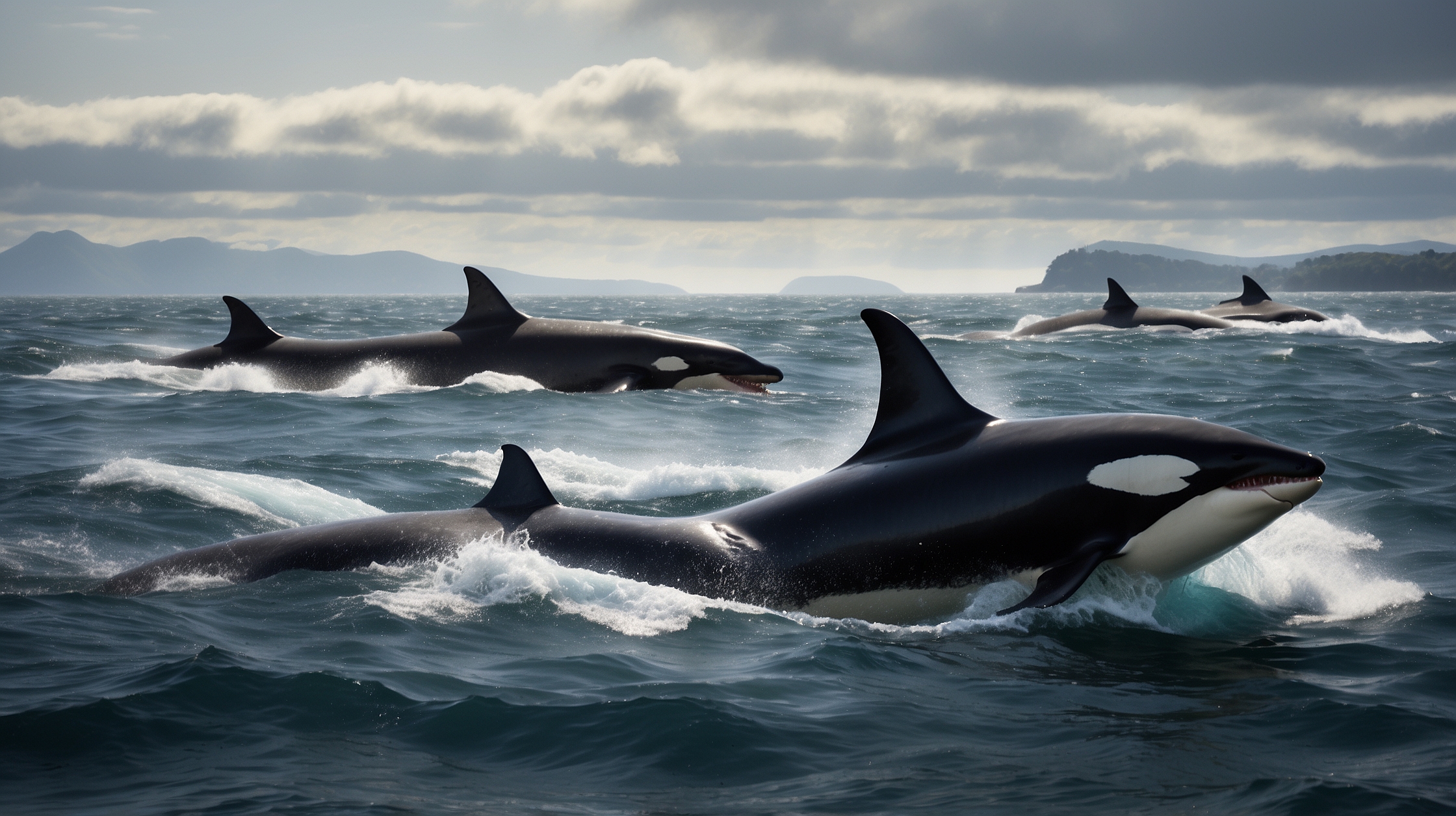
It was a seemingly routine fishing trip off the Iberian coast. The crew of a small vessel had spent hours patiently waiting in the cool Atlantic waters. As they were winding down, a sudden change in the ocean’s temperament signaled something unexpected. A pod of orcas — intelligent, social, and known apex predators — appeared near their boat, circling with palpable curiosity. The crew watched in awe, unaware that this mesmerizing sight was merely the prelude to a tense standoff between predators of the deep.
Just moments after the orcas vanished beneath the waves, the fishermen felt violent tugs on their anchor lines. Pulling in the rope, they expected tangled debris or damage from the encounter with the orcas. Instead, they were stunned to find large, unmistakable bite marks—left behind not by the orcas, but by sharks. It was the first time many had witnessed such aggressive shark behavior occur so soon after an orca interaction, raising questions about the hidden tensions and dynamics within the marine food chain.
This unusual encounter is not only captivating—it’s also becoming more frequent, according to fishermen and marine biologists familiar with the region. As ocean temperatures shift and human activity disrupts natural balances, predators like orcas and sharks appear to be more frequently overlapping in wild, often adversarial ways. The Iberian Peninsula may be on the cusp of a new pattern in marine predator behavior—and experts are paying attention.
Key facts about the orca-shark encounter near Iberia
| Location | Waters off the Iberian Peninsula |
| Incident Date | Reported in mid-2024 |
| Encounters Reported | Multi-species incidents involving orcas and sharks |
| Fishermen Observations | Orcas circling shortly before anchor line bit through by sharks |
| Marine Expert Concerns | Rising interspecies aggression and shifting behavioral patterns |
| Possible Causes | Climate change, food scarcity, human disturbances |
Why the predator dynamics may be changing
Marine ecosystems have long-established hierarchies and relationships. At the top of that chain sit orcas—formidable hunters capable of outsmarting prey and even confronting other apex predators like great white sharks. But recent reports of close succession interactions between orcas and sharks point to a potential rebalancing in behavioral boundaries.
In earlier documented cases, orcas have been known to prey on sharks by targeting their nutrient-rich livers. But the recent Iberian encounter flips this expectation. Here, sharks appeared to become highly aggressive right after an orca presence. Rather than hunting one another, the interaction looked more like a struggle over territory, resources, or prey access.
Their behavior felt unusually coordinated, like the sharks were reacting to something lingering in the water—or perhaps even to the orcas themselves.
— Miguel Torres, Veteran Atlantic Fisherman
This kind of activity suggests that climate and ecological stressors may be inciting more high-stakes interspecies confrontations in the ocean.
What scientists believe is behind these interactions
According to marine biologists, there’s a growing body of evidence that climate change and overfishing are affecting predator-prey dynamics. Orcas may venture closer to coastal waters or fishing routes in search of declining prey, increasing the frequency of human encounters. Sharks, likewise, may be lured by catch residue or distressed signals left behind by predator activity.
Some researchers speculate that chemical signals—pheromones released during orca interactions—may unintentionally attract sharks. These signals could serve as indicators of potential feeding opportunities, triggering the aggressive reactions observed by fishermen.
We’re witnessing evolutionary shifts in real time. These species aren’t just adapting their hunting habits—they’re redefining how they interact with each other.
— Dr. Helena Ruiz, Marine Ecologist
The impact on fishing communities
For fishermen operating off the Iberian coast, this emerging pattern presents a host of new challenges. Nets are more frequently destroyed. Catches are being predated upon before they can be hauled in. And most alarmingly, close contact with large predators raises concerns for human safety.
Even though orcas rarely attack humans, their proximity makes smaller vessels particularly vulnerable to gear loss. Similarly, the aggressive behavior exhibited by sharks during these episodes suggests an increased risk factor for boats navigating traditional fishing zones.
We’ve had to reinforce our lines and start using sonar tracking just to avoid hotspots. It’s not just the storms we worry about anymore—it’s the predators too.
— Arturo Silva, Commercial Fishing Operator
How conservationists are responding to the predator conflict
Conservation groups are launching fresh initiatives to monitor interspecies marine behavior. Satellite tagging programs, underwater drones, and collaborative fisherman-led logging efforts are helping scientists build better models to predict these encounters.
There are also calls to impose temporary no-fishing zones in areas with increasingly high predator traffic. Such actions are aimed at protecting both marine life and the economic livelihood of fishing communities.
The key is balance. Protecting these animals doesn’t mean sidelining people—it means smarter coexistence driven by data.
— Sofia Martinez, Marine Policy Analyst
What this means for the oceans’ future
The sharp uptick in orca and shark interactions paints an evolving portrait of the oceans. As both human-made and natural changes stress marine environments, predators at the top of the food chain react in unprecedented ways. Encounters like those reported off Iberia are no longer one-off anomalies—they may be the signposts of future marine norms.
Understanding these signals now could be pivotal. With the continued cooperation of researchers, policy-makers, and local fishermen, there’s a chance to delve deeper into the root causes and design long-term solutions to preserve both ecological balance and human industry.
Frequently asked questions about the recent predator encounter
Were any fishermen injured during the orca and shark incident?
No injuries were reported. While the encounter was described as intense and surprising, the fishermen remained unharmed.
Do orcas usually interact aggressively with sharks?
Orcas have been known to prey on sharks, specifically hunting for their livers. However, aggressive shark behavior following orca presence is less understood and appears to be a developing trend.
What might have attracted the sharks so quickly after the orcas left?
Experts believe that biological signals left behind by orcas, along with possible bait or catch residue, may have triggered shark aggression.
Is this a one-time event or part of a growing pattern?
Fishermen and marine scientists report that these interactions are becoming more common, potentially signaling a new behavioral trend.
What precautions are fishermen taking now?
Some are deploying reinforced gear, using sonar equipment to monitor predator presence, and adjusting routes based on recent sightings.
Could climate change be influencing predator behavior?
Yes. Warmer oceans and changing fish migration patterns can displace hunting grounds, forcing predators like orcas and sharks into closer proximity — and potential conflict.
Are conservation efforts being affected by these interactions?
Yes, policies are beginning to adapt to incorporate dynamic marine predator monitoring and protective zones to reduce human-wildlife conflict.