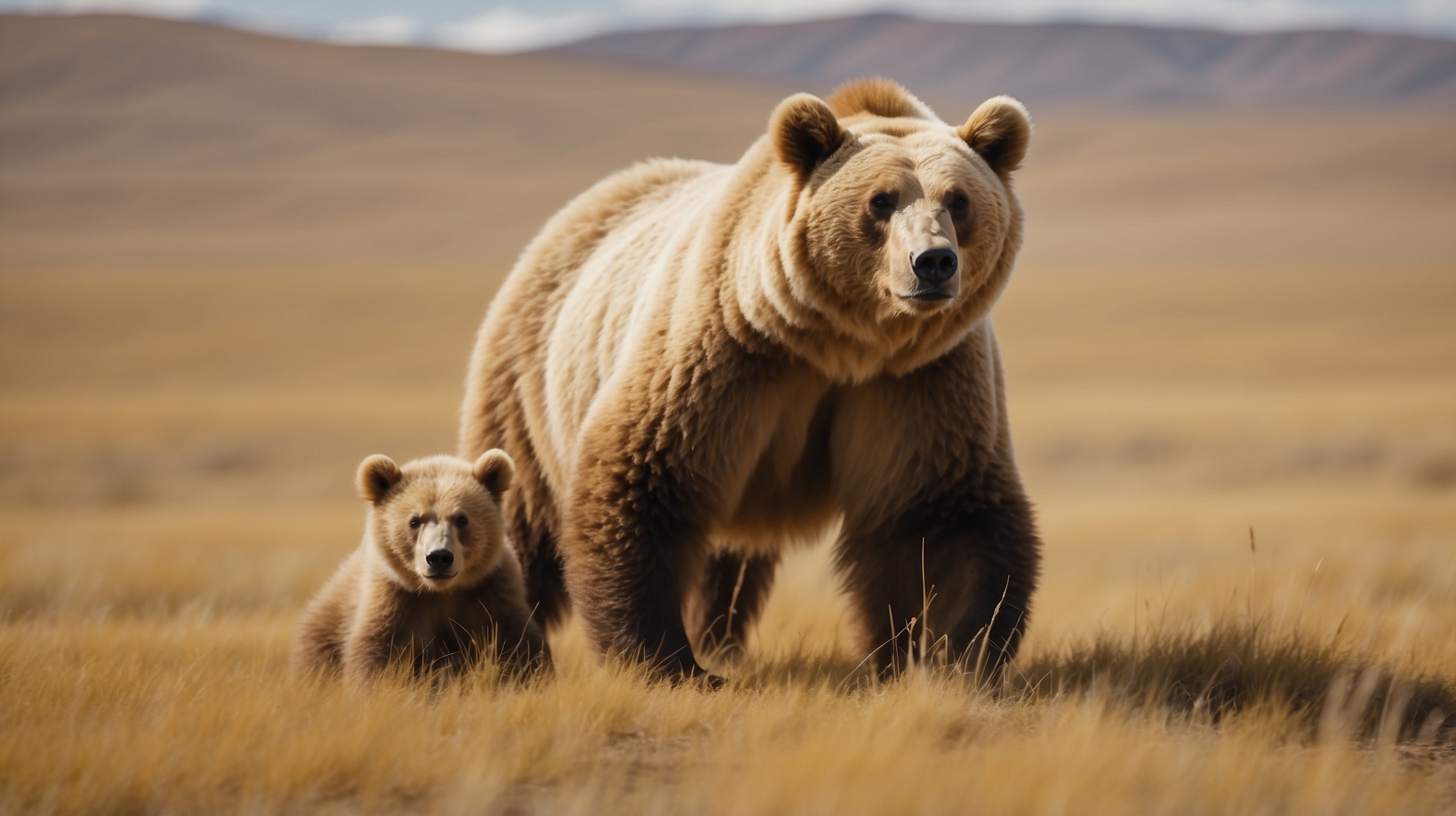
Deep within the sprawling, rugged terrain of western Mongolia, where towering peaks and vast, windswept valleys stretch as far as the eye can see, lives a creature so elusive that even local herders speak of it in hushed, reverent tones. For decades, scientists and wildlife experts have scoured the Altai Mountains for just a glimpse of this ghostly animal — the **Mongolian Gobi bear**, also known locally as the *Mazaalai*. With fewer than 40 known individuals alive, this bear is the **rarest bear species on Earth**.
Yet, in a remarkable breakthrough, triggered cameras recently captured something no one had expected: an adult female Mazaalai walking cautiously across a stony ridge — not alone, but with a cub in tow. These images, gathered from motion-sensitive, automated trail cameras, mark more than just a rare wildlife sighting. For conservationists, they signal something far more profound: hope. A new generation of Mazaalai is clinging to survival in one of Earth’s most unforgiving environments.
Now, as researchers analyze the significance of this moment, the global community’s focus turns toward the future of this critically endangered species. The challenges are vast, but the appearance of a cub suggests that resilience still pulses in the heart of Mongolia’s wildest frontier.
Overview of the rediscovery
| Species | Mongolian Gobi Bear (Mazaalai) |
| Conservation Status | Critically Endangered |
| Estimated Population | Approximately 30–40 individuals |
| Sighting Location | Gobi Desert, Western Mongolia |
| Discovery Significance | First camera trap proof of successful reproduction in years |
| Technology Used | Remote-triggered camera traps |
The world’s rarest bear and its desert home
The **Mazaalai** is no ordinary bear. Smaller and more drought-adapted than its northern cousins, this subspecies of the brown bear survives in one of the most extreme and arid regions on Earth: the **Great Gobi Desert**. With summer temperatures soaring above 40°C and water sources sometimes dozens of kilometers apart, the Mazaalai has adapted to survive where few large carnivores would dare to tread.
Historically found across a broader swath of Central Asia, the Gobi bear is now critically restricted to just the heart of the Gobi, mostly within the specially protected Zone A in Mongolia’s Great Gobi Strictly Protected Area. This region spans over 46,000 square kilometers, making it roughly the size of Switzerland — but containing only a handful of bears.
Why this new sighting is making global headlines
The appearance of a **mother bear and her cub** isn’t just a feel-good wildlife story — it’s scientific gold. For years, conservationists feared that the tiny population of Mazaalai was aging, with few signs of new births. The cameras that captured this pair were part of a broader network aimed specifically at tracking remaining individuals and evaluating reproduction viability.
The recently revealed footage showed a healthy-looking mother and a cub estimated to be a few months old, offering tangible evidence of successful breeding. This not only confirms that the small population is still sexually active but also gives conservationists data to further prioritize these key maternal territories for protection.
“To see a Mazaalai is rare enough. To see a mother and cub? That’s history unfolding in front of our eyes.”
— Dr. Selenge Baatar, Wildlife Biologist
What changed this year for Gobi bear conservation
Several factors contributed to this successful documentation. In recent years, **Mongolian conservation efforts have greatly increased** investment in remote camera systems, deploying over 70 new camera traps across the bears’ known range. Unlike previous attempts relying on human trackers and drones, these cameras are high-resolution, motion-sensitive, and solar-powered — giving researchers unprecedented images of animals that usually remain invisible.
Additionally, the Mongolian government strengthened its environmental protections, enforcing stricter rules on livestock grazing and human encroachment in protected bear habitat. Meanwhile, international funding has supported supplemental feeding initiatives, providing bears with additional sources of calories during the harshest drought months.
Challenges facing the Mazaalai’s survival
Despite this moment of optimism, the road ahead is enormously difficult. The harsh environment is only part of the challenge. **Climate change**, with its increasing droughts and shifting temperatures, continues to threaten the fragile desert ecosystem that sustains the Mazaalai. Additionally, **human activity**, including illegal mining and competition from domesticated animals, adds further stress to an already vulnerable species.
Genetic diversity poses another concern. With a population likely below 40 individuals and no confirmed Mazaalai outside Mongolia, the genetic health of the species is fragile. Offspring like the one just spotted are essential for introducing new lifelines into the small gene pool.
How science and community unite to protect them
Preserving the Gobi bear isn’t just a scientific endeavor — it requires **collaboration with local communities**, many of whom have long-standing cultural reverence for the Mazaalai. Educational outreach and joint ranger programs now boost awareness and even involve nomadic herders in protection efforts.
International scientists work alongside Mongolian ecologists, arming them with GPS data, satellite tracking, and population modeling tools, while local guards patrol access routes to prevent poaching or interference. Together, they form a hybrid network of old-world wisdom and cutting-edge conservation tools.
“The Mazaalai represents not just the resilience of nature, but the resolve of a people to protect one of their rarest national treasures.”
— Erdene Batchuluun, Conservation Ranger
Winners and those still at risk
| Winners | Still at Risk |
|---|---|
| Gobi bear population showing signs of reproduction | Bears outside monitored areas lacking support |
| Conservation technology advancements | Long-term food scarcity from climate change |
| International visibility for rare species conservation | Genetic bottlenecks and inbreeding risks |
What this means for global conservation efforts
Glimpses like these are a crucial reminder: even species standing on the brink can recover with the right support. The Gobi bear’s story proves that **early intervention and technology-led surveillance** can make a real difference in monitoring and preserving critical biodiversity, especially in remote or politically overlooked regions.
As conservationists now analyze the new data and calibrate their next steps, it’s clearer than ever that global attention and sustained funding are necessary. This fragile success story underscores the importance of continued collaboration — not just to save the Mazaalai, but to apply these lessons to critically endangered species globally.
“Each new cub is a thread back from extinction. There’s hope hidden in those pawprints.”
— Placeholder: Conservation Ecologist
Frequently asked questions about the Gobi bear
What is the Mongolian Gobi bear?
The Mongolian Gobi bear, or Mazaalai, is a small, desert-adapted subspecies of brown bear living exclusively in Mongolia’s Gobi Desert. It is considered the rarest bear on the planet.
How many Gobi bears are left?
Estimates suggest fewer than 40 individuals remain in the wild, making it critically endangered and one of the rarest mammal species worldwide.
What makes the Mazaalai different from other bears?
The Mazaalai is uniquely adapted to the harsh desert environment with a smaller frame, scarce diet, and extreme heat resistance, unlike its forest-dwelling cousins.
Why was this recent sighting so significant?
The sighting included not just an adult bear, but also a cub — a rare and hopeful indication of successful breeding among the critically endangered population.
What kind of technology was used to capture the image?
Researchers used motion-activated camera traps strategically placed throughout the desert region to document wildlife activity without human presence.
What threats still face the Gobi bear?
Major threats include climate change, food scarcity, human encroachment, and a limited genetic pool due to the small population size.
How are local communities involved in conservation?
Mongolian herders, rangers, and villages often participate in monitoring efforts, provide local insight, and help reduce wildlife-livestock conflict.
Can the Gobi bear population recover?
With continued support, protection, and scientific monitoring, the population has a chance, though recovery requires long-term commitment and resources.