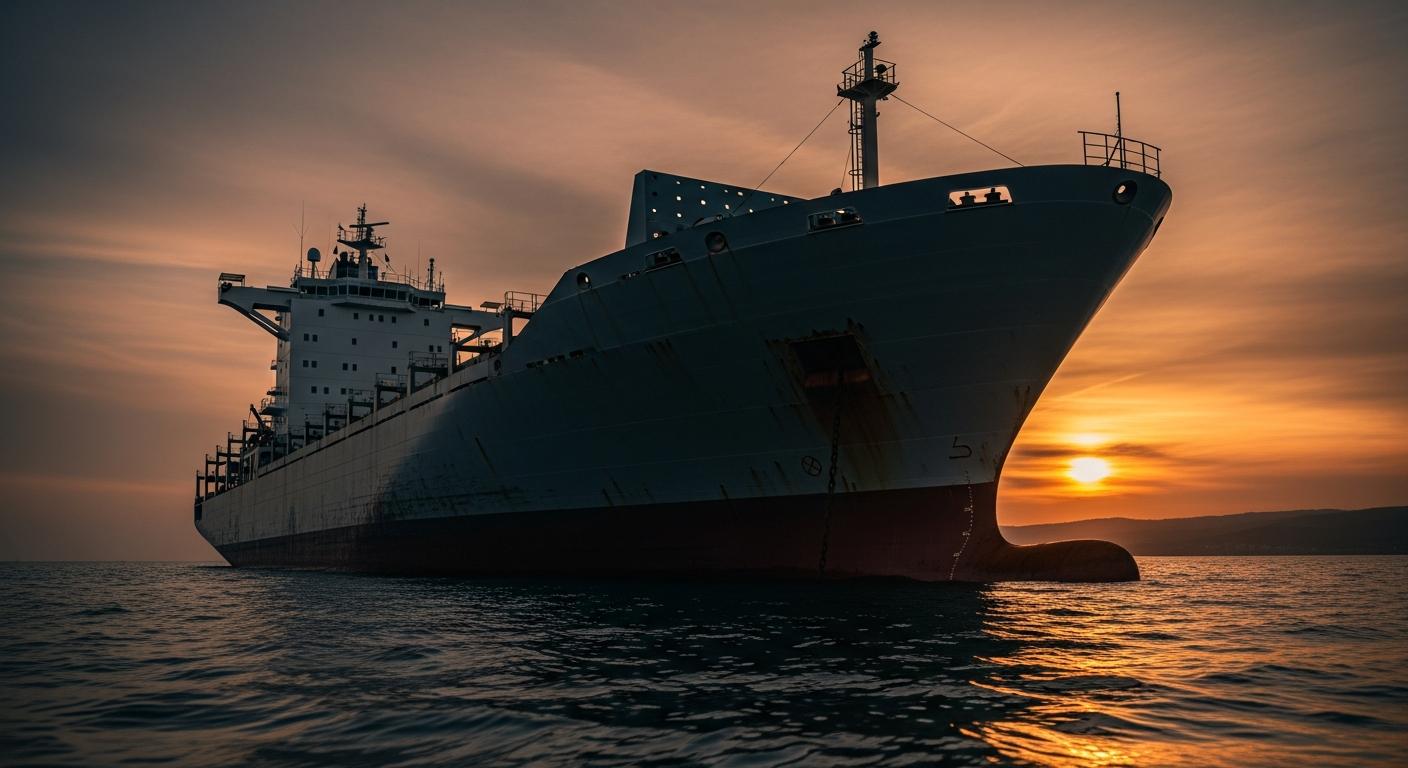
On a foggy morning in the Black Sea, a bulk carrier that had never before raised alarm quietly slipped past international eyes — but not past satellite trackers. Flying the green-and-red tricolor of Cameroon, the ship appeared innocuous. However, the vessel’s true identity and intentions were something far more complex. Far from the coastlines of Africa, the bulk carrier had been “re-flagged” — a process where ships change their nationality on paper — a tactic that’s becoming increasingly prevalent in global shipping networks involving sanctioned countries, notably **Russia**.
The ship in question was part of a larger fleet that had been **reflagged by Russia** to continue operations despite tough Western sanctions imposed in response to the conflict in Ukraine. These sanctions have been designed to isolate Russia economically, especially its lucrative oil trade. But reflagging has allowed Moscow to maintain critical trade routes, circumvent shipping bans, and use obscure or sympathetic national registries to dodge scrutiny. What raised even more eyebrows: the same vessel was also being reportedly monitored via secret intelligence by the United Kingdom, spotlighting what experts describe as a growing “shadow fleet” functioning beneath the radar of traditional oversight mechanisms.
As the geopolitical tensions tighten, so do the tactics used on the high seas. The sharp increase in maritime secrecy is prompting concern among policymakers, shipping industry stakeholders, and global security analysts, prompting questions about maritime governance, global accountability, and the technological tug-of-war in surveillance and counter-surveillance at sea.
Overview of Russia’s Reflagging and UK Surveillance Activity at Sea
| Aspect | Details |
|---|---|
| Key Party Involved | Russia |
| New Flagged Country | Cameroon |
| Sanctions Avoided | EU, UK, and US maritime and trade sanctions |
| Surveillance Country | United Kingdom |
| Main Issues Raised | Sanctions evasion, maritime security, legal loopholes |
| Global Concern | Oil trade transparency and international legal compliance |
What changed this year to spark maritime concern
Since the full-scale invasion of Ukraine in 2022, Russia has faced increasingly tight sanctions from Western nations. These sanctions let the international community restrict the Kremlin’s ability to profit from its most valuable exports — oil, gas, and other raw materials. But 2024 has seen a **notable shift in tactics**. Rather than push back against the sanctions head-on, Russia has taken them sideways: **reflagging its ships** under third-party nations to maintain a veil of legitimacy.
This year, the most unexpected flag sprouted on the radar: **Cameroon**, a Central African nation with a previously negligible shipping registry. Suddenly, Cameroon accounted for a growing share of Black Sea oil exports, raising red flags among intelligence agencies and maritime watchdogs.
Many of these Cameroon-flagged ships previously sailed under the Russian flag — a paper trail that gets increasingly harder to follow due to opaque registries and limited transparency in flagging processes. It’s why **satellite imagery and spy assets** have become key tools for enforcement bodies such as the Royal Navy and intelligence wings in the UK.
Understanding reflagging and why it’s a powerful tool
In international maritime law, the flag a ship flies determines its national jurisdiction. But **changing a flag** is often unsettlingly easy — a ship’s owner simply applies to switch to another national registry, typically for financial or regulatory reasons.
Known as a “flag of convenience,” the new country doesn’t necessarily inspect the vessel or enforce rigorous compliance checks. Some registries, especially those of small or lower-income nations, are more lenient. In Russia’s case, **reflagging to Cameroon** and other obscure flags has become a way of sidestepping trade embargoes, insurance bans, and port access restrictions.
Reflagging is the maritime version of a wolf in sheep’s clothing.
— maritime expert (placeholder)
For sanctions enforcers, distinguishing between a legitimate business and one merely hiding behind a foreign flag is becoming harder by the day. The consequence is a massive **“shadow fleet”** operating beyond usual governance.
The UK’s quiet role in sniffing out suspicious vessels
Behind the scenes, the United Kingdom has taken a leading role in piloting advanced maritime surveillance to monitor sanction evasions. Through satellite tracking, shore-based radar systems, and in some cases, covert human intelligence, UK agencies are attempting to map this elusive fleet and identify whether oil exports are actually Russian in origin — even when the **manifest says otherwise**.
British sources indicate that several of these ships are undergoing covert tracking. The use of ELINT (Electronic Intelligence) and SIGINT (Signals Intelligence) helps uncover ships running with switched-off transponders, forged electronic IDs, or altered AIIS data. These deceptive tactics, in some cases, have enabled Russia to push millions of barrels of crude oil onto the global market, untraceable by traditional methods.
We are no longer just policing state borders, but digital waters.
— UK intelligence officer (placeholder)
By employing submarine optic lines, deep-sea sensors, and partnerships with European space agencies, the UK hopes to stay one step ahead. Yet, many in Parliament are asking whether **international cooperation** is enough to tackle what has essentially become a game of cat and mouse.
Winners and losers in this shadowy maritime game
| Winners | Losers |
|---|---|
| Russian oil exporters | EU and UK sanctions enforcement |
| Flag states like Cameroon (via registration fees) | International maritime transparency |
| Intermediary traders/profiteers | Legitimate shipping operators facing unfair competition |
| Shadow fleet owners | Insurance providers and global shippers facing reputational risk |
Global implications for energy markets and policy
As these ships continue loading oil in Black Sea ports under dubious registries, Western sanctions might struggle to maintain their intended sting. In effect, reflagging has helped **Russia stabilize its oil revenues** despite sweeping limitations. This is complicating the oil markets globally, which now must price in uncertainty not only about supply but also about the **veracity of shipping data and origin claims**.
It raises a key diplomatic urgency. Should countries consider **penalizing lax flag registries**, or even go so far as to question vessels in neutral waters? For many analysts, the answer is complicated. Greater aggression in enforcement could also lead to dangerous maritime standoffs and legal disputes in international waters.
The market’s transparency and global political stability now hinge on boats flying the right flag for the right reasons.
— Dr. Helena Marks, maritime governance scholar
Still, the urgency is clear. With each vessel that slips past enforcement, the integrity of sanctions — and indirectly global consensus on rule-of-law — erodes a little more.
Short FAQs about reflagged vessels and maritime security
What is vessel reflagging?
Reflagging is the practice of changing a ship’s country of registry, often to benefit from more lenient regulations or avoid sanctions.
Why is Russia reflagging ships?
Russia is reflagging to other countries, such as Cameroon, to sidestep Western sanctions related to oil exports and maintain access to global markets.
How does the UK track these ships?
The UK uses a combination of satellite monitoring, signal intelligence, and covert human operations to track suspect vessels at sea.
Is reflagging illegal?
No, reflagging is not inherently illegal. However, it becomes problematic when it’s used to **evade legal restrictions or international sanctions**.
What is the ‘shadow fleet’?
The term “shadow fleet” refers to vessels that operate under obscure flags, evade standard tracking systems, and often participate in sanctioned trading.
Is Cameroon knowingly helping Russia?
There is no public evidence suggesting active complicity. However, the ease with which ships are registered has raised questions about oversight and accountability.
What are the risks of ignoring this trend?
Unchecked reflagging endangers **global trade transparency**, sanctions enforcement, and could heighten geopolitical tensions over contested maritime domains.
Can international bodies enforce flag integrity?
Efforts are underway, but without uniform standards and consensus, enforcement remains **patchy and inconsistent across regions and jurisdictions**.