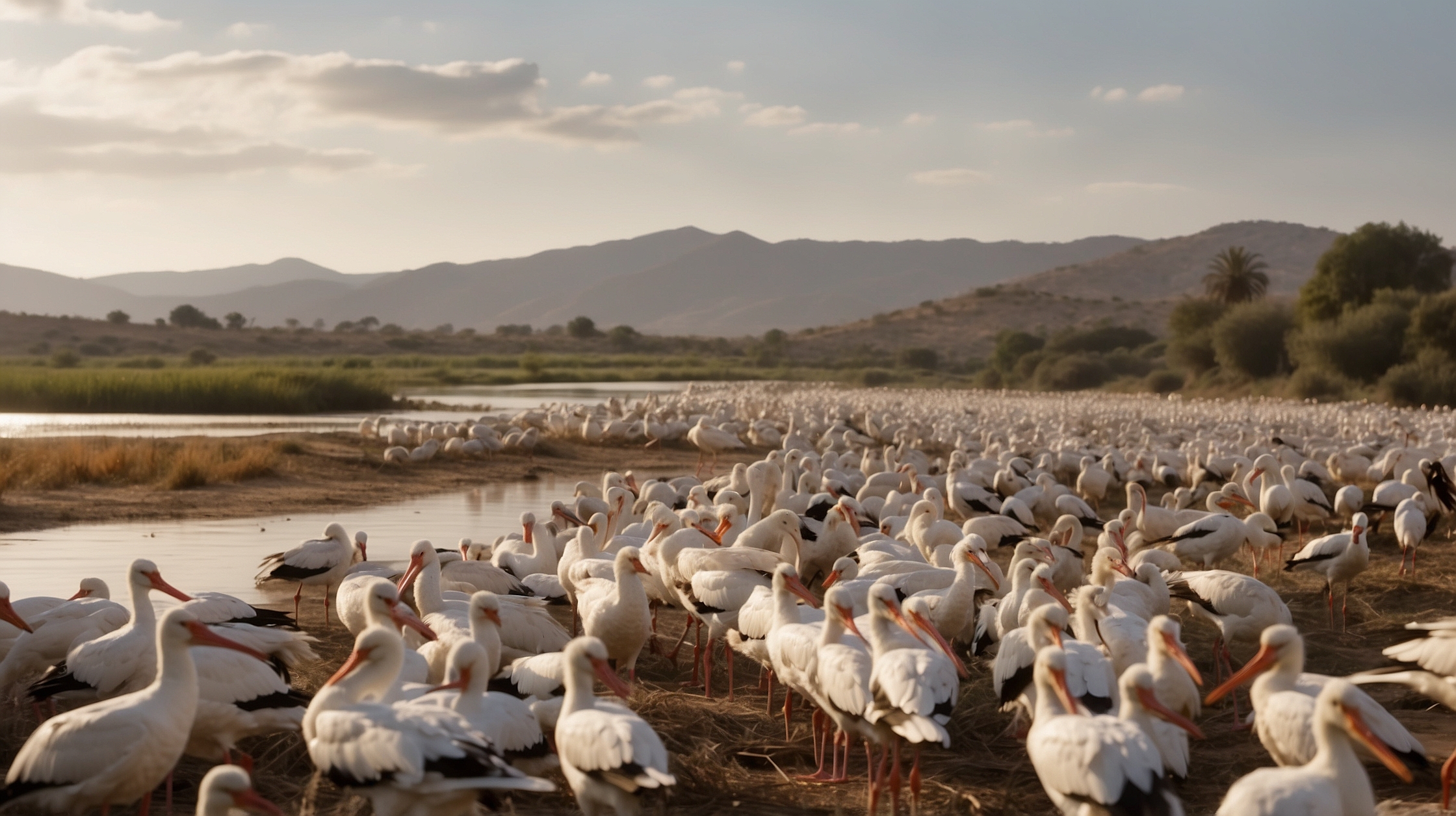
In the stillness of Andalusia’s wetlands, where the melodic calls of birds rise above mirror-like lagoons and reed-fringed shores, a new threat is spreading beneath the beauty—a growing tide of plastic. White storks and yellow-legged gulls, once symbols of vitality in this delicate habitat, have unwittingly become agents of ecological disruption. Each flight, each scavenged meal from nearby landfills brings more than nourishment—it brings plastic, thread, wrappers, and debris into the heart of Spain’s ecological sanctuaries.
This phenomenon, recently recorded and quantified by scientists, is a stark reminder of how deeply waste is woven into our ecosystems. Up to **600 kilograms of plastic** have been transported by birds like storks and gulls into these wetlands, according to a study conducted over a span of years. Wetlands are typically rich bastions of biodiversity—refuges for *dozens of bird species, amphibians, and aquatic life*. However, what was once a haven of migration and mating is quickly transforming into a landfill-by-proxy, carried piece by piece by the very animals these fragile zones are meant to protect.
These discoveries shed light on the **unexpected role of birds as plastic vectors**, linking distant landfills with freshwater ecosystems. It’s a crisis hiding in plain sight, one that calls for urgent attention not just from ornithologists and conservationists, but **policymakers, waste managers, and local communities** who might never set foot in a nature reserve but whose waste ends up there nonetheless.
Overview of stork-and-gull deposition of plastic waste in Andalusia
| Location of Concern | Andalusia’s wetlands, including Doñana National Park |
| Main Bird Species Involved | White Stork, Yellow-legged Gull |
| Source of Waste | Nearby landfills, such as those in Huelva and Cádiz provinces |
| Estimated Plastic Transferred | Over 600 kilograms annually |
| Potential Environmental Impact | Habitat degradation, ingestion and choking hazards for wildlife, microplastic contamination |
| Period of Study | 2019 – 2023 |
| Driving Behavior | Birds foraging in landfills and transporting waste back to nesting or roosting areas |
How birds became unexpected carriers of plastic
The story begins in the open expanses of landfills neighboring the Andalusian countryside. As more organic waste finds its way into these giant heaps, birds have learned to associate these sites with easy meals. Particularly smart and opportunistic bird species, such as storks and gulls, have adapted their behavior to become frequent scavengers. It’s an evolution of survival, adapted to human excess.
But the unintended consequence is haunting. As birds transport both food and nesting materials back to the wetlands, they also carry pieces of **single-use plastics**, foam fragments, textiles, and fishing lines. Over time, these accumulate in nesting zones, floating in lagoons, and soaking into marshes. With each migration cycle, the contamination grows.
“We’ve documented an alarming shift—not just in bird behavior, but in wetland ecology. Birds are inadvertently turning protected zones into microdumping grounds.”
— Dr. Clara Gómez, Ecologist at Andalusia Wetlands Institute
What makes Andalusia’s wetlands so vulnerable
Stretching across southern Spain, **Andalusia’s wetlands** are not just scenic landscapes—they are lifelines for thousands of species, many of them endangered or migratory. Wetlands such as the **Doñana National Park**, recognized by UNESCO, serve as critical rest stops for birds migrating between Europe and Africa. During seasonal peaks, thousands of white storks and gulls populate the area.
What makes these wetlands particularly susceptible is their proximity to large human populations and open landfills, especially in Huelva and Cádiz provinces. These man-made waste facilities lack high-grade containment and often leave waste exposed, blending organic scrap with hazardous debris. For a bird, a rotting bag of food is a feast—whether or not it is bundled in plastic.
Effects on wildlife and long-term risks
The visible evidence is heartbreaking. Researchers have found **nests interwoven with plastic strings**, young chicks choking on discarded wrappers, and lagoons dotted with bottle caps. While some birds regurgitate indigestible material, others cannot—and suffer from impaction, poisoning, or fatal injuries.
Perhaps even more insidious is the **introduction of microplastics**. As plastic degrades in the sun and water, small health-disrupting particles enter the food chain, affecting not just bird species, but fish, amphibians, and even **local agricultural produce irrigated from the affected wetlands**.
“We must understand that these birds are not the problem—they’re the messengers. The real issue lies in how we manage waste and permit its journey from cities to nature’s doorstep.”
— Ricardo Marín, Wildlife Biologist and Wetland Conservation Specialist
How scientists tracked the plastic trail
A critical part of understanding this phenomenon involved rigorous fieldwork and monitoring. Scientists tracked individual bird flights using GPS, while others analyzed nesting sites and wetland zones to quantify plastic arrival.
They found verifiable patterns: sites with **larger landfills nearby correlated with higher plastic waste deposits**. In specific locations, birds were observed making multiple daily trips within a 20–30 km radius, showcasing how even protected parks are not immune to indirect pollution.
Possible solutions and next steps
Addressing this requires more than local regulation. Experts suggest a multi-pronged approach, including:
- **Upgrading landfill infrastructure** to be fully enclosed, deterring scavenger access
- **Creating buffer zones** between major wildlife hubs and landfill sites
- **Removing plastic materials from nesting zones** during vulnerable seasons
- **Public education campaigns** to reduce single-use consumption
- **Policy revisions** enforcing stricter landfill management in ecologically sensitive areas
Spain’s environmental agencies, currently under review of their waste disposal legislations, may soon recommend new laws influenced by such studies. Simultaneously, NGOs and bird conservation groups are pushing for more funding to monitor and protect breeding habitats.
Who are the winners and losers of this ecological shift?
| Winners | Losers |
| Certain scavenger bird species adapting to urban diets | Wetland biodiversity and aquatic species impacted by plastic |
| Urban landfills that divert attention from pollution dispersal | Farmers who rely on clean wetland water for irrigation |
| Scavenger populations temporarily boosted by landfill food supplies | Tourism and eco-value of protected parks |
Short FAQs on plastic transport by birds in Andalusia
What kinds of plastics are birds transporting to wetlands?
Birds are mostly carrying items such as food wrappers, plastic bags, strings, rubber bands, and synthetic fibers—all lightweight materials typically found in landfills.
Which bird species are involved in this phenomenon?
The primary carriers identified are the **White Stork** and the **Yellow-legged Gull**, both of which nest in or near Andalusian wetlands.
Are there legal protections in place for these wetlands?
Yes, many of Andalusia’s wetlands, including **Doñana National Park**, are nationally and internationally protected. However, existing protections mainly target direct human intervention, not indirect pollution sources like wildlife behavior.
Can this plastic affect human health?
Indirectly, yes. Contaminated wetlands can affect **agricultural produce** and water quality, potentially introducing microplastics into the human food chain.
What are scientists doing about it?
Scientists are conducting long-term monitoring, mapping bird movement patterns, and advocating for policy reforms in landfill management and conservation strategies.
How can I help reduce this kind of plastic pollution?
Minimizing your **single-use plastic consumption**, supporting wetland conservation organizations, and advocating for stricter local waste policies can contribute to broader impact.
Is this happening only in Spain?
No. Similar behaviors are being observed globally in areas where wildlife overlaps with landfill zones, but Andalusia’s case is among the most extensively documented.
What happens to the plastic once it reaches the wetland?
It accumulates in nests, water sources, and soil, slowly breaking down into **microplastic particles** that can enter the food web and cause long-term harm to the ecosystem.