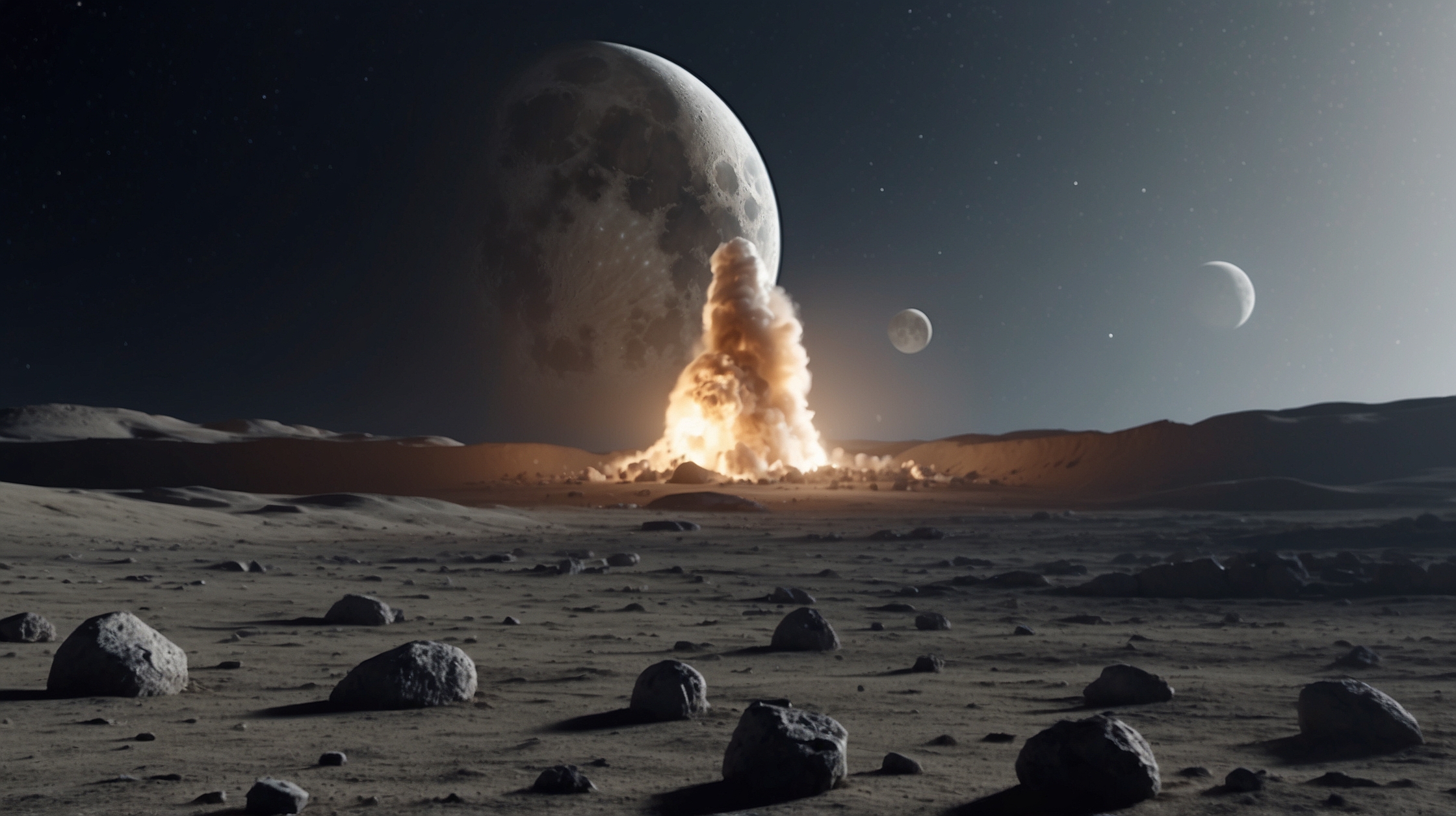
The night skies on December 14 and 15 offered something far more unusual than the typical meteor shower or shooting star. As amateur astronomers and observatories alike turned their attention to the peak activity of the Geminid meteor shower, something extraordinary occurred on the surface of the Moon: not one, but three distinct impacts were captured within the span of just 45 minutes. These rare and closely timed lunar collisions have sparked widespread excitement and curiosity across the scientific community and among stargazers worldwide.
It’s not every day that space rocks collide with the Moon while we watch. However, thanks to the clear skies and the Moon being in near-perfect viewing conditions, these high-energy impacts were not only observed but also recorded live during a public livestream. This rare celestial event offers scientists a rare opportunity to analyze, evaluate, and understand the dynamics of lunar impacts with greater clarity than ever before.
The timing of these luminous bursts—each resulting from a meteoroid crashing into the lunar surface—coincided with the most active period of the Geminid meteor shower, an annual event known for its slow-moving and bright meteors. But what truly stunned space enthusiasts was the fact that all three flashes happened within less than an hour, bringing into focus the volume and velocity of cosmic debris hurtling through our solar system.
Let’s dive into what happened, what it means for lunar science, and what these impacts can reveal about the hidden dangers and mysteries of space.
Quick facts about the December lunar impact events
| Date | Night of December 14–15, 2023 |
| Number of impacts | Three detected in under 45 minutes |
| Observed during | Geminid meteor shower |
| Observation method | Live telescope livestream with video recording |
| Impact cause | Small meteoroids colliding with lunar surface |
| Scientific significance | Rare opportunity for real-time observation and data collection |
| Astronomical impact | Better modeling of lunar cratering and meteoroid density |
Why these lunar impacts are so rare and important
The Moon is constantly being pelted by meteoroids of all sizes, but the vast majority are too small or faint to be seen from Earth. The fact that three visible impact flashes occurred and were caught on video is an exceptional event. These observations are key in helping scientists understand not just the Moon’s environment but also how often such impacts occur and with what force.
Each of these flashes lasted just a fraction of a second but were bright enough to be seen from hundreds of thousands of kilometers away—a compelling display of kinetic energy. The impacts generate a brief light because of the intense heat released when a high-speed meteoroid smashes into the lunar surface, creating a new crater and vaporizing the rock instantly.
Capturing three lunar impacts in one night is rare, especially during a public broadcast. It’s a golden opportunity for lunar research.
— Dr. Ana López, Planetary Geologist
The role of the Geminid meteor shower
The Geminids are one of the most consistent and active meteor showers, and their timing may explain this sudden barrage of impacts on the Moon. Composed mainly of debris from asteroid 3200 Phaethon, the Geminids produce dense streams of particles that Earth—and the Moon—pass through annually in mid-December.
While Earth burns up these particles in its atmosphere, the Moon, which lacks any significant atmosphere, is entirely exposed. As a result, even small fragments that would be harmless shooting stars on Earth strike the Moon with full force. The alignment of the Geminid stream this year enhanced the chance of visible impacts.
This kind of natural bombardment during meteor showers reminds us how vast and dynamic our solar system is.
— Prof. Kenji Morimoto, Astrophysicist
How these flashes were captured on camera
The impacts were recorded using a high-definition telescope as part of a livestream event intended to showcase the Geminid shower. What was meant to be a routine stargazing broadcast quickly turned into an unexpected scientific opportunity. Viewers and researchers were treated to sudden, bright flashes on the lunar surface—close to the Moon’s terminator, the line that separates day and night, where lighting conditions enhance visibility of changes in the landscape.
The use of sophisticated imaging and real-time recording made it possible to not only detect the impacts but also to timestamp and geo-locate them precisely on the lunar surface. Data from the video is now being analyzed to determine the mass, speed, and origin of the meteoroids.
Scientific opportunities created by the impacts
Each lunar impact recorded on video is more than a flash—it’s a datapoint that could help us understand the dynamics of moon-based meteor cratering. Detailed analysis will also provide insight into the types of particles in the Geminid stream, their density, and trajectories.
This information may feed into several lines of research, including lunar geology, impact modeling, and space safety assessments. By measuring the light intensity, scientists can estimate the energy released during each collision and hypothesize the size and composition of the impacting body.
Real-time lunar impacts show us how active our nearby space environment truly is, even if we don’t always see it.
— Dr. Isabelle Treviño, Space Debris Analyst
Why this matters for future lunar missions
With increasing global interest in returning humans to the Moon, including the Artemis missions and numerous private sector initiatives, understanding the frequency and locations of potential impacts is more crucial than ever. Vehicle designs, habitats, and even astronaut walking routes may one day need to account for micrometeoroid risk, particularly during known meteor showers.
This latest event serves as a timely reminder that the Moon is not a static or dormant world. It is a body in constant interaction with space debris, which adds an important dynamic risk consideration for future surface operations.
What remains to be analyzed
While the observed flashes give a clear indication of impacts, much more analysis is needed. Astronomers will have to study residual lunar temperature readings, examine high-resolution images taken afterward for new craters, and cross-reference orbital debris models. These efforts could reveal whether the impacts originated solely from the Geminids or from unrelated meteoroids passing through that same region of space.
This gives us the chance to calibrate our impact models with real-world data. It’s a rare gift from the cosmos.
— Dr. Eliot Granger, Lunar Observatory Director
FAQs about the December 2023 lunar impacts
How often do visible lunar impacts happen?
While the Moon is hit frequently by small meteoroids, visible flashes like the ones seen in December are rare and usually require perfect conditions to observe.
Were these impacts dangerous to Earth?
No. The impacts occurred on the Moon’s surface and posed no direct threat to Earth or its satellites.
Could future astronauts be affected by such impacts?
Yes, especially during meteor showers. Space agencies factor this into the design of habitats and missions.
What causes the flash when a meteoroid hits the Moon?
The flash is caused by the kinetic energy of the meteoroid converting into heat and light upon impact with the Moon’s surface.
Can anyone see a lunar impact with a telescope?
Yes, although it requires timing, luck, and usually high-end equipment to capture one in real-time.
How does this help lunar science?
Observed impacts provide valuable data that help refine models of lunar impacts, surface composition, and meteoroid behavior.
Were these part of the Geminid meteor shower?
It is highly likely due to the timing and density of meteoroid activity during the Geminids.
Will researchers study the new craters formed?
Yes, high-resolution imaging from lunar orbiters may be able to identify and analyze the new craters.