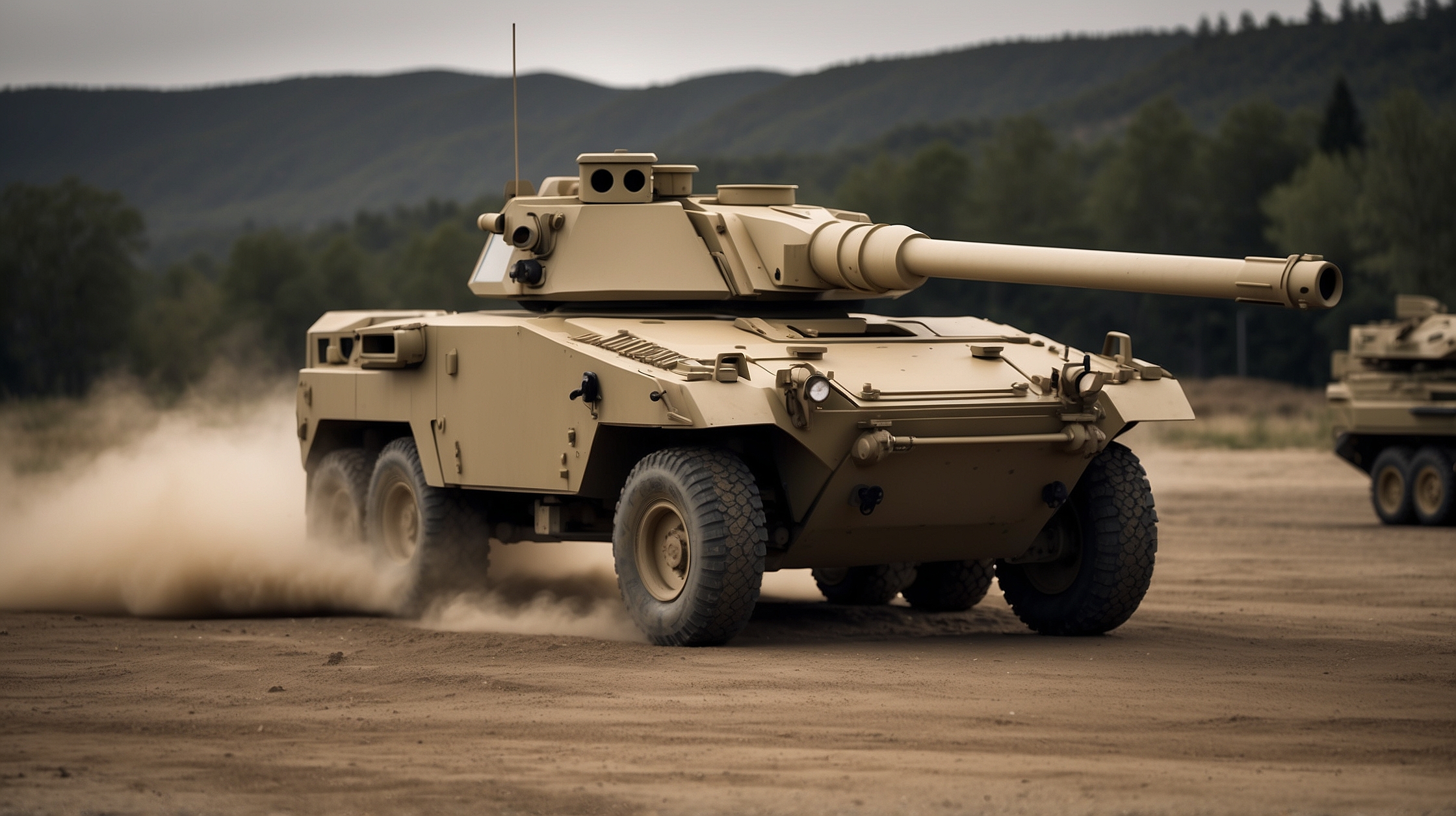
In the ever-evolving landscape of modern warfare, the U.S. Army finds itself in constant pursuit of technological innovations that promise increased firepower, mobility, and versatility. As battlefield threats diversify—from heavily armored vehicles to nimble aerial drones—there’s growing demand for weapons that can adapt in real time. Enter the XM913, a cutting-edge 50mm cannon system currently undergoing rigorous testing that may soon become a game changer for American armored forces.
The United States Army, known for its forward-leaning approach to military innovation, has launched testing for its new **50mm chain gun**, designed to replace or complement existing turret systems on combat vehicles. Early reports suggest that this powerful weapon could reshape the lethality and adaptability of platforms like the Stryker or the Optionally Manned Fighting Vehicle (OMFV). Behind its development lies a strategic vision to equip U.S. vehicles with a **hard-hitting, longer-range, and multi-functional** armament capable of engaging both ground and air threats effectively.
This story traces the trajectory of the XM913’s development, what it could mean for future military engagements, and how it fits into the larger shift toward **next-generation combat solutions**. For soldiers on the ground and policymakers in Washington alike, the success of this new gun may redefine tactical planning and battlefield supremacy in the years ahead.
At a glance: What the 50mm XM913 cannon brings to the table
| Feature | Description |
|---|---|
| Weapon Name | XM913 50mm Chain Gun |
| Caliber | 50mm |
| Developer | Northrop Grumman |
| Intended Platforms | OMFV (Optionally Manned Fighting Vehicle), Stryker variants |
| Primary Purpose | Engage armored vehicles, drones, low-flying aircraft |
| Rate of Fire | 200 rpm (rounds per minute) |
| Range | Twice the range of standard 30mm cannons |
| Current Stage | Live-fire testing |
What makes the new 50mm cannon different
The XM913 stands apart from its predecessors primarily in **firepower, range, and multi-role application**. At 50mm, the cannon introduces significantly more kinetic energy than the widely used 30mm M230 chain guns. The increase in caliber allows for greater target penetration, making it particularly effective against **light to medium armored vehicles** and improving soldier survivability on the battlefield.
In terms of design, the system draws from the well-proven Bushmaster family but **incorporates advanced materials and recoil reduction systems** to manage the cannon’s increased force. The XM913 is capable of **firing programmable airburst rounds**, allowing it to detonate projectiles in mid-air—a major advantage when facing drone swarms or infantry behind cover.
As autonomous systems become integral to modern conflicts, the weapon’s ability to interface with advanced **fire-control and targeting systems** means engagements can be conducted with higher precision from greater distances. The flexibility to integrate with both manned and unmanned platforms makes the XM913 future-forward and scalable.
Why the U.S. Army needs greater firepower now
The development of new military technologies rarely occurs in a vacuum. Rising tensions across Eastern Europe, challenges in the Indo-Pacific, and an increasing prevalence of peer and near-peer adversaries have all driven the Pentagon’s demand for more dynamic combat capabilities.
Today’s battlefield increasingly features a mix of agile unmanned systems, entrenched infantry forces, and light armored vehicles that can evade traditional tank shells or close-range small arms fire. It’s a complex matrix of threats that requires **versatile weaponry**—something lighter systems like the 30mm may no longer adequately address.
“We’re adapting to deal with faster, smarter adversaries who use a blend of manned and unmanned threats. The XM913 enhances our ability to meet that challenge head-on.”
— Lt. Gen. Edward Mason, U.S. Army Futures Command (Placeholder Quote)
The Army also aims to streamline logistics. Deploying one multi-capable weapon that reduces the need for specialized anti-drone or anti-infantry weapons could significantly simplify battlefield operations. Fewer systems to transport, maintain, or train troops on can tilt the logistical balance in favor of operational efficiency.
Integration with future combat vehicles
The XM913 is not being developed in isolation—it is part of a broader shift toward the Army’s **Next Generation Combat Vehicle (NGCV)** program. One of its primary intended hosts, the Optionally Manned Fighting Vehicle (OMFV), will serve as the replacement for the aging Bradley Fighting Vehicle.
Stryker units, already known for their mobility and fast deployment capabilities, may also receive retrofits to accommodate the heavier 50mm system with appropriate stabilization, sensors, and fire-control software. This ensures more frontline units can benefit from what the Army calls **”overmatch capabilities”**—a term describing not just superiority, but dominance in firepower.
The integration goes beyond simply mounting the cannon; it involves constructing an entire **smart weapons ecosystem**, where the vehicle, weapon, sensors, and crew work in concert. This synergy is foundational to future battlefield success, particularly with increasing emphasis on **multi-domain operations (MDO)**—where land, air, sea, cyber, and space resources must all coordinate effectively.
Testing and evaluation milestones
The XM913 is currently in its **live-fire testing phase**, during which the Army will evaluate its performance under varied environmental, logistical, and operational scenarios. Engineers and test personnel are closely monitoring aspects such as barrel durability, recoil control mechanisms, and fire accuracy during standard and stress conditions.
These evaluations are also meant to determine the barrel life under sustained fire conditions and how effectively the weapon can handle **high-explosive airburst shells**, a key capability in countering drones and infiltrated enemies behind fortifications.
“Early test results are promising, showing significant accuracy and stability improvements thanks to recoil optimization and advanced optics.”
— Dr. Melissa Rae, Lead Weapons Systems Engineer (Placeholder Quote)
What military experts are saying
Experts indicate that the XM913 could signal the beginning of a **new era of medium-caliber firepower**. Although 50mm rounds are logistically more demanding than smaller calibers, the benefits can outweigh the drawbacks when integrated as part of a modern combat network.
“Fifty-millimeter systems bridge the gap between small arms and heavy artillery. It’s a sweet spot—mobile, scalable, and precise.”
— Col. James Carter, US Army (Ret.) and Defense Consultant
Moreover, defense analysts predict that other NATO allies may show interest in adopting similar systems for their armored fleets, expanding interoperability and reinforcing collective defense postures.
Winners and losers of the new weapons rollout
| Winners | Losers |
|---|---|
| U.S. Army front-line units | Legacy turret systems like 25mm and 30mm cannons |
| Defense contractors with 50mm supply chains | Enemies relying on drone swarms or light armor |
| Military strategists focused on multi-domain capability | Forces unprepared for high precision mid-range threats |
Frequently Asked Questions
What is the XM913 50mm cannon?
The XM913 is a medium-caliber chain gun developed by Northrop Grumman for the U.S. Army. It is designed to replace or supplement existing turret systems on combat platforms like the OMFV and Stryker by providing extended range and programmable ammunition.
Which vehicles will use the new cannon?
The primary platforms under consideration include the Optionally Manned Fighting Vehicle (OMFV) and potentially upgraded Stryker vehicles.
How far can the XM913 fire compared to older systems?
The XM913 doubles the effective range compared to standard 30mm systems, improving distance engagement capabilities.
Is it effective against drones?
Yes, especially with the use of airburst programmable rounds that can detonate near airborne threats to neutralize them effectively.
When will the XM913 enter full service?
While specific deployment timelines have not been confirmed, the XM913 is currently in the live-testing phase. Operational availability is expected within a few years pending successful evaluations.
What type of ammunition does it use?
The system uses a variety of 50mm rounds, including high-explosive and programmable airburst shells for versatile target engagement.
Is the cannon automated or manually fired?
The XM913 is designed to work with advanced targeting and fire-control systems, offering options for both semi-automated and manual firing configurations.
Why is the Army moving away from smaller caliber weaponry?
Smaller caliber systems face limitations against emerging threats like drone swarms and enhanced armor. The 50mm XM913 provides greater versatility and lethality required for future conflicts.