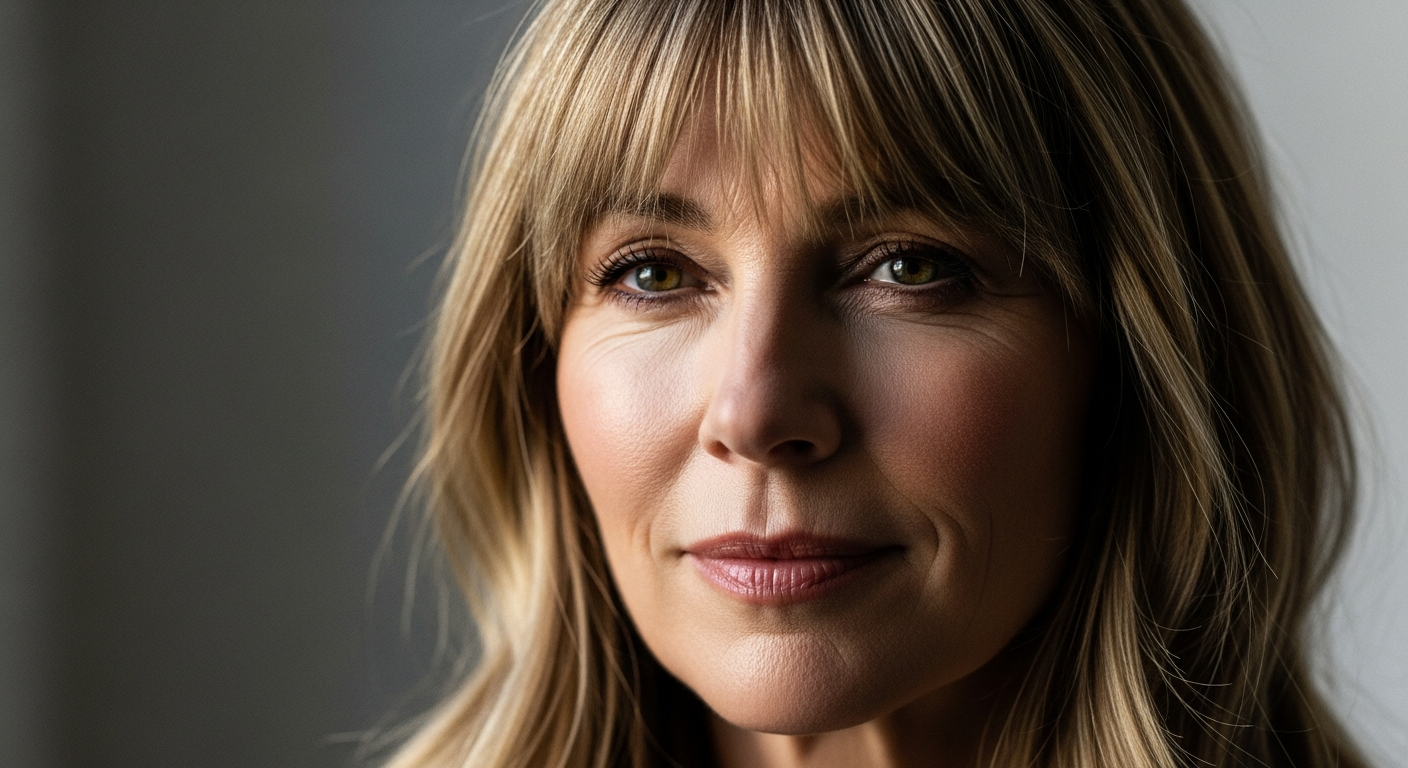
The search for effortless beauty becomes more intentional with age. For many women over 50, looking refreshed without resorting to expensive or invasive cosmetic procedures can be a challenge. But sometimes, the simplest changes make the most profound impact. One of those changes? A pair of well-styled bangs. Not a bold cut, not Botox—just bangs, styled at the right density, length, and shape for your face. It’s no surprise that beauty insiders are now calling bangs the ultimate “non-surgical facelift” for mature women.
Lisa, a 57-year-old marketing executive, had begun to feel her face look “tired around the eyes and jawline.” Despite a good skincare routine, age naturally softened the firmness of her features. On a whim, she asked her stylist to add fringe during a routine haircut. The change was instant. “I looked like myself again—just more awake, more open, more ‘me’,” she said. And it’s not just Lisa. Stylists across the country report an uptick in women over 50 requesting bangs tailored to subtly lift their appearance.
But before you grab the scissors or book a salon visit, there’s a lot to understand about how this understated style trick works—and why it only works when done correctly. From the psychology to the science of face framing, let’s delve into why bangs have become an anti-aging secret weapon—and how to get it right.
Key insights about bangs and non-surgical rejuvenation for women over 50
| Topic | Details |
| Benefit | Creates a lifted, youthful appearance without surgery |
| Who it’s for | Primarily women 50+, but suitable for any age depending on face shape |
| Best type | Soft wispy bangs or feathered curtain bangs, depending on hair texture |
| Density importance | Correct density frames the face subtly without overpowering features |
| Styling frequency | Maintenance needed every 3–5 weeks |
| Investment | Low-cost alternative to cosmetic treatments |
Why bangs create an instant facelift effect
Bangs function like a beauty filter in real life. By covering or softening the forehead and framing the eyes, they draw attention upwards and mask lines or uneven skin texture. The illusion is powerful: strategic fringe placement visually shortens longer faces, lifts drooping brows, and minimizes signs of aging around the eyes.
The psychological impact is significant too. “When you hide your forehead even slightly and emphasize your eyes, everything looks more awake and cleaner,” notes celebrity stylist Marci Cortez. “It tricks the eye into thinking, ‘This person looks well-rested.’”
“Bangs can lift the face and bring youthful energy when cut with precision for maturity.”
— Elena Rowe, Senior Stylist & Hair Educator
This effect, however, is not automatic. Too thick or blunt, and bangs can overwhelm the face. Too sparse or uneven, and they may look unpolished. Like makeup, a bang hairstyle should enhance—not hide or distract.
What changed in the beauty world this year
In the past, bangs were seen as something for the young—teens, pop stars, or models. But this year, we’ve seen a dramatic shift. More women over fifty are embracing midlife fashion as a gateway to self-expression rather than limitation. That’s partly due to increased visibility: icons like Andie MacDowell, Diane Keaton, and Helen Mirren showing up with modern, chic bangs that radiate confidence without erasing maturity.
The rise of “soft glam” aesthetics on social platforms also nudged fringe hairstyles into mainstream conversation. The goal is no longer to look younger, but to look vibrant and elegant at any age. Bangs, when used correctly, align perfectly with that mission.
How to choose the right density and length for your face
Density is perhaps the single most important factor in making bangs flattering. For women with finer hair, overly thick bangs can look choppy or wig-like, especially on shorter foreheads. Thin bangs, on the other hand, may separate easily and lack shape.
Experts recommend starting with a light-to-medium density and adjusting gradually. The cut should follow the natural weight of your hair and allow some forehead to peek through if desired.
Here are popular styles depending on your facial features:
- Feathered curtain bangs – Best for oval and round faces
- Sweeping side bangs – Complements heart-shaped faces
- Wispy blunt bangs – Soften deep-set eyes and long foreheads
- Micro fringe (with texture) – Best for bold, angular features
Consultation is key. A seasoned hairstylist will assess hair type, growth patterns, and facial asymmetry before recommending a fringe style. This is not the time for DIY attempts unless you’re highly confident with scissors.
“I typically recommend a low-density feathered bang to begin with and evolve into layers if needed.”
— Janice Ma, Hair Architect and Salon Owner
Winners and losers: who benefits most
| Winners | Losers |
| Women aged 50+ with forehead lines or facial drooping | Very curly or coarse hair types that resist shaping |
| Anyone seeking a youthful but natural style refresh | People uncomfortable with regular styling maintenance |
| Women with long, oval, or square face shapes | Ultra short haircuts where bangs can’t be integrated |
Regular maintenance makes the look work long-term
Unlike filler treatments or lifting serums, the beauty of bangs lies in their adaptability. However, you do have to maintain them. Most women will need trims every 3 to 5 weeks to keep them from growing into the eyes or losing shape. Many salons offer quick bang trims at discounted prices or even for free between cuts.
Additionally, styling matters. A simple blow-dry with a round brush can set bangs into place without extra heat tools. For those with stubborn hair or humidity-prone regions, a light texturizing spray or smoothing balm helps maintain the look throughout the day without stiffness.
How to communicate your vision to a stylist
Bring photos illustrating the type of bangs you like. Make sure they resemble your own hair type and face shape. Show at least 2 or 3 variations to help stylists tailor the idea rather than copy it outright.
Use words that describe both softness (“feathered,” “wispy,” “side-swept”) and intent (“face-framing,” “eye-emphasizing”). Don’t just say “bangs”—say what you want them to accomplish: “I’d love something that opens up my eyes,” or “I want to soften my forehead lines without losing volume.”
FAQs: Understanding the fringe benefit at any age
Can bangs really make someone look younger?
Yes. By drawing attention to the eyes and upper face, bangs create a lifting illusion that can make mature faces appear more alert and youthful.
What kind of bangs are best for thin hair?
Light, wispy bangs or curtain bangs work well for thin hair. They require less density, maintain movement, and blend easily with natural volume.
Will bangs suit all face shapes?
Most face shapes can benefit from bangs, but the style and length must be tailored. Square and long faces often benefit most from soft, sweeping styles.
How do I style bangs daily?
Use a round brush and blow-dryer to guide the shape. A light styling cream or texturizer can help keep bangs from separating or flattening.
Do bangs work with glasses?
Absolutely. Longer curtain bangs or side bangs often work well with eyewear by blending symmetrically along the temples.
What should I tell my stylist for an age-friendly bang cut?
Say you want soft, face-framing layers that lift your features, balance proportions, and highlight the eyes without looking heavy or blocky.
How often should I trim bangs?
Ideally every 3–5 weeks to maintain shape and visibility. Most salons offer quick bang trims at minimal cost.
Can I try bangs without a dramatic haircut?
Yes. Clip-in bangs or minor shaping around the front hairline can provide a preview effect before committing to a full fringe.