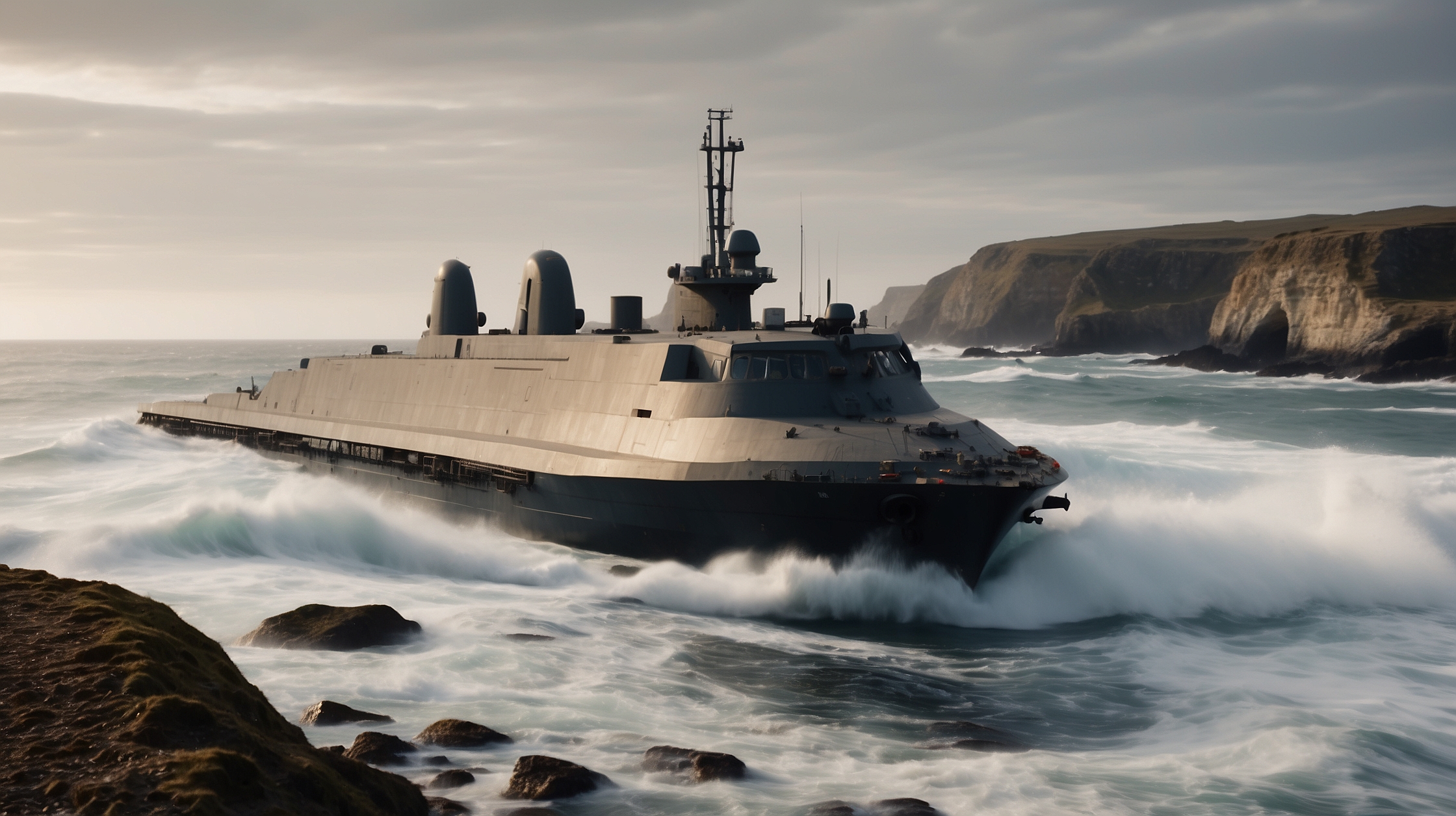
The dark waters of the English Channel, once a fierce battleground during the world wars, now represent a different kind of strategic frontier. Beneath their grey surface lies one of the world’s most highly trafficked maritime passageways—an invisible chessboard where NATO allies and adversarial powers continue to maneuver in complex, silent ways. In this geopolitical theatre of the oceans, a quiet but highly advanced revolution is unfolding. The United Kingdom, grappling with evolving threats in undersea warfare, found itself at a crossroads in maintaining its dominance in mine countermeasures (MCM). When a strategic void started forming, it was France who stepped forward, leveraging its technological edge and naval cooperation under the banner of European alliance and shared security.
This unexpected collaboration is not just about two nations working together. It illustrates the shifting dynamics of modern military readiness—where artificial intelligence (AI), robotics, and swift program execution are no longer optional, but absolute imperatives. In a surprise move likely to shape NATO’s undersea capabilities for a generation to come, France is now helping Britain develop the very tools it needs to detect and neutralize sea mines—a form of silent threat that’s cost nations billions in the past and could prove catastrophic in strategic chokepoints.
At the heart of this story lies a fast-evolving AI-powered system, advanced enough to detect and mitigate naval mines remotely, sparing lives, increasing speed, and strengthening maritime sovereignty. But how did France become Britain’s key partner on this front, and what does it mean for Europe’s collective security strategy? Let’s dive deeper.
Understanding the Anglo-French partnership in minehunting AI
| Project Name | Maritime Mine Counter Measures (MMCM) Programme |
| Core Technology | Artificial Intelligence, Robotics, Remote operation |
| Lead Contractors | Thales Group (France), BAE Systems (UK) |
| System Capability | Autonomous undersea and surface vehicles for mine detection and neutralization |
| Operational Role | Replaces aging Royal Navy minehunter fleets |
| Deployment Timeline | Initial operational capability achieved in 2022 |
What forced Britain to seek rapid assistance
Modern warfare doesn’t wait for slow procurement cycles—and this truth hit hard when Britain realized that its aging fleet of minehunters could no longer keep pace with evolving threats. The Royal Navy had planned to phase out its Sandown-class and Hunt-class vessels, yet their replacements weren’t immediately available. Faced with a critical operational gap, the UK turned to a solution already in testing: an AI-powered remote minehunting system developed jointly with France under the Maritime Mine Counter Measures (MMCM) program.
Instead of waiting for domestic shipbuilding to catch up, the UK opted to adopt a French-configured system as a stopgap—essentially fast-tracking years of procurement through cooperation. The decision illustrated not only operational urgency but also a pragmatic recognition: France’s investment in dual-use AI technology had put it ahead in a niche that had once been dominated by the British Navy.
“We are facing a new generation of undersea threats which are agile, stealthy, and intelligent. Our systems must be smarter still.”
— Rear Admiral Philip Hally, Royal Navy Assistant Chief of Naval Staff
What the new minehunting AI systems actually do
The core of the MMCM system consists of drone-like unmanned surface vessels (USVs) and autonomous underwater vehicles (AUVs), all interconnected through a sophisticated network powered by artificial intelligence. Once deployed, these systems can locate, identify, and neutralize sea mines without requiring a single human diver to enter harm’s way.
The technology also includes a portable command center, allowing the system to function from shore bases, support vessels or motherships—adding critical flexibility. Once deployed, AI algorithms process sonar data autonomously, identify potential threats, and can then either pass on confirmation for human review or trigger neutralization protocols. The aim is faster detection speed, enhanced accuracy, and significantly lower risk to human crews.
“This is not just a step forward in automation—it’s a leap toward intelligent naval sovereignty.”
— Catherine Mercier, Naval Systems Analyst (placeholder)
How France led the design and development timeline
France’s defense sector has historically placed emphasis on dual-use AI applications, with Thales Group—one of its industrial giants—taking the lead in naval systems innovation. Through Thales, France had taken early steps in developing AI-driven MCM tools, giving it a head start when the French and UK governments decided to collaborate. The MMCM project was awarded back in 2015, and after multiple phases of testing, France reached initial operational capability by 2022 with more consistent deployment than the UK side.
Critically, while both nations shared technical know-how, France’s configuration reached deployment faster, due in large part to a streamlined military-industrial pipeline and stronger integration with its naval doctrine. This allowed the UK to essentially “borrow” time and capacity by purchasing French-conditioned units, bringing the Royal Navy’s capabilities closer to parity and avoiding critical gaps.
The strategic implications for Europe and NATO
The Anglo-French minehunters don’t just represent a technological upgrade—they’re part of a symbolic and material shift in NATO’s capacity for undersea warfare. Routes like the English Channel and the Baltic Sea are crucial not only for merchant shipping but also for submarine movements, troop deployments, and deterrent postures. Any operational delay in securing these waters could be exploited by adversaries.
Moreover, interoperability between France and the UK supports broader NATO goals. As both nations now deploy similar unmanned systems, they can share operational data, participate in joint exercises, and scale procurement more effectively. The MMCM platform thus becomes not only a defense tool but a vehicle for alliance resilience and tactical unity in Europe’s waters.
Who gains and who faces challenges
| Winners | Losers |
|---|---|
| Royal Navy (faster capability deployment) | Traditional minehunter shipbuilders |
| Thales Group (market expansion and validation) | Naval personnel in traditional roles (due to crew downsizing) |
| NATO (enhanced joint operational capability) | Countries with aging, non-digital minehunting fleets |
What changed this year that accelerated collaboration
Prior to 2023, the MMCM program had been moving at a standard joint-development pace. But geopolitical pressures following the war in Ukraine, combined with ongoing tensions in the South China Sea and Eastern Mediterranean, have turned maritime readiness into a key priority. NATO command has strongly advocated for modernizations in naval tech—and Britain responded by opting to operationalize the MMCM units faster through French-manufactured versions.
This move was also facilitated by recent bilateral defense agreements between France and the UK designed to increase military interoperability. In essence, 2024 became the moment when quiet cooperative design turned into urgent field deployment.
Why this benchmark matters for global navies
The entry into operational service of AI-powered mine countermeasure systems is more than just a modernization decision. It’s a signal that traditional naval strategies—relying on large vessels, manned crews, and hierarchical command flow—are giving way to distributed, autonomous, and data-driven operations. This will set a precedent for Australia, Japan, the United States and beyond, all of whom face maritime threats where mine-laying remains a viable tactic.
In a post-AUKUS naval landscape, such European-led initiatives provide a counterbalance to Pacific-focused procurement, ensuring that European waters and trade routes remain secure using homegrown solutions. As France and the UK move toward full integration of the MMCM platforms, naval warfare may never look the same again.
Frequently Asked Questions
What does the MMCM system actually do?
It uses autonomous surface and underwater drones to detect, identify, and neutralize underwater mines, guided by AI algorithms for high-speed efficiency and safety.
Why is minehunting still relevant in today’s navy?
Sea mines are low-cost, high-impact threats that can cripple shipping lanes, ports, and military operations, so effective mine countermeasures remain vital for any naval power.
Who developed the MMCM system?
The system was jointly developed by Thales (France) and BAE Systems (UK), as part of a larger Anglo-French defense collaboration.
Why didn’t the UK build its own system faster?
Delays in procurement and legacy ship replacement programs made it more practical for the UK to procure already-functional systems from the French configuration.
Will other countries in NATO adopt this technology?
Potentially yes. Its modularity and operational efficiency make it attractive for other allies dealing with aging mine countermeasure fleets.
Can these AI systems operate without human oversight?
They are semi-autonomous. Operators provide mission parameters and oversee critical decisions, but many detection and tracking processes are AI-driven.
How soon will the MMCM system be fully integrated in the Royal Navy?
Initial deployments have begun, and full operational integration is expected over the next 2–3 years.
Does this mean traditional minehunting ships are obsolete?
Not entirely, but there is a clear shift toward unmanned and remote systems as the future standard for mine warfare operations.