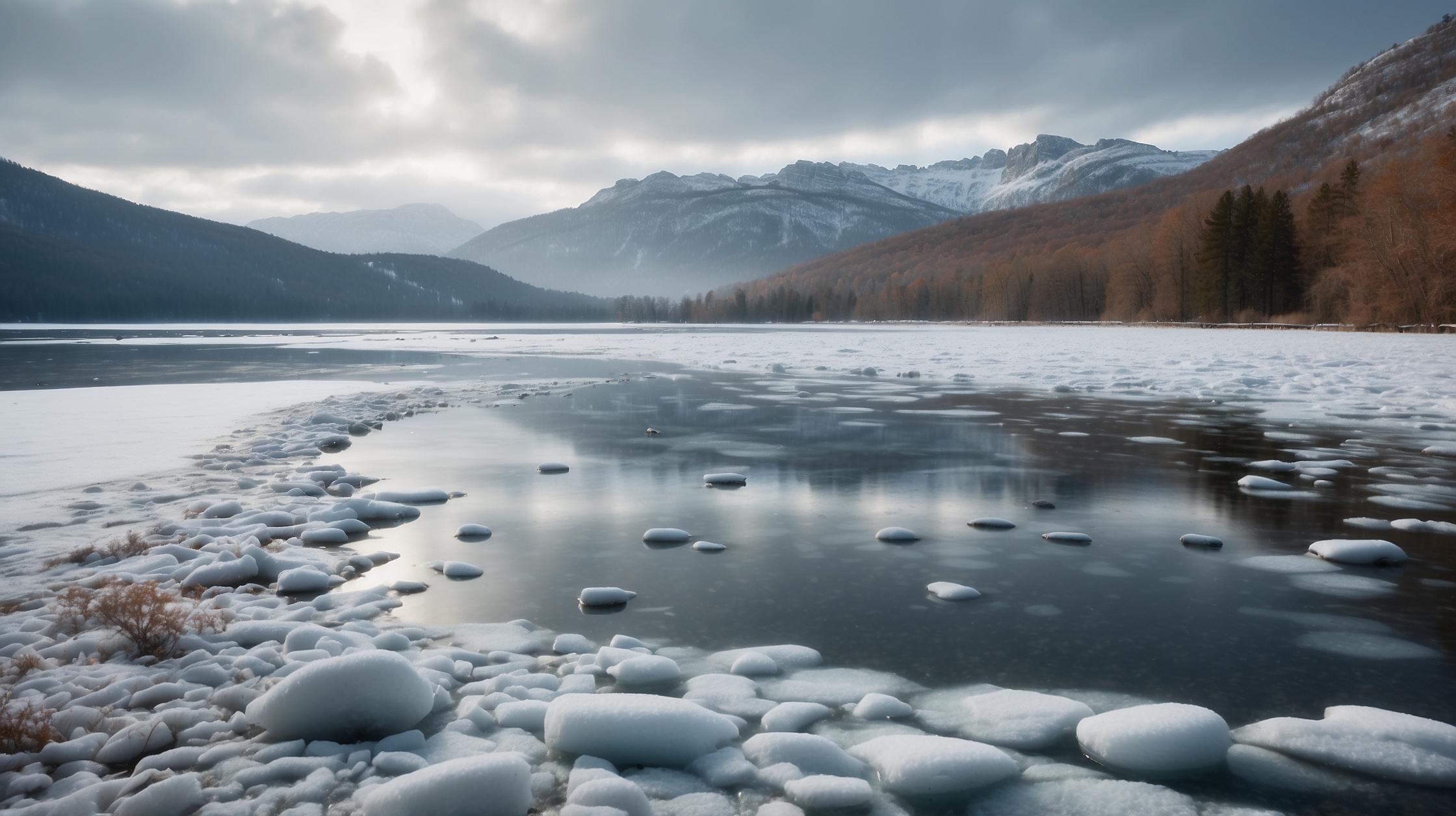
On a crisp winter afternoon in Créteil, a peculiar natural phenomenon caught the attention of local residents and passersby: **Lake Créteil**, a serene urban lake located just outside Paris, had partially frozen — but not in the way most would expect. A perfect ring of ice rimmed the lake’s edges while its center remained conspicuously unfrozen, drawing astonishment and questions in equal measure. In a region where winter chills can freeze even the most stubborn surfaces, this scene looked like nature’s own optical illusion.
Social media buzzed with snapshots and speculation. Was it an underground spring? A sudden change in temperature? Perhaps urban pollution or even a glitch in environmental engineering? As the sun softened the chilled air and children skated cautiously along the frozen banks, scientists and curious minds alike sought to uncover the reason behind this captivating display. The answer, it turns out, touches on **physics, urban geography**, and the quiet but profound changes happening beneath the surface.
This anomaly at Lake Créteil isn’t just a one-day curiosity — it’s a window into **how microclimates and water dynamics** are evolving in urban settings. Understanding the interplay of environmental factors here doesn’t just solve a riddle; it opens a broader conversation about **climate patterns**, infrastructural influences, and nature’s subtle balancing acts.
Why Lake Créteil froze around the edges but not in the center
| Location | Lake Créteil, Val-de-Marne, France |
| Date Observed | January 17, 2024 |
| Phenomenon | Edges of lake frozen while the center remained thawed |
| Possible Causes | Water current, depth, urban heat effect, delayed thermal loss |
| Scientific Explanation | Thermodynamics and internal water mixing slow freezing at depth |
What makes Lake Créteil different from other lakes in winter
While many lakes in the surrounding region swiftly ice over during extended cold spells, **Lake Créteil defies simple expectations**. The lake, an artificial body of water developed from a former quarry site, is deeper than average and surrounded by high-density urban development. This combination of **depth and urban heat retention** plays a critical role in how the lake behaves under freezing conditions.
The shape of the lake basin and its interaction with inflowing underground springs or thermal pathways can also influence **water stratification** — the natural layering of water temperatures. Lower layers often stay warmer because they retain heat absorbed during warmer months. As the cold air hits, surface layers freeze first — particularly near the edges where depth is shallow and loss of heat is rapid.
The role of thermal inertia and water mixing
Thermal inertia, or the resistance of a body to temperature change, plays a big part in this event. **Large bodies of water don’t cool instantly**; they gently release heat over time. The shallow edges of Lake Créteil are quick to surrender their residual warmth and freeze, while the deeper center retains its temperature longer.
Add to this the possibility of **internal water currents or subtle wind-driven movement**, and it becomes even clearer why the lake’s center resists freezing. Even slight water movement can inhibit ice formation. Think of it like constantly stirring a cup of water in a freezer — it takes longer to freeze than if left still.
It’s a textbook example of urban thermodynamics at work. Lakes like Créteil hold surprises in winter due to their variable depths and anthropogenic surroundings.
— Dr. Luc Monnier, Hydrologist and Environmental Physicist
Why urban lakes are vulnerable to subtle climate shifts
As cities grow, so too does the number of artificial or modified natural lakes. These lakes, while valuable for recreation and urban cooling, often operate under delicate **microclimatic conditions**. The concrete infrastructure, reduced tree cover, and proximity to heat-retaining buildings mean that urban lakes experience miniature interplays of **heat islands and cooling flows**.
In Lake Créteil’s case, even the sidewalks and park benches surrounding the lake may contribute to delayed cooling at its core. Combined with climate data showing milder winters and increased atmospheric instability, this phenomenon may become **more frequent**, reminding us of the broader transformations cities are undergoing.
What residents observed and how they reacted
To local residents, the sight was described as “half-dream, half-science fiction.” Children made cautious forays onto the frozen fringes, while their parents watched with wonder. Several morning joggers reported visible steam hovering over the lake’s center while frost sparkled along the banks. The contrast was stark enough that one local poetry club reportedly gathered for a spontaneous reading inspired by the icy divide.
I’ve walked this lake path for twenty years, and I’ve never seen anything like this. It felt like the lake was breathing — cold breath at the edges, warmth in the heart.
— Gérard Dufresne, Créteil Resident since 1992
A deeper understanding could help with future climate adaptation
This unexpected divide on a suburban lakefront is more than a marvel — it’s a **lesson in nuanced climate observation**. Monitoring how local water bodies behave in such instances can provide **valuable data** for broader climate models. It also shows that even small changes in environment — like sunlight angle, wind direction, or heat reflection — can have large visual impacts.
For urban planners and climate scientists, such events underscore the need for **adaptive landscape design**, where water health, atmospheric behavior, and ecological balance are considered together. Could constructing shaded areas, strategic aerators, or controlled flows prevent abrupt ice behaviors in similar lakes? These are now active research questions.
Winners and losers from this rare phenomenon
| Winners | Losers |
|---|---|
| Local photographers and artists inspired by the unique sight | Amateur skaters unable to access the full ice surface safely |
| Environment scientists using the lake as a cold-weather case study | Wildlife confused by inconsistent freezing patterns |
| Students and educators using the scene as a physics teaching moment | Emergency services concerned about partial ice safety for public |
FAQs about the Lake Créteil ice phenomenon
Why did the lake freeze only at the edges?
The lake froze at the edges because those areas are shallower and lose heat more quickly. The deeper center retains warmth longer and resists freezing.
Is this a common occurrence in other lakes?
It can happen, especially in deeper lakes or those influenced by urban heat or water currents. However, it is relatively rare to see it so clearly pronounced.
Was the center of the lake warmer than the edges?
Yes, the center likely maintained a higher temperature due to thermal inertia and internal water mixing, making it resistant to freezing during the cold snap.
Could an underground spring be responsible?
It’s possible but not confirmed. Springs or groundwater inflow can contribute warmer water, preventing ice formation in specific areas.
Is it safe to walk on the ice near the shore?
Safety cannot be guaranteed. While the edges may appear frozen, conditions can change quickly. Authorities typically discourage walking on lakes unless officially deemed safe.
How does urban heat affect lake freezing?
Urban features like roads, buildings, and infrastructure retain and radiate heat, which can slow down the cooling of nearby bodies of water, delaying or preventing ice formation.
Can this pattern reveal climate change effects?
Yes, unusual freezing patterns can hint at broader meteorological shifts. Monitoring these events contributes to local climate assessments.
Will this happen again next winter?
It’s possible, especially if winter conditions mimic those of this year. The combination of depth, weather and environmental factors will determine it.