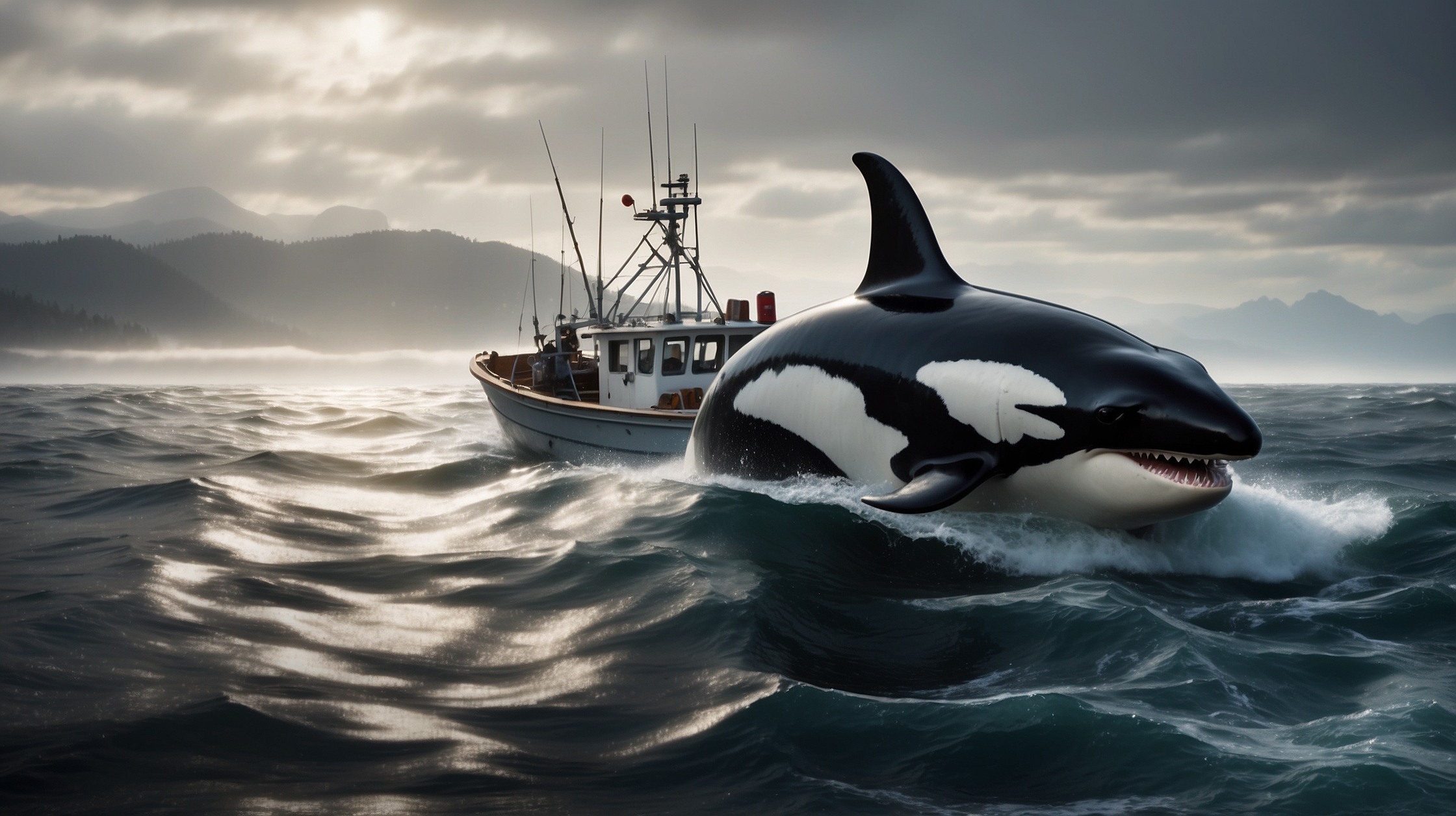
It started as a routine day at sea for a group of experienced fishermen navigating the waters near the Iberian Peninsula—but what unfolded would become one of the most chilling maritime encounters of the year. A pod of orcas trailing their fishing boat had already raised suspicions and stirred a sense of unease aboard. That unease quickly escalated into visceral fear when sharks descended upon the same vessel and bit through its anchor rope with deliberate force. With tensions running high, the crew faced a double threat from two of the ocean’s apex predators—at the same time, in the same place.
Reports of orcas interfering with boats have grown increasingly common in recent years, especially off the coasts of Spain and Portugal. However, this bizarre convergence—where orcas seemed to trigger an aggressive response from sharks—was a maritime first for those who lived it. “It felt like they were communicating somehow, like they were working together,” one crewman recounted. Whether a coincidence or newly understood predator behavior, the event has sent ripples of concern through the marine and fishing communities alike.
Marine biologists are now seriously analyzing the incident to assess behavioral shifts in sea predators. With climate pressures and shifting fish patterns already changing the balance of ocean ecosystems, this unprecedented encounter may signal more than just a freak event. Could this be the start of emerging patterns as old boundaries give way to new alliances—or confrontations—between marine species?
What we know about the shark and orca encounter
| Date of incident | June 2024 |
| Location | Off the Iberian Peninsula, near the Strait of Gibraltar |
| Animals involved | Pod of orcas and multiple sharks (species unconfirmed) |
| Reported activity | Orcas circling boat, sharks biting through anchor rope |
| Significance | First known concurrent threat behavior from both predators toward a vessel |
The fishermen’s account of the events
The unnamed fishing crew had been operating legally off the coast when a group of orcas began to approach their vessel. Described as curious but persistent, the orcas initially swam around the stern, brushing their sides against the hull. While this kind of behavior has been documented before, the fishermen noted a significant shift when the pod grew agitated and began slapping their tails against the water surface forcefully.
It was then, in the midst of navigating the interaction with the orcas, that the fishermen noticed another threat: the movement of sharks beneath the boat. “We could feel the tension in the water. Then came a jolt. Our anchor line had snapped—not worn, but cleanly severed,” one of the men recalled.
Looking into the water revealed that sharks, possibly drawn by the commotion, had not just entered the vicinity but were actively biting at the vessel’s anchor line and gear. This swift and coordinated behavior left the crew convinced that the apex predators were reacting to each other—or to something unfamiliar happening in the environment.
“This wasn’t just a random feeding frenzy. These animals were making decisions, responding to something. That’s the part that has the marine science community on edge.”
— Dr. Elena Vasquez, Marine Biologist
What experts are saying about the predator interaction
For marine ecologists, the incident raises fascinating questions. Orcas are known to be strategic hunters with the ability to pass learned behaviors between pods. However, sharks—while intelligent in their own right—are not typically observed working in tandem with other predators. The observed “handoff” from orca threat to shark aggression has led some researchers to speculate about either opportunistic behavior or a more complex form of interspecies response.
At the intersection of this activity could be shifting prey populations, warming waters, or changes in migratory routes. According to experts, such factors could compress predator territories or lead animals into uncharacteristic behaviors out of survival necessity.
“This kind of interaction is not something we have documented before. It’s too early to say if it’s cooperative, but it’s certainly coordinated in proximity and timing.”
— Dr. Alan Frey, Ocean Behavioral Scientist
Historical context of orca attacks on boats
In recent years, orcas have developed a now well-known pattern: ramming boats, damaging rudders, and in some cases, causing severe enough damage to require tow or rescue. Large pods off Iberia, particularly referred to as the “Gladys” subpopulation of orcas, have been observed targeting sailing vessels, especially catamarans and sailboats, with persistence and accuracy.
The theory behind this pattern ranges from a learned behavior response to perceived threats, to simple play taken to extremes. However, those attacks have never been known to draw in other marine predators—until now.
Could climate change be a contributing factor?
Increasingly warm ocean temperatures and overfishing have pushed fish stocks either deeper into oceanic zones or toward new territorial boundaries, often closer to shorelines or shipping routes. For predators like orcas and sharks, whose hunting zones historically differed, overlapping now could be an unintended consequence of these environmental stressors.
Marine heatwaves in the North Atlantic have already altered the movement of various fish species such as tuna or sardines, magnets for both sharks and whales. This convergence may have placed the fishermen’s vessel squarely between two hungry and geographically displaced predator groups.
Response from maritime authorities
Authorities have issued updated guidelines for vessels operating in the affected zones, warning crews to avoid known whale activity areas if possible and to avoid casting anchor in turbulent or predator-dense waters. New emergency protocols are under evaluation, and there are calls for enhanced sonar detection tools to monitor both species in real time.
“We can’t rule out that this type of event might happen again. Our approach now has to involve technology and training to keep vessels safe.”
— Marta Velasco, Chief Safety Officer, Maritime Spain
Winners and losers in this emerging predatory pattern
| Winners | Losers |
|---|---|
| Marine research community gaining new behavioral data | Commercial fishing industry facing increased safety risks |
| Sonar and vessel tech developers | Local tourism operators with marine-focused voyages |
| Orcas adapting to human-influenced environments | Small-scale boats lacking advanced detection equipment |
What it means for the future of ocean navigation
This incident may tip the balance in maritime safety discussions, shifting focus not just to human accidents, but to ecological threat integrations. The intertwining of inter-predator dynamics with vessel operations signals a new frontier in understanding human interaction with ocean ecosystems.
It’s now more crucial than ever for ships—especially smaller fishing vessels—to have real-time behavioral updates on local marine life movements. For now, the best advice remains: stay vigilant, avoid known wildlife corridors when possible, and always treat the ocean as an unpredictable environment.
Short FAQs about shark and orca encounters at sea
What happens when orcas approach a vessel?
Orcas may swim around the hull, slap tails, or appear curious. In recent years, some pods have been observed deliberately targeting boat rudders.
Are sharks known to attack boats?
While rare, there are cases of sharks biting propellers, rudders, or even anchor lines. Such behavior is usually prompted by stress or stimuli in the water.
Can orcas and sharks work together?
There’s no evidence of coordinated hunting, but proximity coordination during shared events like feeding frenzies may occur.
Is this kind of predator behavior normal?
No, simultaneous shark and orca aggression toward a vessel is extremely rare and likely due to changing habitat pressures or anomalies.
What should boats do in such situations?
Turn off engines when safe, avoid further noise stimuli, and contact maritime warnings channel immediately for guidance.
Are these attacks increasing globally?
Orca encounters have increased near Iberia, but global numbers are still within rare limits. Shark interactions are largely unchanged based on current data.
What technology can help vessel crews?
Sonar and live marine detection systems can alert crews to nearby large aquatic mammal and fish activity before visual contact occurs.
Will marine laws be updated in light of this?
It is possible maritime safety codes will be revised to include protocols for multi-species predator responses.