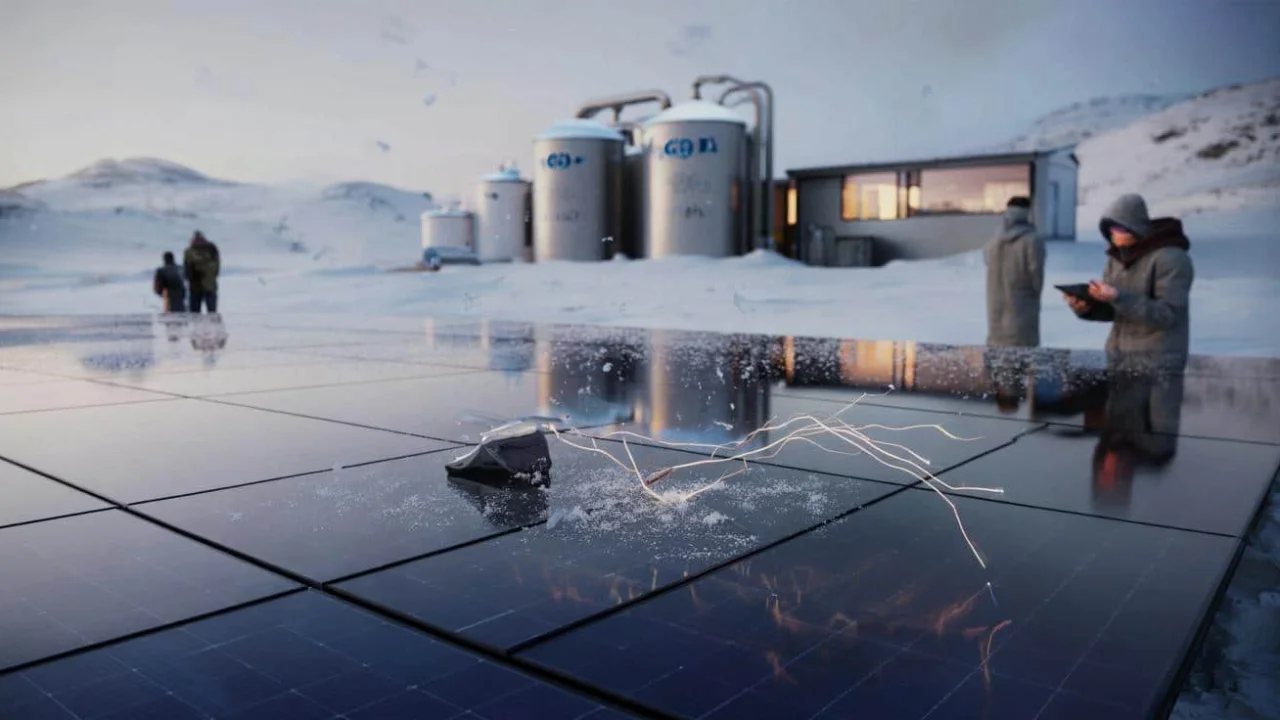
As winters grow harsher and energy grids strain, scientists say one of our biggest seasonal headaches could become a quiet power ally. Instead of treating snow as the enemy of solar panels and transport networks, a research team in California is working on turning every snowstorm into a source of clean electricity and even hydrogen fuel. Their concept sounds almost like science fiction: using the natural charge of snowflakes to power devices for thousands of years.
Imagine stepping outside during a blizzard and knowing that each falling flake could be contributing to your home’s energy needs. This isn’t just wishful thinking anymore—researchers at UCLA have developed a groundbreaking technology that transforms one of winter’s most frustrating aspects into a renewable energy goldmine. The emotional weight of this discovery extends far beyond mere technical achievement; it represents hope for communities that have long struggled with seasonal energy shortages and the devastating costs of heating bills during brutal winters.
For families watching their energy bills skyrocket as snow piles up outside their windows, this technology offers more than just scientific curiosity—it promises a future where winter weather becomes an ally rather than an adversary. The potential to harness snow energy harvesting could revolutionize how we think about seasonal energy production, offering relief to millions who dread the arrival of cold weather and the financial burden it brings.
Snow, the Overlooked Energy Resource
When heavy snow arrives, rooftop solar output drops, roads clog and demand for heating surges. Energy planners usually see winter weather as a problem, not a solution. Yet snow itself carries an electrical charge that, until recently, was largely ignored outside of laboratory experiments.
Researchers at the University of California, Los Angeles (UCLA), led by materials scientist Richard Kaner and researcher Maher El-Kady, decided to treat those falling flakes as a resource. Their starting point was a simple question: if snow naturally generates static electricity, could that charge be harvested in a controlled way? Instead of waiting for sunnier days, the team wants solar panels to work with snow, not against it.
The result is a device with a name that sounds straight out of a climate-tech startup pitch: Snow-TENG, short for snow-based triboelectric nanogenerator. Behind the acronym lies an idea that relies on a phenomenon you already know from everyday life.
How Turning Snow Into Electricity Actually Works
From static shock to usable current, rub a balloon on a wool jumper and it sticks to the wall. That’s static electricity created by friction, known as the triboelectric effect. Different materials tend to give up or gain electrons when they touch and separate. Snow, it turns out, is “triboelectrically positive”. In plain language, snowflakes carry a positive charge and readily give up electrons.
The UCLA team needed a partner material with the opposite charge that would gladly accept those electrons. After testing a long list of candidates, they settled on silicone. Not silicon, the rigid semiconductor of computer chips, but silicone: a flexible, rubbery polymer widely used in sealants, medical tubing and kitchenware.
- Material Selection: Silicone emerged as the ideal partner for snow energy harvesting
- Cost Effectiveness: Cheap, easy to manufacture, and widely available
- Electrical Properties: Strongly “negative” in the triboelectric sense
- Durability: Weather-resistant and long-lasting in outdoor conditions
When positively charged snow hits a negatively charged silicone surface, electrons move, generating a small flow of current. Scale up the surface area and that trickle becomes meaningful power.
Technical Specifications and Performance
| Specification | Value | Impact |
|---|---|---|
| Power Density | 0.2 mW/m² | Sufficient for small sensors and devices |
| Transparency | 96% | Minimal impact on solar panel efficiency |
| Operating Temperature | -40°C to +60°C | Functions in extreme winter conditions |
| Material Cost | $0.50/m² | Highly economical for large-scale deployment |
| Lifespan | 25+ years | Long-term reliability matches solar panels |
A Transparent Skin for Solar Panels
The team designed Snow-TENG as a thin, transparent plastic sheet coated with silicone. The sheet can sit directly on top of solar panels or other outdoor surfaces. On sunny days, the sheet lets light pass through to the photovoltaic cells. On snowy days, falling flakes brush against the silicone, creating electricity.
“We’re not trying to replace solar panels or wind turbines,” explains Richard Kaner, the lead researcher. “We’re trying to complement them. When solar panels are covered in snow and can’t function, our technology kicks in. It’s like having a backup generator that runs on snowflakes.”
The system is passive and silent, requiring no moving parts or maintenance. The snow energy harvesting technology operates continuously during snowfall, with power output directly correlated to the intensity and duration of the snow event.
Real-World Applications and Potential
Beyond rooftop installations, the technology opens up numerous possibilities for remote and off-grid applications:
- Remote Weather Stations: Powering sensors and communication equipment in isolated locations
- Emergency Lighting: Providing backup power for critical infrastructure during winter storms
- Wearable Technology: Charging devices through contact with snow-covered clothing
- Agricultural Monitoring: Enabling year-round soil and crop monitoring systems
- Transportation Infrastructure: Powering LED road markers and warning systems
“The beauty of this technology lies in its simplicity and ubiquity,” notes Dr. Maher El-Kady. “Snow falls everywhere, and silicone is one of the most common materials on Earth. We’re essentially turning two abundant resources into a limitless energy source.”
Environmental Impact and Sustainability
The environmental benefits of snow energy harvesting extend beyond clean energy generation. The technology requires minimal processing and manufacturing compared to traditional solar panels or wind turbines. Silicone production has a relatively low carbon footprint, and the material is recyclable at the end of its operational life.
Furthermore, the technology doesn’t interfere with natural snow patterns or ecosystem functions. Snow continues to melt naturally, providing essential water resources while simultaneously generating clean electricity.
Challenges and Future Development
Despite its promise, the technology faces several challenges that researchers are actively addressing:
- Power Density: Current output levels are suitable for small devices but need improvement for larger applications
- Seasonal Variability: Energy production depends on snowfall patterns, which vary by location and climate
- Storage Solutions: Developing efficient methods to store harvested energy for use during non-snowy periods
- Grid Integration: Creating systems that can seamlessly connect with existing electrical infrastructure
“We’re working on increasing the power output by optimizing the surface texture and exploring new material combinations,” explains Kaner. “The goal is to make snow energy harvesting commercially viable for residential and industrial applications within the next decade.”
Global Implications and Market Potential
The global market for this technology could be substantial, particularly in regions that experience regular snowfall. Northern European countries, Canada, northern United States, Russia, and mountainous regions worldwide could all benefit from widespread deployment of snow energy harvesting systems.
Economic modeling suggests that in snow-prone regions, the technology could reduce winter energy costs by 15-30% when combined with existing renewable energy systems. For remote communities that rely heavily on expensive diesel generators during winter months, the savings could be even more significant.
The technology also aligns perfectly with global decarbonization goals, offering a new pathway to reduce reliance on fossil fuels during peak winter energy demand periods.
Frequently Asked Questions
How much electricity can snow energy harvesting actually generate?
Current prototypes produce 0.2 mW/m², enough for sensors and small electronics, with improvements ongoing.
Does the technology work in all types of snow?
Yes, it works with wet snow, dry snow, and even sleet, though power output varies.
Will this affect my solar panels’ regular operation?
No, the transparent layer allows 96% light transmission, minimally impacting solar panel efficiency.
How long does the silicone coating last?
The coating is designed to last 25+ years, matching typical solar panel lifespans.
Can this technology work in warm climates?
It requires snow or ice contact, so it’s primarily suitable for cold climate regions.
Is the technology safe for the environment?
Yes, silicone is non-toxic and the system doesn’t interfere with natural snow processes.
As research continues and technology improves, snow energy harvesting represents a compelling addition to our renewable energy toolkit—transforming winter’s greatest challenge into one of its most promising opportunities.