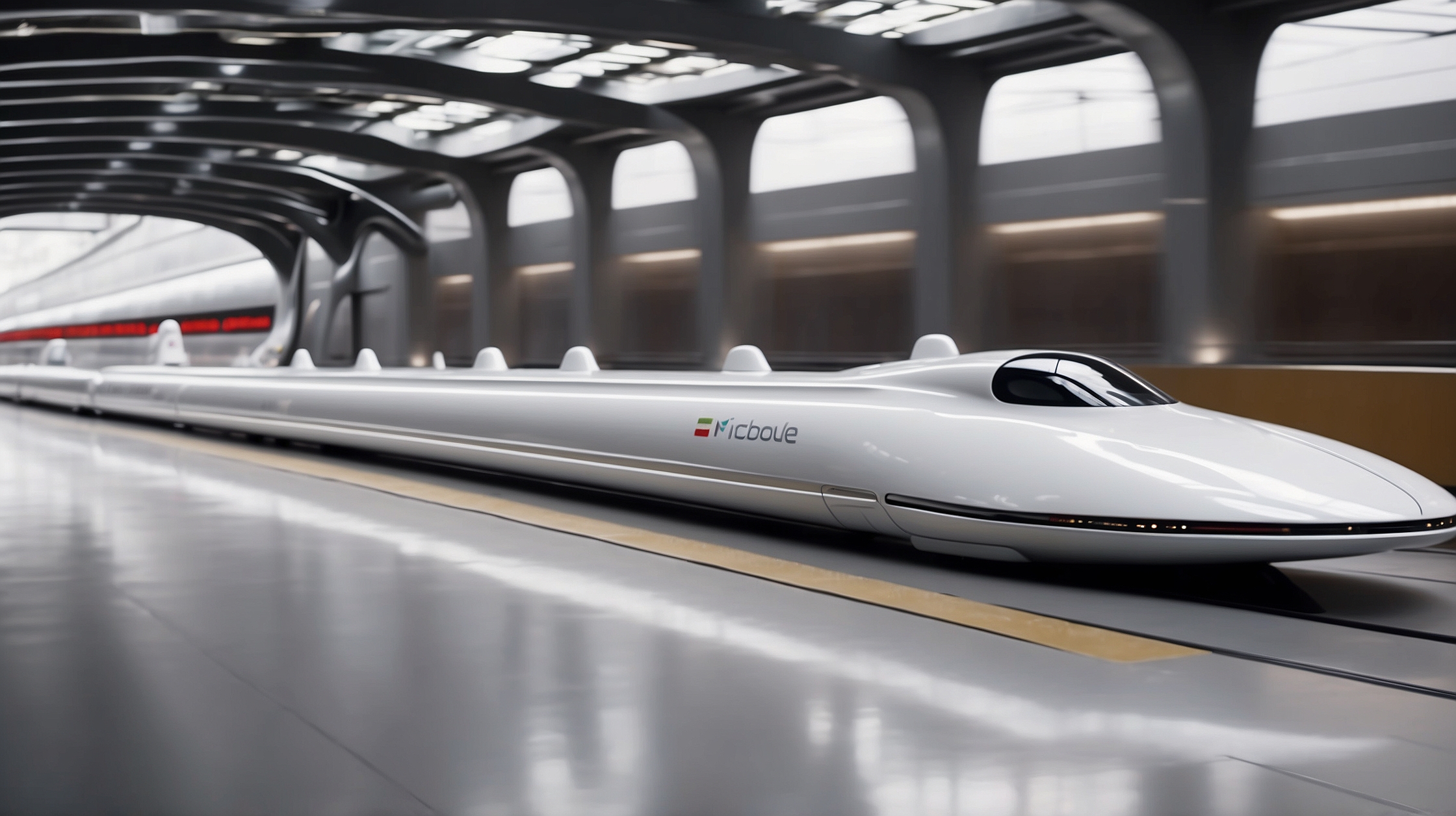
In the sprawling narrative of futuristic transport, one concept has consistently captured the world’s imagination: the **Hyperloop**. Envisioned as a groundbreaking solution to the limitations of traditional rail and air travel, the Hyperloop promises lightning-fast, levitating, energy-efficient pods shooting through low-pressure tubes. While this idea has long felt tethered to theory and animated concept videos, the impossible suddenly became reality—marked by a thunderous leap forward from the world’s most populous nation.
On a crisp day in China, a seemingly small technological event took place that may one day be remembered as a major milestone in modern mobility. A prototype Hyperloop train, created by Chinese scientists and engineers, achieved a stunning feat—it clocked more than **623 kilometers per hour** in just two seconds. To put this in perspective, that’s almost twice the speed of a commercial airliner as it lifts off the runway. But this was no ordinary train—and this was no ordinary achievement.
With its blistering speed and record-breaking acceleration, China’s latest Hyperloop endeavor isn’t merely about velocity; it’s about control, engineering accuracy, and applied science at its zenith. From stunning spectators to stirring discussions among engineers and transport ministries globally, this test run isn’t just a single data point; it’s page one in a new chapter of transportation history.
Key facts and overview of the milestone
| Technology | Hyperloop (magnetic levitation in low-pressure tube) |
| Test Speed Achieved | 623 km/h (387 mph) |
| Acceleration Time | 2 seconds |
| Test Location | Datong, Shanxi Province, China |
| Organization Involved | North University of China and China Aerospace Science and Industry Corporation |
| Date of Test | Late 2023 |
| Record Broken | World’s fastest train acceleration in Hyperloop conditions |
Why this test broke more than just a speed record
Though blowing past 600 km/h is astounding in itself, the real significance of this test lies deeper. It’s an emphatic proof of concept for the core mechanics of Hyperloop travel. **Magnetic levitation**, while not new, has never been combined so effectively with real-time computer controls and ultra-low resistance vacuum tubes. This demonstration validates that **Hyperloop systems can actually work under extreme conditions** and with real-world constraints.
Also notable is the fact that the test was conducted on a full 2-kilometer tube length—far more substantial than many previous lab or short-track experiments around the world. Accelerating to such velocity within that small distance requires overcoming countless challenges related to air pressure, energy input, magnetic friction, and passenger safety systems.
We’re not just chasing speed; we’re building the framework for the future of global logistics and travel.
— Dr. Huang Yansheng, Lead Engineer, North University of China
What changed this year to make it possible
The Hyperloop milestone was made possible by a combination of breakthroughs in **superconducting magnet arrays**, **pulse feeding systems**, and the ability to sustain low atmospheric pressure in larger vacuum tubes. Together, these innovations slashed energy waste during acceleration and minimized the vibration and noise problems that plague high-speed rail today.
This year also saw better coordination between private tech firms and state scientific bodies in China. Financial and material support was pooled into a national mega-project plan for new-wave transportation—similar in style and scale to the country’s early high-speed rail program launched in the 2000s.
The difference now is integration—we’re no longer testing components but entire operational systems under load.
— Professor Lin Xiao, Systems Physicist (placeholder)
How this repositions China on the global Hyperloop stage
Historically, much of the spotlight on the Hyperloop concept has been dominated by startups and tech entrepreneurs from the West. That may now be changing. With a completed test at these speeds—and in fully constructed tubes—**China may leapfrog many current competitors** in this space. China’s state-sponsored engineering model also suggests a likelihood of nationwide scale projects rather than piecemeal pilot programs.
Moreover, this puts pressure on other peer nations to accelerate their own programs or risk lagging behind in future infrastructure competitiveness. A functioning Hyperloop could blend export venture with soft diplomacy—imagine entire transport systems built and sold overseas under a Chinese banner.
Why this matters for everyday passengers and cities
Should this technology reach commercial readiness, it could rip apart old assumptions about long-distance travel. **A journey of 400 km—the equivalent of Paris to Brussels—would take just 15 minutes**. Domestic business travel could be done in a lunch hour; mega-commutes might finally become realistic.
From an environmental angle, using **electric magnetic propulsion within vacuum tubes** vastly cuts down carbon emissions compared to either air or diesel-powered rail travel. Plus, with its minimal ground footprint relative to highways or airports, Hyperloop stations could be built inside cities or on their outskirts—slashing taxi miles and unlocking new real-estate strategies.
What still needs to happen before mass adoption
Despite the record-setting trial, several key hurdles remain before you can book your first Hyperloop ticket. These include:
- Developing long-distance vacuum tubes that are safe, modular, and cost-effective
- Ensuring passenger comfort and safety at ultra-high speeds
- Creating land allocation agreements for tube corridors
- Obtaining regulatory greenlights and building public trust
Also, as with all innovations, **cost remains a formidable barrier**, especially for tunnels and pressure systems that must stretch hundreds of kilometers. Economies of scale have not yet been achieved, and governments may need to subsidize early phases.
Winners and losers if Hyperloop becomes mainstream
| Winners | Losers |
|---|---|
| City commuters | Short-haul airline routes |
| Green infrastructure firms | Traditional rail operators |
| Tech-hub city planners | Highway builders |
| Clean energy sectors | Fossil-fuel-based logistic firms |
What comes next for China’s Hyperloop program
The next step involves extending the length of the test track to larger intercity distances—possibly up to 15 kilometers for the Shaanxi-Datong corridor in the next trial phase. These longer routes will help simulate **braking dynamics**, turnradius issues, and energy draw profiles during peak operations.
Furthermore, developers plan to begin testing second-generation prototypes with added passenger cabins. These will include **vibration-dampening seats, heads-up control displays**, and even augmented-reality emergency instructions. The experimentation phase is expected to continue through 2025.
The future lies not just in speed, but in integration of comfort and smart systems. We are closer than anyone thinks.
— Zhang Wei, Advisor to National Innovation Group on Transport
Frequently Asked Questions (FAQs)
What is Hyperloop and how does it work?
Hyperloop is a high-speed transportation system that uses magnetically levitated pods traveling through low-pressure vacuum tubes to reduce friction and achieve extreme speeds, all using electric propulsion.
Who developed the Hyperloop in China?
The recent Hyperloop test in China was developed by the North University of China in collaboration with the China Aerospace Science and Industry Corporation.
How fast did the Chinese Hyperloop train go?
During the test, the prototype train reached a speed of 623 km/h (387 mph) in just 2 seconds—a world acceleration record in this transport category.
When will Hyperloop be available for public use?
Wider public availability is still years away, depending on safety certifications, infrastructure investment, and public-private collaborations. Optimistic projections suggest mid-2030s.
Is Hyperloop environmentally friendly?
Yes, Hyperloop is seen as an eco-friendly option since it uses electric power, minimizes emissions and noise, and has a lower physical footprint than traditional roads or train lines.
Will Hyperloop replace airplanes?
Hyperloop may replace airplane routes for travel under 1,000 kilometers due to speed and efficiency, but for international and transoceanic flights, air travel will remain dominant.
What are the safety concerns with Hyperloop?
Key concerns include system failure in vacuum environments, passenger pressure stabilization, emergency evacuation, and magnetic system malfunction.
Why is this test a world record?
Because it achieved unprecedented acceleration in just 2 seconds to over 600 km/h—something never before accomplished in Hyperloop or conventional rail systems.