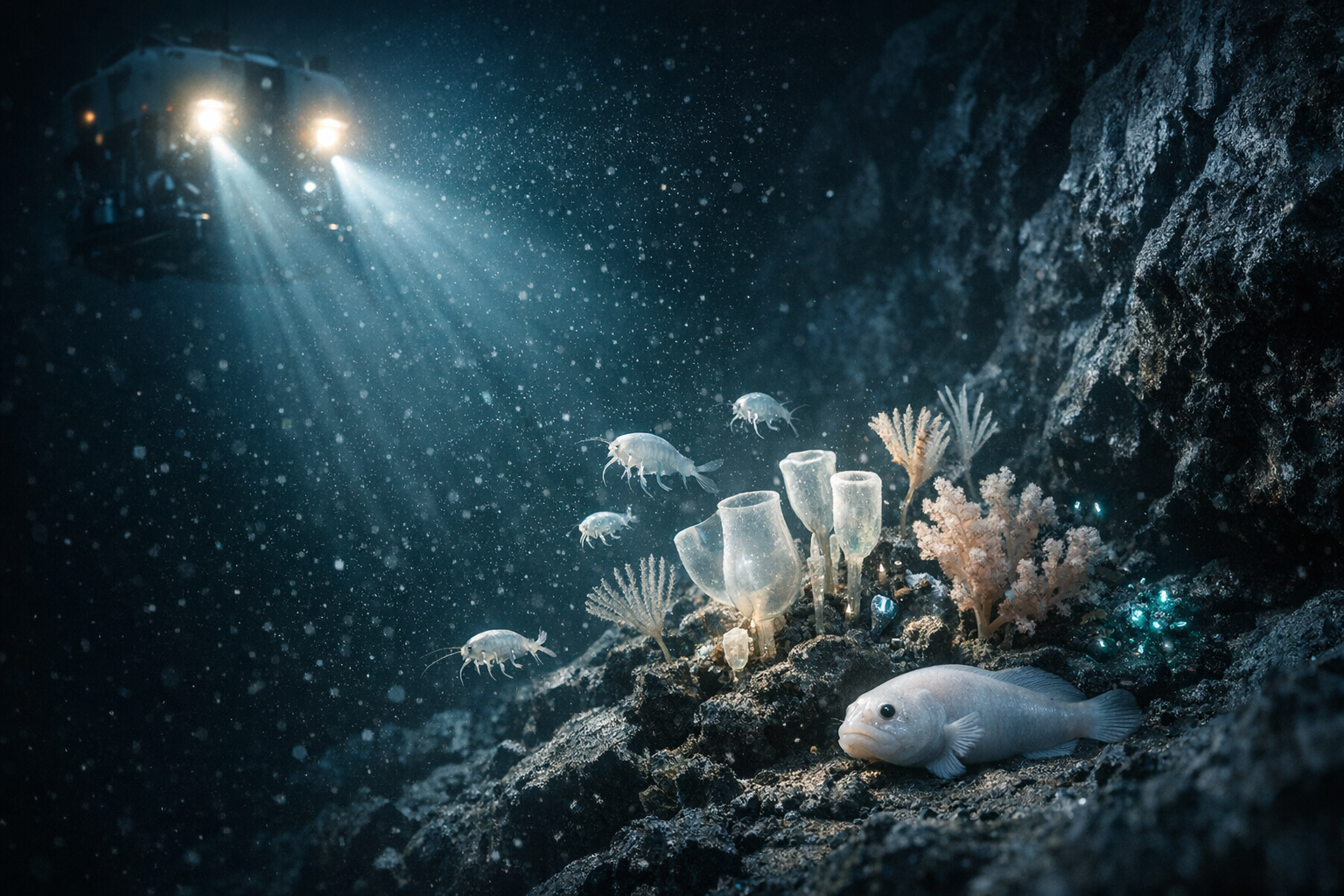
In the pitch-black depths off the coast of Japan, where sunlight has never penetrated, a stunning scientific revelation is transforming what we know of life on Earth. Hundreds of meters beneath the sea’s surface, Japan’s deep ocean trenches are yielding an astonishing diversity of previously unknown species. From translucent sea creatures straight out of science fiction to resilient organisms surviving under crushing pressures, an underexplored world is finally coming into view—thanks to cutting-edge marine research.
This isn’t just a tale of biodiversity. It’s a story of resilience, evolution, and the awe-inspiring ability for life to thrive in the harshest environments imaginable. As Japanese researchers launch submersibles and deep-sea probes into some of the world’s most complex underwater terrain, what they are encountering is nothing short of miraculous. Tiny, energy-efficient lifeforms, bizarre crustaceans, and never-before-seen marine animals are redefining what scientists thought was possible in these oceanic voids.
But these discoveries are more than marine curiosities; they could hold the key to better understanding climate change, Earth’s early history, and potentially even medical breakthroughs. The exploration of Japan’s deep-sea trenches is opening a portal to an alien world—right here on our own planet.
What researchers found in Japan’s uncharted depths
| Topic | Details |
|---|---|
| Location | Japan’s deep-sea trenches, including areas near the Izu-Ogasawara Trench |
| Main Discovery | Over 100 new species of marine life |
| Depth Explored | Down to 8,000 meters |
| Instruments Used | Deep-sea submersibles and remote sensing devices |
| Scientific Importance | Improved understanding of deep-sea ecosystems and potential resources |
How the mission revealed a hidden oceanic world
The latest expedition, led by a cohort of Japanese marine biologists and scientists, ventured into the Izu-Ogasawara Trench—one of the deepest parts of the Pacific Ocean. Temperatures hovered just above freezing, extreme pressure compressed every movement, and yet, life was not only present but flourishing.
Using advanced submersibles capable of withstanding depths of up to 8,000 meters, the research team collected samples from the ocean floor. What they retrieved amazed even the most seasoned marine experts. Among the captured footage were squishy critters resembling jelly-like worms, sea cucumbers with luminescent patches, and a multitude of organisms entirely new to science.
“We expected to find a couple of unknown species,” one researcher commented, “but the sheer diversity and unique adaptability of these creatures blew us away.”
“This is not just an isolated biological fluke. It’s a whole ecosystem we didn’t know existed.”
— Dr. Hiroshi Tanaka, Marine Biologist
Why these discoveries matter more than ever
Deep-sea ecosystems are often likened to alien planets due to their extreme conditions. Yet, they also hold vital clues to understanding our planet’s development and future. By studying extremophile species—organisms that survive in conditions lethal to most known life—scientists gain insights into biology’s adaptability.
These discoveries may also pave the way for biomedical advancements. Certain deep-sea microorganisms produce unique biochemical compounds, which may be used in antibacterial drugs or cancer treatments. Additionally, life found near hydrothermal vents has special enzymes that function under high temperatures—ideal for industrial biotechnology.
More broadly, understanding how these species extract energy and nutrients in pitch darkness may even inform the search for extraterrestrial life, especially in subsurface oceans such as those believed to exist on Europa, one of Jupiter’s moons.
Species that surprised even the experts
Among the remarkable new species cataloged, a few stood out:
- A see-through snailfish with elastic skins adapted to dark environments
- Gelatinous anemones capable of ballooning in size to snare prey
- Crustaceans with limbs evolved to anchor on nutrient-sparse seabeds
- Bioluminescent worms pulsing with rhythmic light patterns
- Microscopic extremophiles that digest toxic minerals
The adaptations demonstrate a level of biological creativity that stunned scientists. These are not blunt survivalists—they’re specialized marvels sculpted by millennia of isolated evolution.
“Each deep dive feels like opening a time capsule from Earth’s ancient past.”
— Dr. Mei Kobayashi, Oceanographer
Japan’s leadership in marine exploration
Japan has long been at the forefront of oceanographic research, from tsunami detection technology to eco-friendly fisheries. The country’s expansive Pacific basin and island geography make it both vulnerable to and dependent upon marine resources, prompting major investments in underwater research infrastructure.
The Japan Agency for Marine-Earth Science and Technology (JAMSTEC) has deployed state-of-the-art remotely operated vehicles (ROVs) capable of transmitting high-definition video and sampling matter without contaminating it. These facilities have enabled Japanese researchers to not just observe but also model deep ocean biology in laboratory conditions.
“Other countries are now looking to Japan as a blueprint for ethical and advanced marine research.”
— Takashi Watanabe, Environmental Policy Analyst
Challenges in exploring the deep sea
Despite technological advances, deep-sea exploration remains notoriously difficult. The lack of light, crushing pressure, and logistical complexity of long-term missions make each expedition an enormous endeavor. Funding constraints and environmental concerns further limit the frequency and scale of such studies.
Moreover, sampling must be done with extreme care. Disturbing these fragile ecosystems can upset biological balances or even destroy unknown species before they are studied properly. Japan’s researchers are developing low-impact collection techniques specifically to minimize these risks.
Future missions and what lies ahead
Given the successes of recent trench explorations, Japan plans to expand its marine programs. Future missions will likely include robotic swarms and AI-equipped drones for autonomous sampling. Collaborative efforts with international institutions are also in view, but Japan remains committed to environmentally responsible deep-sea science.
This is just the beginning. With less than 5% of the world’s ocean floor explored, Japan’s recent findings underscore how little we know—and how much we have yet to learn—about the blue expanse beneath us.
Quick questions and fascinating answers
What is the Izu-Ogasawara Trench?
It’s a deep-sea trench in the Pacific Ocean near Japan, reaching depths over 8,000 meters, and known for extreme underwater conditions.
How many new species were found during this mission?
Scientists identified over 100 potentially new species during the latest deep-sea expedition.
Are these discoveries useful beyond biology?
Yes, they may aid in biotechnology, medicine, and even in the search for life on other planets.
Why is the deep ocean still mostly a mystery?
Because it’s extremely difficult and expensive to explore due to crushing pressures, darkness, and vast depths.
How does Japan lead in deep-sea exploration?
Through government-backed organizations like JAMSTEC and advanced underwater technology, including high-precision submersibles and probes.
Is this exploration harmful to marine life?
Japan employs low-impact techniques to minimize ecosystem disruption, aiming for ethical exploration practices.
Could there be even stranger life deeper down?
Absolutely. With vast areas yet untouched, further expeditions may uncover even more alien-like species and ecosystems.
When is the next mission scheduled?
Future missions are being planned for the next few years, with increased automation and international collaboration in focus.