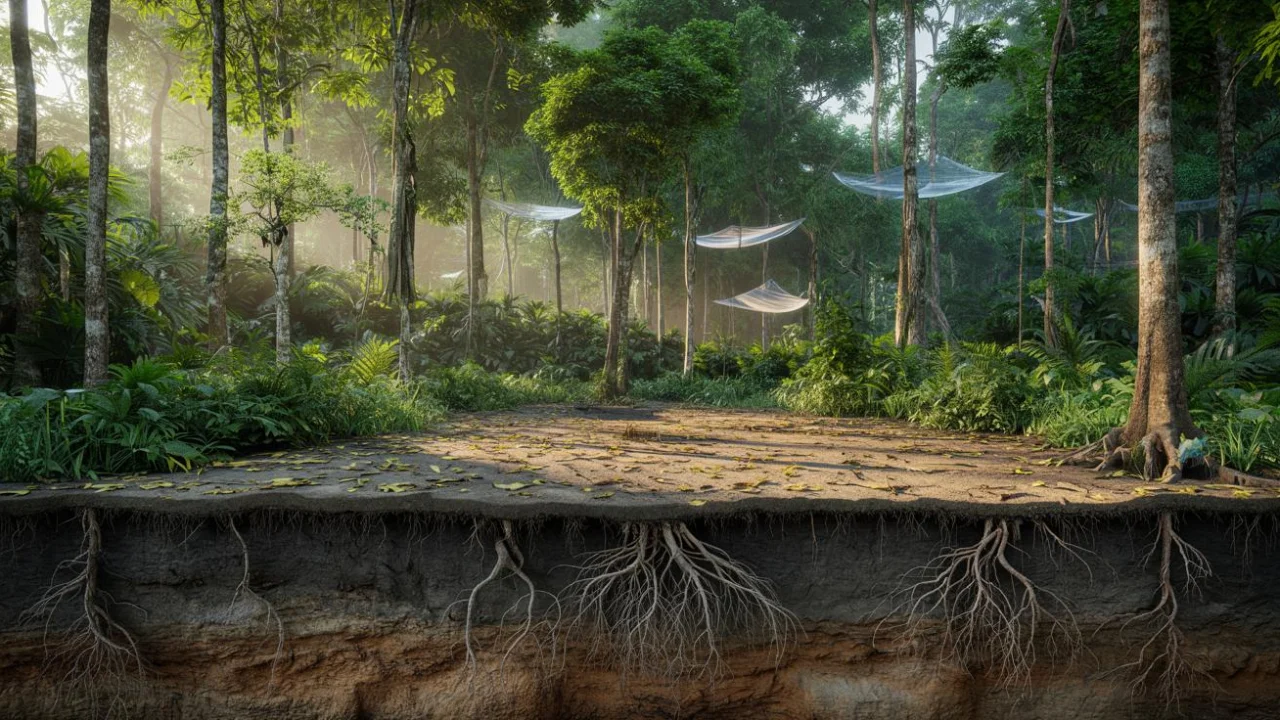
The humid air of Panama’s tropical forests carries secrets that most visitors never notice. While tourists marvel at towering cecropia trees and colorful toucans overhead, something profound is happening beneath their feet. Deep in the dark, nutrient-rich soil, an ancient survival strategy is quietly unfolding—one that could determine the fate of some of Earth’s most important ecosystems.
In laboratories and field stations across Panama, scientists are documenting a remarkable transformation. As climate change brings longer dry seasons and more intense droughts to Central America, the forests themselves are fighting back. Trees that have thrived for centuries in Panama’s reliable wet-dry cycle are now extending their lifelines deeper into the earth, growing longer, more extensive root systems to chase retreating water tables. These panama tropical forest roots are literally reshaping themselves, stretching further underground in what researchers describe as an emergency response to an increasingly unpredictable climate.
The implications extend far beyond Panama’s borders. Tropical forests store nearly 30% of the world’s terrestrial carbon, with much of it locked away in root systems and surrounding soil. If these ecosystems can adapt their underground architecture quickly enough, they might weather the coming decades of climate disruption. But if they can’t, the consequences could ripple across the global climate system.
What makes this story particularly compelling is how invisible it remains to the casual observer. The forest canopy looks as lush and green as ever, but underneath, an evolutionary arms race is playing out in slow motion—trees versus drought, adaptation versus extinction.
The PARCHED Experiment: Engineering Drought in Paradise
Understanding how tropical forests respond to drought requires more than just waiting for dry weather to arrive naturally. Climate scientists need controlled conditions, consistent measurements, and the patience to watch slow-moving ecological processes unfold over years. That’s exactly what the Panama Rainforest Changes with Experimental Drying (PARCHED) project set out to accomplish.
The experimental design reads like something from a climate science thriller. Researchers installed massive clear plastic panels high above the forest floor, creating partial roofs that intercept 50-70% of incoming rainfall. These structures stretch across 32 experimental plots scattered throughout four distinct forest sites across Panama, each with its own unique soil composition, tree species, and natural rainfall patterns.
“We’re essentially creating a controlled drought in the middle of a rainforest,” explains Dr. Sarah Johnson, lead researcher on the PARCHED project. “The plastic panels let us simulate the kind of chronic drying that climate models predict for this region, but in a way that allows us to measure exactly how trees respond.”
But the roof panels were only half the solution. To prevent panama tropical forest roots from simply growing laterally to access water from neighboring areas, the team dug deep trenches around each experimental plot and lined them with thick plastic barriers. This created isolated islands of artificial drought, surrounded by normally watered forest.
Three Windows into the Underground World
Studying roots presents unique challenges that don’t exist with above-ground plant parts. You can’t simply look up and count root growth the way you might measure leaf production or trunk diameter. The PARCHED team developed three complementary approaches to peer into the hidden world of panama tropical forest roots:
- Soil Cores: Scientists used specialized drilling equipment to extract cylindrical sections of soil and roots down to 20 centimeters below the surface. These cores were collected multiple times per year, allowing researchers to track changes in root biomass and distribution over time.
- Root Traps: Clear plastic chambers were installed at various depths in the soil, designed to capture and measure new root growth as it occurred. These traps provided real-time data on how quickly trees were extending their root systems.
- Deep Soil Sampling: Using more intensive excavation techniques, researchers dug deeper into the soil profile to understand how root architecture was changing at greater depths, where the most reliable water sources might be found during extended dry periods.
Key Findings: Root Response Overview
| Measurement | Control Plots | Drought Plots | Change |
|---|---|---|---|
| Surface Root Density (0-10cm) | High | Reduced | -25% to -40% |
| Deep Root Growth (10-20cm) | Moderate | Increased | +30% to +60% |
| Root Fineness | Standard | Increased | +15% to +25% |
| Water Uptake Efficiency | Baseline | Enhanced | +20% to +35% |
The Underground Rescue Strategy
After five years of careful monitoring, the PARCHED experiment revealed a clear pattern. Trees facing experimental drought conditions systematically shifted their growth strategies, reducing investment in shallow, surface roots while dramatically increasing production of longer, finer roots that could penetrate deeper into the soil profile.
“What we’re seeing is essentially a underground rescue operation,” notes Dr. Maria Santos, a tropical ecologist involved in the research. “Trees are abandoning their traditional root architecture and rebuilding it from scratch, optimizing for a world where water is scarcer and less predictable.”
This response wasn’t uniform across all forest types. Trees growing in clay-rich soils, which retain moisture longer during dry periods, showed more moderate root restructuring compared to those in sandy soils that drain quickly. Similarly, forests with naturally higher species diversity displayed more varied and flexible responses than less diverse forest plots.
Species-Specific Adaptations
Different tree species showed markedly different abilities to modify their root systems. The research revealed several distinct categories of response among panama tropical forest roots:
- Pioneer Species: Fast-growing trees like cecropia and balsa showed rapid, dramatic increases in deep root production, sometimes doubling their below-ground biomass within two growing seasons.
- Canopy Dominants: Large, established trees such as kapok and mahogany displayed more gradual but persistent root system modifications, steadily extending their reach deeper into soil layers.
- Understory Specialists: Smaller trees adapted to low-light conditions showed the most conservative responses, with minimal changes to root architecture but increased efficiency in water uptake from existing root networks.
- Palm Species: These trees, with their fundamentally different root systems, showed unique responses including increased production of pneumatophore roots that can access deeper water tables.
Carbon Storage Implications
The root restructuring documented in Panama has profound implications for global carbon cycling. When trees invest more heavily in deep root systems, they’re not just accessing water—they’re also moving carbon to different layers of the soil profile where it may persist for different lengths of time.
“Deep roots can transport carbon to soil layers where it’s more likely to be stored long-term,” explains Dr. James Rodriguez, a soil carbon specialist. “But this also means less carbon is being cycled through the surface layers where it supports the complex fungal and bacterial networks that tropical forests depend on.”
Early measurements suggest that forests undergoing root restructuring may initially store more total carbon underground, but the long-term stability of this storage remains uncertain. Some computer models predict that deeper carbon storage could be more resistant to future climate disruptions, while others suggest it might be more vulnerable to changes in soil chemistry and microbial communities.
Limitations and Concerns
Despite the remarkable adaptability demonstrated by panama tropical forest roots, researchers emphasize that this response has clear limits. Extended drought periods lasting more than three consecutive years began to overwhelm even the most adaptive species in the PARCHED experiment. Trees that had successfully restructured their root systems still showed signs of severe stress when faced with the most extreme drying scenarios.
Additionally, the energy costs of growing new root systems are substantial. Trees investing heavily in deep root growth showed reduced leaf production, slower trunk diameter increases, and decreased reproductive output. This suggests that while root restructuring may help forests survive moderate increases in drought frequency, it comes at the cost of overall forest productivity and regeneration.
Regional Variations and Future Projections
The PARCHED findings are now being compared with observational data from other tropical forests across Central and South America. Preliminary results suggest that the root restructuring phenomenon documented in Panama is occurring naturally in forests from Costa Rica to Colombia, wherever drought frequency has increased over the past two decades.
Climate projections for the region paint a challenging picture. By 2050, most climate models predict that Central America will experience 20-40% longer dry seasons, with some areas seeing drought conditions that persist for five or six months annually rather than the current two to three months.
Frequently Asked Questions
How quickly can tropical tree roots adapt to drought conditions?
Most species begin showing measurable changes within one to two growing seasons after drought stress begins.
Do all tropical trees show the same root response to drought?
No, responses vary significantly by species, with pioneer species adapting fastest and understory trees most conservatively.
Can root restructuring help forests survive climate change long-term?
It helps with moderate drought increases but has limits when dry periods exceed three consecutive years.
Does deeper root growth affect the forest’s carbon storage?
Yes, it typically increases total underground carbon storage but may reduce surface soil carbon cycling.
Are scientists seeing this root adaptation in other tropical regions?
Preliminary evidence suggests similar responses in forests from Costa Rica to Colombia where droughts have intensified.
What happens to forest productivity when trees grow deeper roots?
Trees typically show reduced leaf production and slower growth as they invest energy in root development.
Looking Toward an Uncertain Future
The discovery of rapid root restructuring in Panama’s tropical forests offers both hope and concern for conservation biologists. On one hand, it demonstrates that these critical ecosystems possess more adaptive capacity than previously understood. Trees that have evolved over millions of years in relatively stable climates are proving capable of dramatic architectural changes within just a few growing seasons.
On the other hand, the research makes clear that adaptation comes with costs and limitations. Even the most successful root restructuring observed in the PARCHED experiment would likely be insufficient to cope with the most severe drought scenarios projected for the late 21st century. The underground rescue strategy unfolding beneath Panama’s tropical forests may buy these ecosystems crucial time, but it won’t be enough on its own to ensure their long-term survival in a rapidly warming world.
As researchers continue monitoring the experimental plots and expanding their work to other tropical regions, one thing remains certain: the invisible world of panama tropical forest roots will play a crucial role in determining whether Earth’s most biodiverse ecosystems can weather the climate crisis ahead. The trees are already voting with their roots—growing deeper, reaching further, fighting to survive in a world that grows drier each year.