| Key Finding | Impact |
|---|---|
| Trees shift 50-70% less shallow root growth | Reduced surface carbon storage |
| Deeper root systems develop rapidly | Enhanced drought survival capability |
| Total root biomass still declines | Weakened carbon absorption capacity |
| Stronger fungal partnerships emerge | Improved nutrient and water access |
| Four forest types show consistent patterns | Universal adaptation strategy confirmed |
Panama’s tropical forests are quietly rewiring their underground architecture as tropical forest drought intensifies, with trees rapidly shifting root growth patterns in what scientists call an emergency “rescue strategy” for survival.
The discovery emerges from a groundbreaking five-year experiment that artificially created drought conditions across 32 forest plots, revealing how Earth’s most biodiverse ecosystems respond when their water supply vanishes. What researchers found challenges assumptions about forest resilience and raises urgent questions about our planet’s largest carbon storage systems.
Underground Emergency Response Reshapes Forest Architecture
Trees facing chronic water stress abandon shallow root systems that once captured rainfall near the surface, instead investing energy into deeper, moisture-hunting roots that can reach stable groundwater reserves. This dramatic shift occurs within months of drought onset, demonstrating forests’ remarkable ability to adapt quickly to changing conditions.
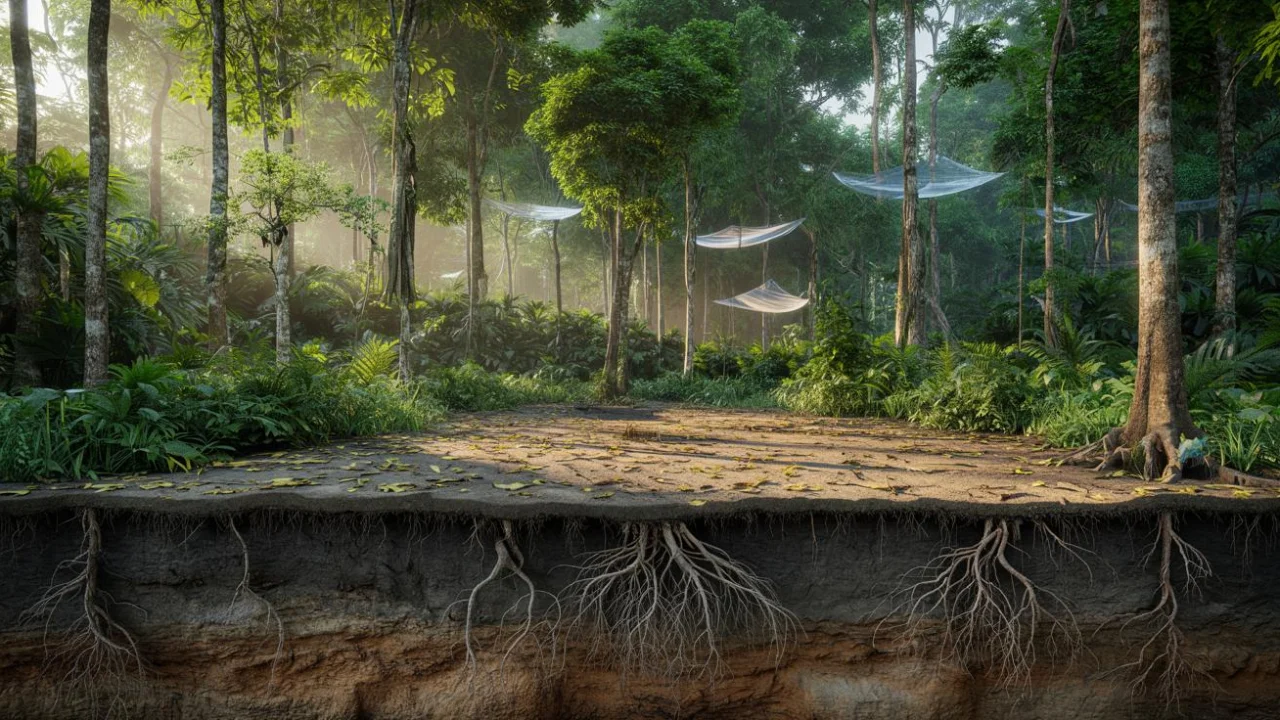
The Panama Rainforest Changes with Experimental Drying (PARCHED) project used innovative roof panels to reduce rainfall by 50-70% while plastic-lined trenches prevented roots from accessing water outside experimental plots. This controlled approach allowed scientists to observe pure drought responses without external water sources interfering.
Across four distinct forest types with varying soil conditions and tree species, the pattern remained consistent: surface fine roots declined while deeper root networks expanded. Trees essentially rebuilt their underground infrastructure to survive in a water-scarce world.
Critical Numbers Reveal Forests Under Pressure
The scale of root system reorganization surprised researchers. Surface root biomass dropped significantly in drought plots, while deeper roots increased by substantial margins. Total root biomass still declined overall, meaning forests store less carbon underground even as they adapt to survive.
This carbon storage reduction matters enormously because tropical forests hold more than half of terrestrial life and represent massive carbon reservoirs. Underground root networks and surrounding soil contain vast amounts of carbon that, when released, accelerates climate change.
Central America already experiences more frequent and intense droughts linked to climate change and El Niño events. Panama’s forests provide a preview of adaptations occurring across tropical regions worldwide as rainfall patterns shift and dry seasons extend.
Forest Types Most Vulnerable to Drought Stress
Research identifies specific forest characteristics that determine drought vulnerability:
- ✓ Forests on nutrient-poor soils show higher sensitivity
- ✓ Tree species without historical drought exposure struggle most
- ✓ Naturally wet forests lack evolved drought-tolerance traits
- ✓ Young forest stands adapt faster than mature systems
- ✓ Fragmented forests face additional human-caused stress
- ✓ Seasonal dry forests demonstrate better resilience
“These trees are essentially performing underground surgery on themselves, cutting away shallow roots and growing deeper ones to reach water that’s still available,” explains a forest ecologist studying the results.
Three Revolutionary Methods Track Hidden Root Changes
Scientists overcame the challenge of studying invisible root systems through three complementary approaches that revealed unprecedented detail about underground adaptations.
| Research Method | Measurement Focus | Depth Reached |
|---|---|---|
| Soil Core Sampling | Root biomass distribution | 20 cm below surface |
| Root Trap Monitoring | New growth patterns | Variable depths |
| Underground Camera Systems | Fine-scale root behavior | 1.2 meters deep |
Underground cameras inserted into clear acrylic tubes provided real-time footage of root growth and death, capturing the precise moment trees began redirecting energy from surface to deep root development. This technological innovation allowed researchers to document root behavior changes as they happened rather than inferring patterns from periodic sampling.
Practical Impacts Transform Forest Function
The root architecture changes create cascading effects throughout forest ecosystems:
- ✓ Reduced surface nutrient capture during rainfall events
- ✓ Enhanced access to deep soil moisture reserves
- ✓ Stronger partnerships with beneficial soil fungi
- ✓ Decreased total carbon storage in root systems
- ✓ Modified water transport efficiency within trees
- ✓ Altered soil stability and erosion patterns
Trees maintain their hydraulic systems—the internal water transport networks that keep leaves hydrated and photosynthesis functioning—but operate with leaner, more efficient root architectures. This survival strategy prevents immediate death but reduces overall forest biomass and carbon storage capacity.
“We’re witnessing forests perform a kind of biological triage, sacrificing some functions to preserve essential survival capabilities,” notes a tropical ecology researcher involved in the study.
Fungal Allies Strengthen During Forest Stress
As tropical forest drought reduces surface root density, remaining shallow roots forge stronger partnerships with arbuscular mycorrhizal fungi. These beneficial microorganisms extend thread-like networks through soil, effectively expanding each tree’s reach for water and nutrients.
The fungal alliance becomes increasingly important as root systems thin out. Fungi help trees extract maximum value from remaining surface roots while new deep roots establish themselves in lower soil layers. This symbiotic relationship represents a secondary adaptation that enhances primary root architecture changes.
Enhanced fungal partnerships may explain why some trees successfully navigate drought stress while others succumb. The ability to quickly establish or strengthen these underground relationships appears crucial for forest survival during extended dry periods.
Species Adaptation Rates Determine Forest Futures
Not all tropical tree species possess equal capacity for rapid root system reorganization. Evolutionary history plays a decisive role in determining which forests survive increasing drought frequency and intensity.
Species native to seasonally dry regions carry genetic advantages developed over millennia, including traits like thick bark, dense wood, and naturally deeper root systems. These trees adapt more readily to extended dry seasons because they already possess drought-survival mechanisms.
Conversely, species evolved in consistently wet environments lack these adaptations and face greater risks as tropical forest drought intensifies. Rapid climate change may outpace their evolutionary capacity, potentially leading to local extinctions and fundamental shifts in forest composition.
“The forests that emerge from this century of climate change will likely look very different from today’s ecosystems, with drought-tolerant species expanding while water-dependent trees retreat,” predicts a climate adaptation specialist.
Carbon Storage Implications Reshape Climate Models
Root system changes directly impact global carbon cycling because underground biomass represents a major carbon reservoir. When surface roots die off, their stored carbon can return to the atmosphere through microbial decomposition, accelerating climate change.
Deeper roots may partially offset this carbon loss because underground carbon typically remains stable longer and decomposes more slowly than surface organic matter. However, the overall reduction in root biomass means forests store less carbon even as they develop survival adaptations.
This finding forces scientists to reconsider tropical forests’ role as carbon sinks under climate change. Forests may continue functioning and supporting biodiversity while simultaneously weakening as carbon storage systems, creating complex trade-offs for climate policy.
Frequently Asked Questions
How quickly do trees change their root systems during drought?
Root architecture shifts begin within months of drought onset, with measurable changes detected in the first growing season.
Do all tropical tree species respond the same way to drought stress?
No, species with evolutionary drought experience adapt faster than those from consistently wet environments.
Can forests recover their original carbon storage after drought ends?
Recovery depends on drought duration and intensity, but some carbon storage capacity may be permanently reduced.
What happens to wildlife when forest root systems change?
Species composition shifts may affect animals dependent on specific trees for food and habitat.
Are these root changes happening in other tropical regions besides Panama?
Similar patterns likely occur worldwide, but Panama provides the first controlled experimental evidence of these adaptations.
How do fungal partnerships help trees survive drought conditions?
Fungi expand root reach and improve water and nutrient extraction from increasingly dry soils.
Long-term Monitoring Reveals Uncertain Forest Futures
The PARCHED experiment represents only the beginning of understanding how tropical forest drought reshapes ecosystems. Five years of data capture a small fraction of tree lifespans, yet already reveal profound underground transformations that may determine forest survival.
Continued monitoring will determine whether deeper rooting patterns persist or whether trees eventually reach physiological limits under constant stress. Prolonged drought could reduce growth, seed production, and recovery capacity after storms or pest outbreaks, potentially triggering forest collapse despite initial adaptations.
These findings underscore the critical importance of protecting diverse forest types to spread climate risks. Naturally drought-tolerant forests may serve as refuges for adapted species, while vulnerable wet forests require protection from additional human stresses like logging and fragmentation. The underground revolution occurring in Panama’s forests offers both hope for ecosystem resilience and sobering reminders of the profound changes ahead as our planet continues warming.