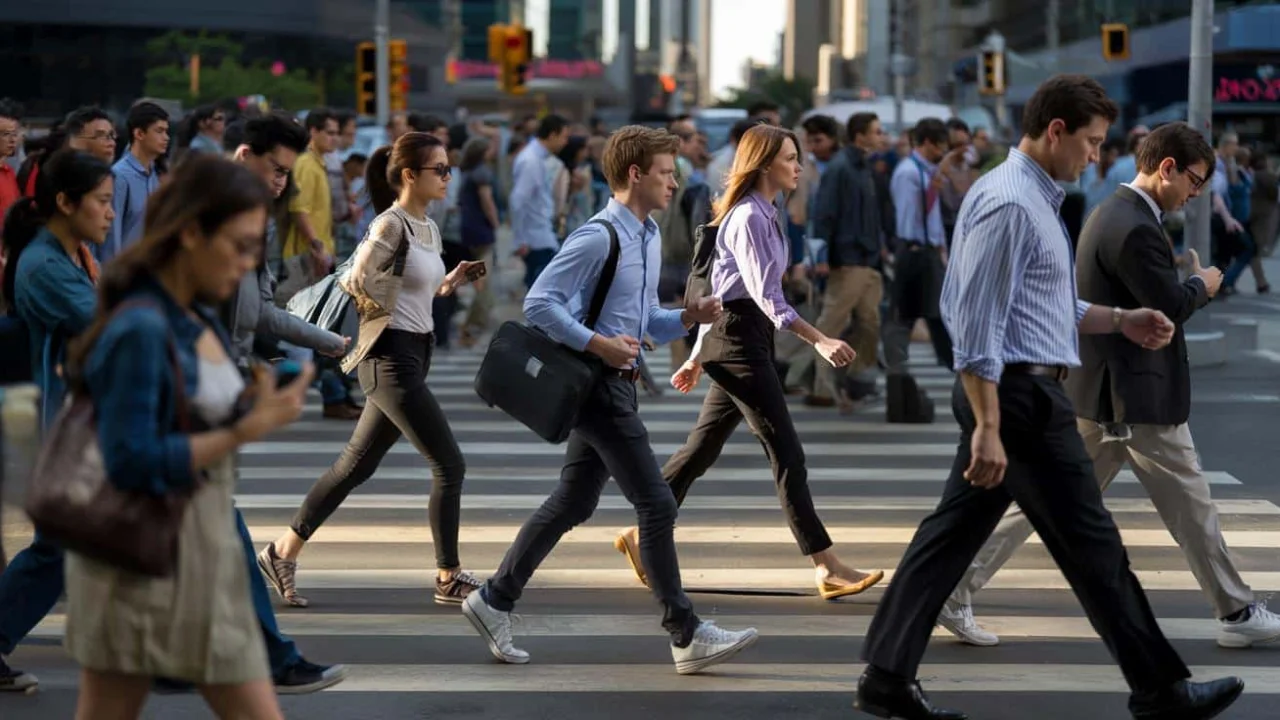
The other day, at a busy crosswalk, I caught myself doing something odd. The light turned green, and instead of just walking, I quietly timed the people around me. One woman in sneakers cut through the crowd like she knew exactly where she was going in life. A man with a briefcase followed briskly, eyes ahead, steps sharp. Behind them, a small group shuffled along, phones in hand, dragging their feet like the day was already too heavy.
I noticed who dodged obstacles smoothly, who hesitated, who seemed lost. And that’s when a strange thought hit me. Maybe the way we walk is saying more about us than we think. What if our walking speed is a silent broadcast of our inner world – our confidence, our cognitive sharpness, even our potential for success?
This wasn’t just idle observation. Behavioral scientists have been studying this phenomenon for decades, and their findings are remarkable. The pace at which you naturally move through the world might reveal more about your mental capacity and life outcomes than you ever imagined.
What Your Walking Speed Silently Reveals About Your Brain
Behavioral scientists have been studying this for years, quietly tracking how fast people move through streets, corridors, even hospitals. When they plot the data, a clear pattern emerges again and again. People who naturally walk faster than average tend to score higher on cognitive tests and report better life outcomes.
We’re not talking about Olympic-speed walking or frantic rushing. This is about that crisp, purposeful pace you notice in people who seem like they have somewhere meaningful to be. It’s not about being stressed or hurried – it’s about how quickly your brain processes the world and translates decisions into movement.
Researchers at Duke University followed nearly a thousand people from birth to midlife. When those participants turned 45, scientists measured their brain function, biological age, and yes, even their walking speed. The faster walkers didn’t just look fitter – their brains appeared younger on scans, and they performed better on memory and reasoning tests.
“Walking speed is a window into the brain’s processing power. It reflects how efficiently the nervous system coordinates complex movements while simultaneously managing cognitive tasks,” explains Dr. Stephanie Studenski, a geriatrician who has extensively researched gait and cognition.
The Science Behind the Stride
Another set of studies in the UK tracked older adults and found that slower walkers had a higher risk of health problems and even earlier mortality. The body was essentially sending a quiet warning through the feet. What sounds like a random quirk starts to look like a subtle, walking MRI of your life.
| Walking Speed Category | Average Pace | Associated Traits | Cognitive Performance |
|---|---|---|---|
| Slow Walkers | Under 1.2 m/s | Higher health risks, increased mortality | Lower processing speed |
| Average Walkers | 1.2-1.4 m/s | Standard health outcomes | Moderate cognitive function |
| Fast Walkers | Over 1.4 m/s | Better life outcomes, success markers | Superior processing speed |
Why Does This Connection Exist?
Part of the answer lies in something called “processing speed” – the mental ability to take in information, sort it, and respond quickly. A brisk walker is constantly reading the environment, adjusting to people, traffic lights, uneven pavements, dogs on leashes. That chain from brain to muscles is shorter and snappier. Decisions fire faster. Actions follow without drama.
The key factors that link walking speed to success include:
- Enhanced cognitive flexibility: Fast walkers demonstrate superior ability to switch between different mental tasks
- Better executive function: The brain regions controlling planning and decision-making show increased activity
- Improved reaction time: Quick walkers respond faster to unexpected situations and opportunities
- Higher confidence levels: Body language influences internal state, creating a positive feedback loop
- Increased energy levels: Regular brisk walking boosts cardiovascular health and mental alertness
Over years, this rhythm translates into habits: showing up on time, acting on ideas, not lingering endlessly in doubt. Walking speed becomes a kind of everyday proxy for how swiftly you move through choices, challenges, and chances.
“The way we move reflects the way we think. People who walk with purpose tend to approach life’s challenges with the same decisive energy,” notes Dr. James Prochaska, a behavioral change researcher at the University of Rhode Island.
The Success Connection: What the Data Shows
Multiple studies have tracked the correlation between gait and life outcomes. A fascinating longitudinal study published in the Journal of the American Geriatrics Society found that people who maintained faster walking speeds throughout their lives were more likely to:
- Achieve higher educational levels
- Earn more in their careers
- Report greater life satisfaction
- Maintain better physical and mental health
- Show fewer signs of cognitive decline with age
- Demonstrate stronger social connections and leadership qualities
The researchers weren’t suggesting that simply walking faster makes you successful. Instead, both fast walking and success seem to spring from similar underlying traits: mental agility, goal-directed behavior, and the ability to process information efficiently.
Can You Train Yourself to Walk Like a Successful Person?
There’s a simple experiment you can run on yourself this week. The next time you walk somewhere alone – to the shop, to the bus, from the car park to the office – slightly increase your pace. Not to the point of panting, just 10-15% faster than your default.
Lift your chest. Let your arms swing naturally. Eyes up, scanning, not stuck to your phone. Notice how different the world feels when your body sends the signal: I’m going somewhere on purpose.
Most of us underestimate how much our physical posture and movement patterns influence our mental state. This phenomenon, known as embodied cognition, suggests that changing how you move can actually alter how you think and feel.
“When you walk with intention and energy, you’re not just moving your body differently – you’re rewiring your brain’s approach to challenges and opportunities. It’s a powerful form of behavioral priming,” explains Dr. Amy Cuddy, whose research on power poses revealed similar mind-body connections.
The Neuroscience of Purposeful Movement
Recent brain imaging studies reveal that people with naturally faster walking speeds show different patterns of neural activity. Their prefrontal cortex – the brain’s executive control center – demonstrates enhanced connectivity with motor regions. This improved communication between thinking and moving parts of the brain translates into real-world advantages in problem-solving and decision-making.
The benefits extend beyond cognitive performance. Fast walkers typically exhibit:
- Lower stress hormones throughout the day
- Better cardiovascular health markers
- Improved mood and reduced anxiety
- Enhanced sleep quality
- Greater overall life satisfaction
Frequently Asked Questions
Does walking faster actually make you more successful?
Walking speed reflects underlying traits like cognitive processing speed and goal-directed behavior that contribute to success.
What’s considered a “fast” walking speed?
Research typically defines fast walking as over 1.4 meters per second, or about 3.1 mph.
Can slow walkers improve their cognitive function by walking faster?
Yes, deliberately increasing walking pace can enhance mental alertness and decision-making abilities through embodied cognition.
Is this research applicable to people with mobility issues?
The research focuses on natural walking ability; adaptations exist for measuring cognitive-movement connections in various populations.
Does age affect the walking speed-success correlation?
The correlation exists across age groups, though the specific speed thresholds may vary with age.
Are there cultural differences in walking speed and its meanings?
Yes, cultural norms influence walking pace, but the cognitive-movement connection appears across diverse populations.
The next time you’re walking somewhere, pay attention to your pace. Are you moving with purpose, or just going through the motions? Your feet might be telling a story about your mind that’s worth listening to. After all, in a world where success often comes down to how quickly you can process information and act on opportunities, your natural walking speed might be one of the most honest indicators of your potential.