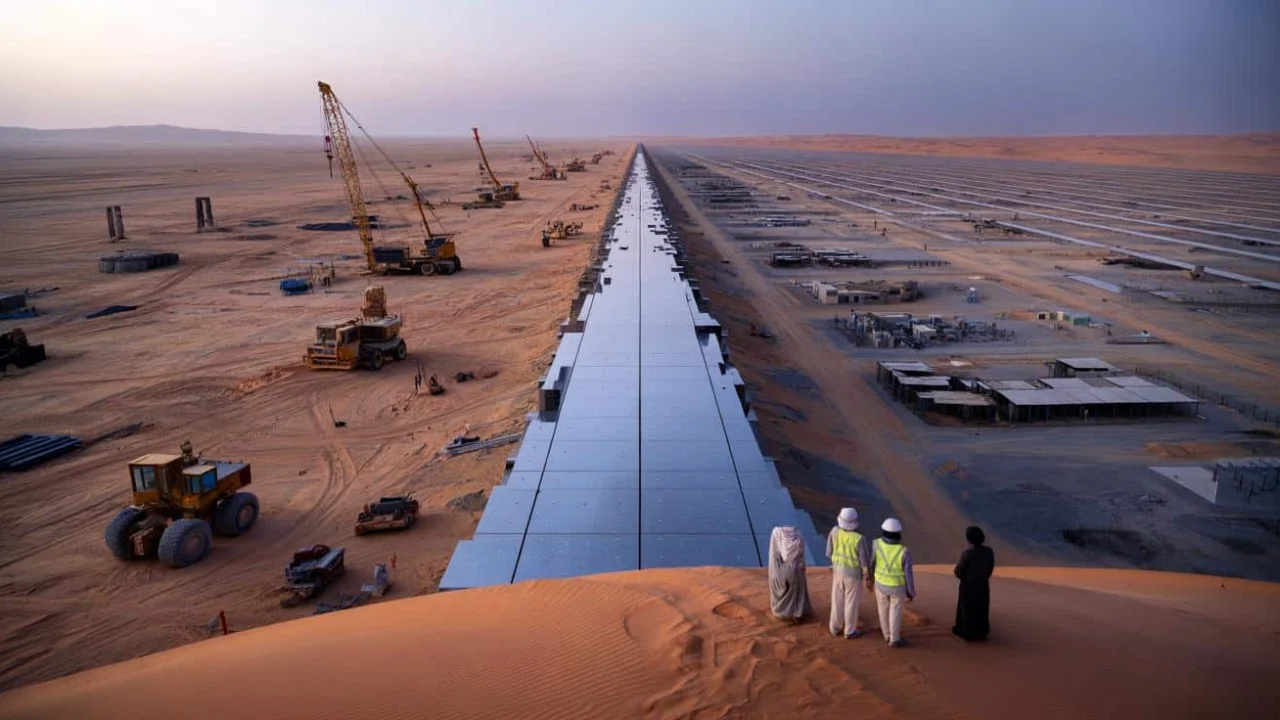
In the sweeping expanse of Saudi Arabia’s northwest desert, a grand vision once shimmered with promise — a futuristic, 100-mile city known as The Line. This audacious project, designed as a linear urban utopia without streets, cars, or sprawl, aimed to house nine million residents in a sleek mirrored corridor stretching across 170 kilometers of challenging terrain. Paired with the ambitious NEOM development, it symbolized Saudi Arabia’s relentless push to diversify beyond oil and establish itself as a beacon of the 21st century.
Yet, recent satellite imagery and insider accounts reveal a starkly different reality. The Line’s glowing ribbon of development has unraveled into a fragmented and significantly scaled-down footprint. Construction has stalled, contracts are in disarray, and the initial vision of a seamless, futuristic megacity has been sliced to a fraction of its original scale. No official statement has acknowledged this retreat, leaving domestic observers, global investors, and urban planners grappling with the fallout. After billions spent and years of hype, the megaproject’s quietly shrinking footprint surfaces difficult questions about accountability, feasibility, and the price of dreaming too big.
| Aspect | Original Plan | Current Reality |
|---|---|---|
| Length of The Line | 170 kilometers (100 miles) | Approximately 2.4 kilometers |
| Projected Population by 2030 | 9 million | Less than 300,000 (optimistic estimate) |
| Main Features | Car-free, no streets, linear city with mirrored skyscraper | Partial segments only, limited infrastructure development |
| Investment | Tens of billions of dollars | Large sunk costs, unclear future funding |
| Employment Impact | High-tech jobs and new economy roles promised | Job reallocations, resignations, disillusionment |
What shifted the dream from grandeur to retreat
The core reasons behind The Line’s dramatic downscaling are tied closely to financial realities and logistical challenges. Saudi Arabia’s ambitious Vision 2030 roadmap depended heavily on sustained oil revenues to finance a rapid transformation into sectors like tourism, technology, and cutting-edge urbanism. However, diminished oil receipts, global economic uncertainties, and increasing investor caution converged to tighten budgets. The projected costs of maintaining a 170 km-long linear city—with its intense infrastructure demands and extreme desert environment—proved overwhelming.
Experts warned early on that building a gleaming mirrored megastructure through sandstorms and searing heat, while providing world-class high-speed transit along a narrow spine, was rooted more in spectacle than in sound planning. The financial and operational tolls were rarely publicly addressed during the project’s peak promotion. Instead, fantasy and symbolism dominated official messaging.
Internally, the project atmosphere on the ground morphed from enthusiastic to uncertain. Workers report abrupt reassignments away from The Line toward smaller-scale initiatives, some contractors faced delayed or unpaid contracts, and foreign experts quietly exited. This exodus highlights a shift from relentless optimism to cautious scaling down, compounded by the absence of clear communication from Riyadh.
The social and human costs beneath the surface
The Line’s retreat reverberates profoundly among those personally affected. The resettlement of indigenous communities, notably the Huwaitat tribe, to clear land for the project is a bitter memory. Many families were uprooted from their ancestral homes with promises of progress and opportunity. Yet, as the grand vision recedes, these promises now ring hollow.
Meanwhile, young Saudis who bought into the project’s high-tech allure have faced disillusionment. Graduates left secure jobs elsewhere chasing the promise of futuristic careers and international opportunities linked to The Line—only to confront delays, scaled-back ambitions, and increasingly ambiguous prospects. The shrinking dream exposes not just a failed urban experiment, but a deeply personal fracture of hope and trust.
Who wins and who loses as The Line unravels?
| Stakeholders | Potential Winners | Potential Losers |
|---|---|---|
| Saudi Government | Maintains partial project momentum, retains strategic Vision 2030 narrative | Credibility risk, financial burden, diminished public trust |
| Local Communities | Potential for gradual investment in modest local projects | Forced displacement, lost homes, broken promises |
| International Investors and Contractors | Opportunities in ongoing regional development | Financial losses, abandoned contracts, reputational damage |
| Saudi Youth and Workforce | Some jobs in scaled-back NEOM initiatives | Career disruption, limited job prospects, social disillusionment |
| Urban Planners and Environmentalists | Validation of critiques on feasibility and sustainability concerns | Setbacks to innovative urban development discussions in the region |
Challenges that made the vision unsustainable
The project’s vast scale was matched by engineering and environmental hurdles. Building a narrow linear city capable of supporting millions in one of the world’s hottest, most arid regions introduced enormous complexities. The logistics of maintaining uninterrupted high-speed transport, air quality control without open streets or green buffer zones, and energy demands on solar and technology-driven infrastructure were daunting.
Urbanists pointed out from inception that morphing human patterns into a rigid linear model defies centuries of organic city growth shaped by social interactions, transportation needs, and ecological balance. Building such a megastructure also raised serious environmental questions, especially about the ecological footprint in sensitive desert ecosystems. These challenges never fully entered public discourse amid the fervor of unveiling new phases and promotional materials.
The impact on Saudi Arabia’s Vision 2030 ambitions
The Line was the jewel in the crown of Saudi Arabia’s transformative Vision 2030, which aspires to reduce oil dependence and create a diversified economy led by tourism, technology, and urban innovation. The scaling back of such a high-profile project raises questions about the feasibility of ultra-futuristic ventures as pathways for national reform.
This setback underscores the delicate balance Riyadh must strike between bold vision and pragmatic execution. While the government emphasizes “flexible timelines” and “adaptive vision,” the absence of accountability or a transparent explanation has fostered skepticism both among citizens and international markets. It serves as a cautionary tale about the limits of spearheading change through spectacle rather than through measured, systemic reform.
“Mega-projects are easy to launch and hard to walk back. The bigger the promise, the more people get hurt when no one is willing to say: we overreached.”
— Gulf-based infrastructure consultant
Lessons from The Line’s slow unraveling
The saga of The Line offers important lessons not only for Saudi Arabia but for global megaprojects. One core takeaway is that visionary symbols must be grounded in realistic economics, environmental stewardship, and social inclusion. Projects driven by media appeal and leadership image risk collapse if they outpace engineering realities and community needs.
Additionally, transparency and accountability are critical. When large-scale initiatives falter without clear explanation, trust erodes quickly. For citizens and investors alike, the retreat from grand promises invites cynicism and damages the broader narrative of a nation’s future capabilities.
Finally, real, long-lasting change is often the result of incremental investments in education, infrastructure, and governance — efforts that rarely generate viral drone shots but build resilient economies and societies capable of weathering global uncertainty.
Frequently asked questions about The Line and NEOM’s future
Why has The Line project been drastically scaled back?
The main reasons are financial constraints due to falling oil revenues, logistical and environmental challenges, and growing investor caution about the feasibility of such a large and complex project in a desert climate.
How much of The Line was initially planned versus what is under construction?
The original design envisioned a 170 km linear city housing nine million people, but current construction focuses on roughly 2.4 kilometers, a small fraction of the original length.
What happened to the people displaced for NEOM and The Line?
Communities like the Huwaitat tribe were forcibly relocated to clear land, leading to significant social disruption and grievances now exacerbated by the project’s scaling back.
Has the Saudi government officially acknowledged cutting back The Line?
No formal public announcement has been issued. Instead, the project’s goals have quietly shifted with revised timelines and toned-down public messaging.
What impact does this have on Saudi Arabia’s Vision 2030?
The Line was a flagship project of Vision 2030. Its downscaling highlights challenges in achieving rapid diversification and modernization purely through headline-grabbing megaprojects.
Are there any ongoing development plans in NEOM aside from The Line?
Yes, more modest projects within NEOM continue, but they lack the scale and futuristic ambition originally promoted for The Line.
What lessons can other countries learn from The Line’s setbacks?
Balancing visionary urban designs with practical budgets, environmental realities, and human factors is crucial. Transparent communication and accountability are essential to maintain public and investor trust.
Could The Line concept be revived in the future under different plans?
While unlikely in its original form, portions or adaptations of the idea could resurface within scaled or phased developments aligned with more realistic goals.
What was the original vision for The Line city in Saudi Arabia?
The Line was envisioned as a 100-mile (170 kilometers) linear city built in the northwest desert of Saudi Arabia, designed to house nine million residents in a futuristic, car-free environment without streets or urban sprawl, featuring a sleek mirrored corridor.
How has the scope of The Line project changed recently?
The project has been significantly scaled down from 170 kilometers to approximately 2.4 kilometers, with construction stalling, fragmented development, and a much smaller population projection of less than 300,000 residents instead of 9 million.
What are the main reasons behind the scaling down of The Line project?
The primary reasons for the retreat include financial realities, logistical challenges, and difficulties in sustaining the ambitious Vision 2030 roadmap, which heavily depended on the success of The Line.
What has been the impact on employment related to The Line project?
Employment has been affected by job reallocations, resignations, and growing disillusionment among workers, deviating from the initial promise of creating high-tech jobs and roles in the new economy.
How transparent have Saudi authorities been about the changes to The Line project?
There has been no official statement acknowledging the significant downscaling or retreat of The Line project, causing confusion among domestic observers, investors, and urban planners.
What challenges remain in moving forward with The Line project?
Challenges include unclear future funding, large sunk costs, addressing logistical and financial feasibility, maintaining investor confidence, and delivering on the original ambitious vision amid scaled-back development.