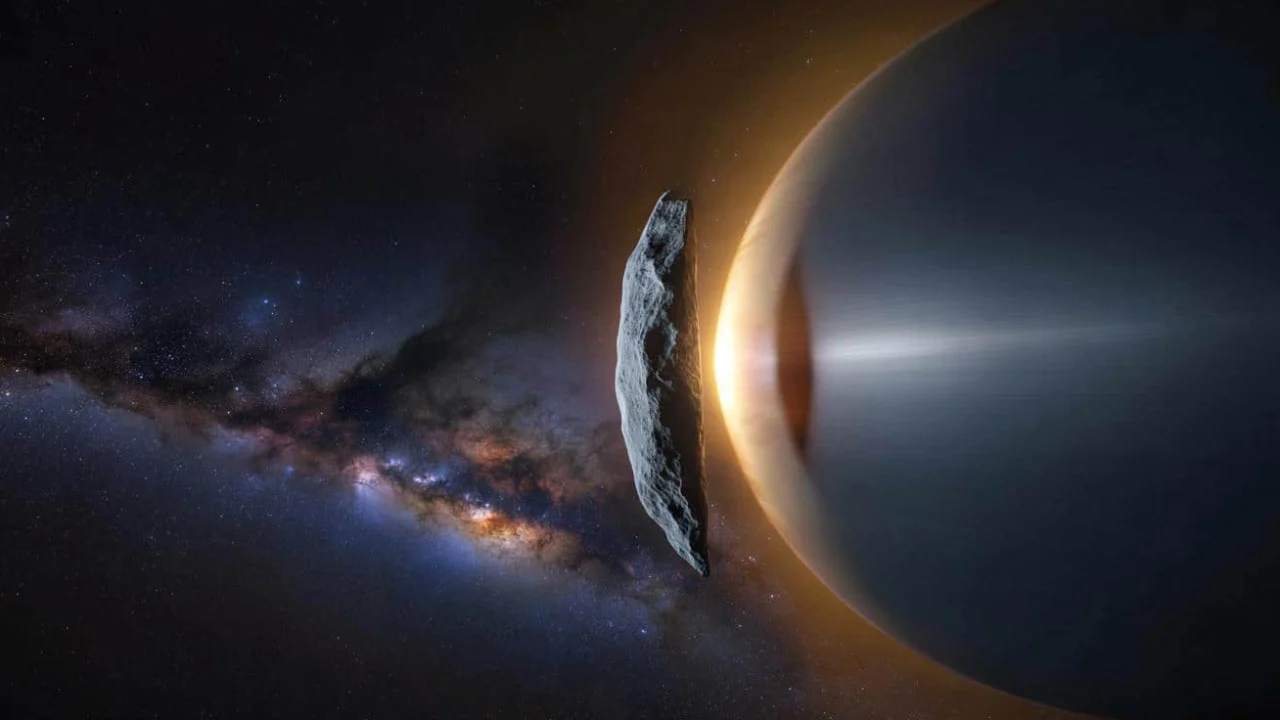
In the vast cosmic ocean, a mysterious visitor from beyond has once again caught the attention of astronomers worldwide. This newly detected interstellar object is racing toward our Solar System at an unprecedented speed, offering a rare and thrilling glimpse into the deep reaches of space outside our celestial neighborhood. Unlike the countless asteroids and comets bound by the Sun’s gravity, this rock is traveling on a hyperbolic path—meaning it is not gravitationally tethered to our Sun and will merely pass through before continuing its endless journey across the stars.
Our first known interstellar visitor, ‘Oumuamua, stunned scientists in 2017 by its peculiar cigar-like shape and odd acceleration, fundamentally challenging previous ideas about objects entering our Solar System. Then, in 2019, comet 2I/Borisov made a grand entrance, confirming that interstellar wanderers are not just anomalies but part of an ongoing cosmic phenomenon. Now, this new, faster, and likely larger object is detected farther away than its predecessors, giving astronomers an unprecedented window of opportunity to study it in detail, track its trajectory, and prepare for its close pass.
This latest discovery underscores how technological advancements have empowered researchers to transform what was once considered science fiction into a routine part of modern astronomy. It also inspires a broader public reflection on our place in the universe, highlighting the delicate balance between curiosity, caution, and wonder as we encounter cosmic visitors that have traveled for millions, if not billions, of years to reach us.
Overview of Recent Interstellar Objects
| Object | Year Discovered | Speed at Closest Approach | Notable Characteristics |
|---|---|---|---|
| ‘Oumuamua (1I/2017 U1) | 2017 | ~87 km/s | Long, cigar-like shape; unusual acceleration; no comet tail |
| 2I/Borisov | 2019 | Variable, typical of comets | Comet-like with gas emissions; clearly extraterrestrial origin |
| New Interstellar Object (Unnamed) | 2024 | Record-breaking speed; likely faster than ‘Oumuamua | Larger and detected earlier; currently approaching the inner Solar System |
Why This Visitor Matters More Than Ever
The discovery of this new interstellar object is significant not just because of its record speed, but also because it arrives with a far larger lead time for observations than prior visitors. In past encounters, astronomers scrambled to direct instrumentation and collect data as quickly as possible, often limited by the object’s faintness and sudden appearance. This time, detecting the rock while it is still faint and distant means teams can coordinate efforts worldwide, leveraging space-based and ground observatories to gather comprehensive data on its orbit, composition, and behavior.
Understanding such interstellar visitors can revolutionize our knowledge of planetary formation, cosmic chemical evolution, and even the prevalence of life’s building blocks beyond our Solar System. Unlike local asteroids and comets shaped by the Sun’s gravity and history, an object from outside our system carries a unique chemical fingerprint and orbital signature shaped by the environment of an entirely different star system.
How Astronomers Identify Interstellar Visitors
Detecting these visitors involves meticulous monitoring of countless celestial bodies against a backdrop of countless stars. Usually, objects in our Solar System follow elliptical orbits, strongly influenced by the Sun’s gravity. When a moving dot’s trajectory deviates sharply, forming a hyperbolic escape path that crosses the Solar System at an unusual angle and does not loop back, astronomers take notice.
Speed plays a crucial role. Interstellar objects approach the Sun at velocities that cannot be explained simply by gravitational pulls within our system—often exceeding tens of kilometers per second. Moreover, their approach angles can be highly inclined, coming from above or below the plane where planets circle the Sun, indicating an origin from another star’s neighborhood.
The Curious Case of ‘Oumuamua and 2I/Borisov
In 2017, ‘Oumuamua shocked scientists by its unusual shape and behavior: it lacked a cometary tail, reflected light unevenly, and exhibited slight acceleration that defied traditional models. Some speculated wildly, from natural debris to alien technology, but the consensus settled on a natural—though still mysterious—origin. Then, in 2019, comet 2I/Borisov appeared with more expected comet-like features such as gas emissions and dust, clearly confirming the existence of interstellar comets.
Both cases forced astronomers to rethink their detection capabilities, orbit modeling, and data analysis techniques. Each visitor brought unique insights, reinforcing the need for ongoing sky surveys equipped with fast and efficient algorithms to spot such transient phenomena early and accurately.
What Makes This New Object So Extraordinary?
Unlike previous visitors, this new object is not only moving faster but presents rare observational advantages because it was detected sooner and farther away. This early detection translates into a longer observation window, allowing for a carousel of advanced instruments to be aimed at this visitor. Scientists hope to resolve questions regarding its shape, size, composition, and possible outgassing behavior—the gentle release of gases triggered by the Sun’s warming effect, which can change trajectory or brightness.
Moreover, its trajectory cuts steeply through the inner Solar System, entering from an unusual angle “above” the planets’ orbital plane. This orientation strengthens the story of an interstellar wanderer disrupting expected norms and allows researchers to refine models of how such objects evolve and travel after being ejected from distant star systems.
Preparing for Cosmic Visitors: Lessons and Upgrades
Since ‘Oumuamua’s startling appearance, astronomers worldwide have been preparing their “cosmic radar” for future visits. Advances include wider and deeper sky surveys, faster computational processing, and smarter detection algorithms. Observatories are now better positioned to identify faint objects and adapt to rapid changes in trajectory data.
This infrastructure boost means that future interstellar visitors will be detected earlier and studied more thoroughly, allowing scientists to unveil details about the building blocks of other planetary systems and the dynamics of cosmic ejection events. The growing field of interstellar object astronomy also informs planetary defense strategies, ensuring that unexpectedly fast or errant bodies can be differentiated from threats.
What These Visitors Teach Us About Ourselves
The story of objects like ‘Oumuamua and the new visitor is about much more than their physical traits. It reflects the human spirit of curiosity, risk, and the willingness to question established models. Their arrival challenges our cosmic self-image, reminding us that our Solar System is not an isolated island but part of a vast and dynamic galactic ecosystem.
As astrophysicist Avi Loeb notes, “Every time nature throws us something that doesn’t fit our boxes, we have a choice. We can defend the boxes, or we can rebuild them.” In this attitude lies the scientific journey: open yet cautious, imaginative yet evidence-based.
For the average person, these visitors are reminders to look up, reconnect with the night sky, and consider our place—not just physically but philosophically—in the cooler and older universe stretching beyond.
How to Experience the Mystery of Interstellar Visitors
While these objects are too faint for the naked eye, anyone with a curiosity about space can observe the cosmos actively. Stepping outside to a location free from light pollution to gaze skyward can inspire wonder that is otherwise confined to headlines. Using star charts or astronomy apps can help identify planets and constellations, reinforcing the reality that amidst familiar cosmic landmarks, an ancient visitor silently threads its way through.
Following live updates and reading about scientific progress related to such objects offers a shared connection between communities of researchers and curious individuals across the globe, united in the awe of discovery.
Short FAQ on Interstellar Objects
What makes an object interstellar?
An object is considered interstellar if it is not gravitationally bound to the Sun and travels through our Solar System on a hyperbolic orbit, indicating it originated from another star system.
Are these objects dangerous to Earth?
No, being “racing toward us” means passing through the Solar System, not necessarily on a collision course with Earth. Such objects typically swing close to the Sun and continue on their path outward.
How fast do interstellar objects travel?
They can travel at speeds significantly higher than typical Solar System objects—often tens of kilometers per second. ‘Oumuamua, for example, moved around 87 km/s relative to the Sun at closest approach.
Why did ‘Oumuamua behave strangely?
‘Oumuamua lacked a cometary tail but showed unusual acceleration, possibly due to outgassing or other forces, which puzzled scientists and challenged existing comet and asteroid models.
Can we identify their composition?
With advanced telescopes and spectral analysis during their approach, scientists can infer surface materials and gases released, though data remains limited due to the objects’ faintness and speed.
How often do interstellar visitors come close?
Interstellar objects passing through our system appear rare but are likely more common than we previously thought, with improved detection technologies revealing more frequent appearances.
How do scientists prepare for new interstellar discoveries?
Through expanded sky surveys, real-time data processing, global collaboration, and the allocation of telescope time for rapid follow-up observations upon detection.
What can the public do to learn more?
Anyone interested can follow astronomy news, participate in public observing events, use astronomy apps, and appreciate the broader scientific quest to understand our universe.
“Every time nature throws us something that doesn’t fit our boxes, we have a choice. We can defend the boxes, or we can rebuild them.”
— Avi Loeb, Astrophysicist
What is unique about the newly detected interstellar object?
The newly detected interstellar object is traveling at an unprecedented speed on a hyperbolic path, meaning it is not gravitationally bound to the Sun and will pass through the Solar System before continuing its journey across the stars.
How does this new interstellar object compare to previous ones like u2018Oumuamua and 2I/Borisov?
This new object is faster and likely larger than previous interstellar visitors such as u2018Oumuamua and 2I/Borisov, and it was detected farther away, giving astronomers more time to study and track it.
What was significant about the interstellar object u2018Oumuamua discovered in 2017?
u2018Oumuamua surprised scientists with its long, cigar-like shape and unusual acceleration without a comet tail, challenging existing ideas about objects entering our Solar System.
What did the discovery of comet 2I/Borisov in 2019 confirm?
The discovery of 2I/Borisov confirmed that interstellar wanderers are not just rare anomalies but part of an ongoing cosmic phenomenon, as it was a comet-like object with gas emissions clearly originating from outside our Solar System.
How have technological advancements impacted the study of interstellar objects?
Technological advancements have transformed the detection and study of interstellar objects from a rarity into a routine part of modern astronomy, allowing astronomers to track trajectories and prepare for close encounters with greater precision.
What broader impact does the discovery of interstellar objects have on the public?
These discoveries inspire public reflection on our place in the universe and highlight the delicate balance of curiosity, caution, and wonder as we encounter cosmic visitors that have traveled for millions or billions of years to reach us.