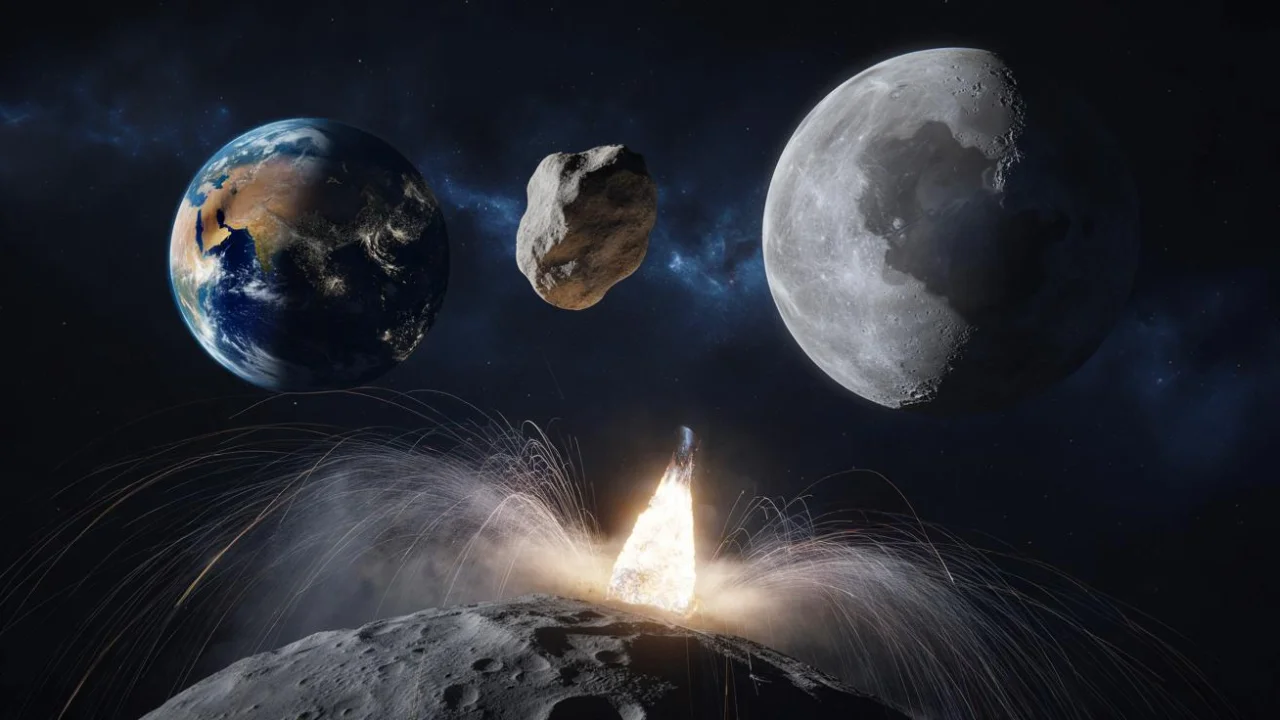
Scientists have mapped thousands of potential collision scenarios for a city-sized space rock heading toward the inner solar system, revealing that our moon faces a 4.3% chance of impact in December 2032. Asteroid 2024 yr4, roughly 60 meters across and about the height of a 15-story building, could create the largest lunar strike visible in modern telescope history, potentially triggering a flash as bright as Venus and sending meteor storms toward Earth.
The discovery has transformed what began as Earth’s most threatening asteroid encounter into an unprecedented scientific opportunity to study cosmic impacts in real-time.
Mission-Critical Impact Predictions Overview
| Parameter | Current Assessment | Confidence Level |
|---|---|---|
| Asteroid Size | 60 meters diameter | High |
| Earth Impact Probability | 0% (ruled out) | Confirmed |
| Lunar Impact Probability | 4.3% (1 in 25 chance) | NASA official estimate |
| Impact Date | December 22, 2032 | High precision |
| Impact Time | 10:19 AM Eastern | Within observation window |
| Flash Brightness | Magnitude -2.5 to -3 | Venus-level visibility |
Computational Impact Modeling Results
Researchers at Tsinghua University and UC Santa Cruz ran 10,000 computer simulations to map every possible collision scenario. Their massive computational effort reveals precise impact corridors and aftermath predictions.
| Simulation Component | Scale | Key Finding |
|---|---|---|
| Orbital Variations Tested | 10,000 scenarios | 3,000 km impact corridor identified |
| Impact Energy Release | 6.5 million tonnes TNT | Largest modern lunar strike |
| Flash Duration | 200-300 seconds | 10+ seconds clearly visible |
| Secondary Impacts | Thousands of debris strikes | Minutes to hours of flashes |
| Lunar Material Ejected | Up to 100 million kg | Super meteor storm potential |
| Meteor Storm Timeline | 2-100 days post-impact | Multiple intense episodes |
How Detection Capabilities Compare Across Scenarios
The visibility of any lunar impact depends heavily on timing, location, and observational equipment. Current models show dramatic differences in detection probability across various conditions.
| Viewing Condition | Detection Probability | Equipment Required | Geographic Coverage |
|---|---|---|---|
| Naked Eye (Dark Moon) | Less than 3% | None | East Asia, Oceania, Hawaii, W. North America |
| Naked Eye (Bright Moon) | Near 0% | None | Same regions |
| Small Telescope | 95%+ if moon visible | 4-inch telescope minimum | All favorable longitudes |
| Professional Observatory | 100% if moon above horizon | Research-grade instruments | Global coordination possible |
| Space-Based Detection | 100% | Orbital telescopes | Continuous monitoring |
Geographic Regions Most Likely to Witness Impact
The predicted impact timing of 10:19 AM Eastern on December 22, 2032, creates clear advantages for specific global regions. Asteroid 2024 yr4 would strike during optimal viewing conditions for nearly half the planet.
Prime Viewing Locations (Moon Above Horizon):
- East Asia: Evening sky, excellent positioning for telescopic observation
- Australia and New Zealand: Late evening hours, minimal atmospheric interference
- Hawaii: Midnight positioning, dark skies available
- Western North America: Pre-dawn hours, experienced amateur astronomy communities
- Western Pacific Islands: Optimal viewing angles, minimal light pollution
Regions with Poor or No Visibility:
- Europe and Africa: Moon below horizon during impact window
- Eastern North America: Daylight hours, moon not visible
- South America: Limited to southern regions only
“This represents the first time we’ve had advance warning of a potential major lunar impact with enough lead time to prepare coordinated global observations,” says a planetary defense specialist at NASA’s Jet Propulsion Laboratory.
Scientific Preparation Activities Already Underway
The astronomical community has mobilized unprecedented resources to track and study this potential impact. Even the James Webb Space Telescope allocated discretionary observation time to refine the asteroid’s properties.
Current Research Priorities:
- Orbital Refinement: Weekly tracking observations through 2029 to narrow impact probability
- Composition Analysis: Spectroscopic studies to predict crater formation and debris patterns
- Impact Site Preparation: Detailed mapping of potential target areas on lunar surface
- Observation Network Coordination: International telescope scheduling for December 2032
- Debris Tracking Models: Predicting Earth-directed fragment trajectories
- Amateur Astronomy Integration: Protocols for citizen science contributions
Equipment Deployment Timeline:
- 2025-2027: Enhanced ground-based tracking systems installation
- 2028-2030: Specialized impact detection instruments preparation
- 2031-2032: Final positioning of mobile observatories
- December 2032: Coordinated global observation campaign execution
“We’re essentially turning the entire solar system into a controlled laboratory experiment, with thousands of telescopes as our instruments,” explains a computational astrophysicist at UC Santa Cruz.
Expected Meteor Storm Characteristics
If the impact occurs, Earth could experience unprecedented meteor activity as lunar debris enters our atmosphere. The intensity would far exceed typical annual meteor showers, creating what researchers term “super meteor storms.”
Normal meteor showers like the Perseids peak at roughly 100 meteors per hour under ideal conditions. A lunar impact debris field could produce meteors every few seconds during peak activity periods, with bursts lasting minutes to hours across multiple nights.
| Meteor Storm Phase | Timeline After Impact | Expected Intensity | Duration |
|---|---|---|---|
| Initial Fragment Arrival | 2-5 days | Moderate increase | Several hours |
| Primary Storm Peak | 7-21 days | Extreme (1000+ per hour) | Multiple nights |
| Secondary Peaks | 30-60 days | High (300-500 per hour) | Intermittent bursts |
| Extended Activity | 60-100 days | Enhanced background | Weeks |
Critical Questions About Lunar Impact Scenarios
What makes this asteroid particularly threatening to the moon?
Its orbital path intersects the moon’s trajectory with unusual precision, creating a 4.3% collision probability.
Could the impact affect Earth directly?
No physical danger to Earth, but debris could create spectacular meteor displays for months.
How bright would the flash appear from Earth?
Similar to Venus at peak brightness, easily visible to naked eye under dark skies.
What would happen to the International Space Station?
ISS faces minimal risk from debris, with ample warning time for protective positioning.
How accurate are the current impact predictions?
Probability estimates will improve significantly as the asteroid approaches in the late 2020s.
Would amateur astronomers be able to contribute meaningful data?
Yes, coordinated timing observations from backyard telescopes would provide valuable scientific measurements.
Strategic Observation Preparation Timeline
The scientific community faces an eight-year window to prepare for potential observations of the century. Asteroid 2024 yr4 has already triggered the largest coordinated asteroid tracking campaign in history, serving as an invaluable rehearsal for planetary defense protocols.
This rare opportunity allows researchers to position instruments, coordinate international observations, and refine impact prediction models with unprecedented precision. Whether or not the impact occurs, the preparatory work advances our capability to respond to future asteroid threats.
| Preparation Phase | Timeline | Key Actions | Success Metrics |
|---|---|---|---|
| Orbital Refinement | 2025-2028 | Monthly tracking observations | Impact probability ±0.1% accuracy |
| Equipment Positioning | 2029-2031 | Telescope network deployment | 100+ coordinated instruments |
| Final Preparations | 2032 | Real-time tracking protocols | Second-by-second impact timing |
| Impact Documentation | December 22, 2032 | Global observation campaign | Complete impact sequence recording |