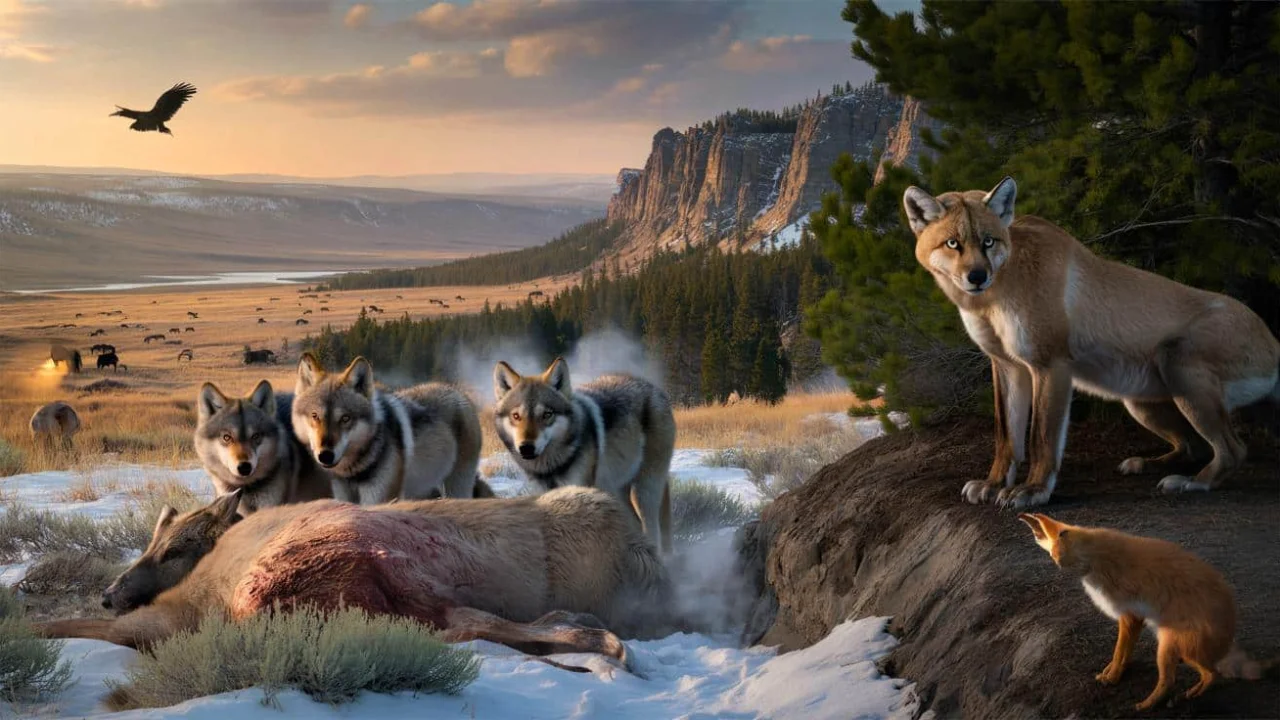
When Apex Predators Collide: The Yellowstone Story
In the golden light of dawn across Yellowstone’s expansive valleys, a drama unfolds that has captivated scientists and nature lovers alike. Two of North America’s most formidable hunters—wolves and cougars—navigate a delicate dance of survival, territory, and adaptation that speaks to the very heart of what it means to coexist in the wild. This isn’t just another wildlife story; it’s a testament to nature’s remarkable ability to find balance even when the odds seem insurmountable.
For decades, these valleys echoed with an incomplete symphony. The howl of the wolf had been silenced, and the shadow of the cougar had all but vanished from these mountains. But nature, as it often does, found a way to heal itself. Today, as morning mist rises from the Lamar Valley and elk graze cautiously in meadows where their ancestors once roamed freely, we witness one of conservation’s most remarkable success stories—and its most complex challenges.
The return of yellowstone predators has transformed this landscape into a living laboratory where scientists can observe, for perhaps the first time in modern history, how two apex predators learn to share the same home. It’s a story of adaptation, conflict, and surprising cooperation that continues to unfold with each passing season.
A Laboratory of Coexistence
Yellowstone National Park has become something unprecedented in the modern American West—a place where the full complement of large carnivores that once ruled this continent roam free once again. The park now hosts wolves, cougars, grizzly bears, and black bears, creating a predator community that most ecosystems lost more than a century ago.
The wolves returned first through human intervention. In 1995, wildlife managers released 31 gray wolves from Canada into Yellowstone’s northern range, marking the end of a 70-year absence. The cougars had been slowly filtering back on their own since the 1960s, taking advantage of improved protections and expanding deer populations.
“What we’re seeing in Yellowstone is extraordinary because it gives us a window into how these species might have coexisted historically,” explains Dr. Sarah Martinez, lead researcher on the decade-long study tracking both species. “We’re watching evolution in real-time as these predators figure out how to share resources.”
| Predator Characteristic | Wolves | Cougars |
|---|---|---|
| Hunting Strategy | Pack coordination | Solitary ambush |
| Average Pack/Individual Size | 8-10 individuals | Single adult |
| Primary Historical Prey | Elk (95% in 1998) | Elk (80% in 1998) |
| Current Primary Prey | Elk (64% in 2024) | Elk (53% in 2024) |
| Territory Size | 50-1000 sq miles | 30-300 sq miles |
| Interaction with Rival | Dominant, sometimes kills cougars | Avoidant, never kills wolves |
The Hierarchy of Power
Despite cougars being formidable predators in their own right—capable of taking down elk weighing several times their body weight—the research reveals a stark reality: in direct confrontations, wolves almost always win. This dominance stems not from individual strength but from pack dynamics that give wolves overwhelming tactical advantages.
The data, collected from GPS collars and thousands of kill site investigations, tells a compelling story of adaptation under pressure. Yellowstone predators have developed intricate strategies to minimize direct conflict while maximizing their hunting success.
- Temporal Separation: Cougars have shifted their activity patterns to avoid peak wolf hunting times
- Spatial Avoidance: Mountain lions increasingly use rugged terrain where wolf packs struggle to coordinate
- Rapid Feeding: Cougars consume kills faster to reduce the risk of being displaced by wolves
- Cache Strategies: Mountain lions have refined their ability to hide kills from scavenging wolves
- Alternative Prey Selection: Both species have diversified diets to reduce competition pressure
The Great Dietary Shift
Perhaps the most fascinating aspect of this ongoing study is how both predators have adapted their hunting strategies as elk populations declined. The abundance of elk that initially supported both species has decreased significantly since the late 1990s, forcing each predator to make different choices.
Wolves, with their pack advantage, began targeting bison more frequently—massive animals that would be impossible for a solitary cougar to bring down. This shift toward larger prey makes ecological sense: a single bison provides enough meat to feed an entire wolf pack for days, making the energy investment worthwhile despite the increased risk.
“The dietary flexibility we’re observing challenges many of our assumptions about predator behavior,” notes Dr. James Thompson, a wildlife ecologist who has studied Yellowstone’s ecosystem for over two decades. “These animals are proving far more adaptable than we ever imagined.”
Cougars took the opposite approach, increasingly focusing on deer and other smaller prey. This strategy allows them to avoid direct competition with wolf packs while still maintaining their solitary hunting lifestyle. Smaller prey also means cougars can consume their kills more quickly, reducing the likelihood of theft by opportunistic wolves.
Ripple Effects Across the Ecosystem
The dietary shifts of yellowstone predators have created cascading effects throughout the park’s ecosystem. As wolves focus more on bison and cougars turn to deer, the pressure on different ungulate populations has redistributed in unexpected ways.
This redistribution has implications far beyond predator-prey relationships:
- Vegetation Recovery: Reduced elk browsing in some areas has allowed aspen and willow stands to regenerate
- Stream Morphology: Recovering vegetation along waterways has helped stabilize stream banks
- Scavenger Communities: Different kill patterns have altered food availability for ravens, eagles, and bears
- Ungulate Behavior: Elk, deer, and bison have all modified their feeding patterns and habitat use
The complexity of these interactions underscores why Yellowstone has become such a valuable research site. Unlike most ecosystems where humans have simplified predator communities, Yellowstone offers a glimpse into the intricate web of relationships that once characterized much of North America.
Seasonal Dynamics and Climate Influence
The relationship between wolves and cougars doesn’t remain static throughout the year. Winter brings unique challenges and opportunities that further complicate their coexistence. Snow depth affects hunting success differently for each species, while extreme weather events can dramatically alter prey availability and behavior.
During harsh winters, both predators face increased pressure to secure kills, leading to more frequent encounters and heightened competition. However, deep snow can actually benefit cougars by providing better ambush opportunities and hindering wolf pack coordination.
“Climate change adds another layer of complexity to predator interactions,” explains Dr. Lisa Chen, a climate ecologist studying Yellowstone’s changing conditions. “As weather patterns become more unpredictable, these animals must adapt not just to each other, but to an increasingly variable environment.”
Conservation Implications Beyond Yellowstone
The lessons learned from studying yellowstone predators extend far beyond the park’s boundaries. As conservation efforts work to restore predator populations across the American West, understanding how multiple apex predators can coexist becomes crucial for ecosystem management.
The research suggests that landscapes can support multiple predator species, but only under specific conditions. Adequate prey diversity, sufficient habitat complexity, and minimal human interference all play critical roles in enabling coexistence.
Frequently Asked Questions
How many wolves and cougars currently live in Yellowstone?
Approximately 95 wolves in 8-10 packs and an estimated 34-42 adult cougars currently inhabit the park.
Do wolves actively hunt cougars as prey?
Wolves occasionally kill cougars but don’t typically hunt them as prey; most deaths result from territorial conflicts.
How has elk population decline affected both predators?
Both species diversified diets: wolves increased bison consumption while cougars shifted toward smaller prey like deer.
Can cougars and wolves share the same territory peacefully?
Yes, through temporal and spatial separation strategies that minimize direct encounters and competition.
What role do scavengers play in predator interactions?
Ravens, eagles, and bears benefit from kills but also alert competing predators to active feeding sites.
How do weather conditions affect predator competition?
Deep snow can hinder wolf pack coordination while providing cougars with better ambush opportunities and cover.
The story of Yellowstone’s returning predators continues to evolve with each passing year, offering new insights into the remarkable adaptability of wildlife and the complex dynamics that govern ecosystem function. As we witness this natural experiment unfold, we gain invaluable knowledge about conservation, coexistence, and the resilience of nature itself. The wolves and cougars of Yellowstone aren’t just surviving together—they’re teaching us what’s possible when we give ecosystems the space and time to heal.