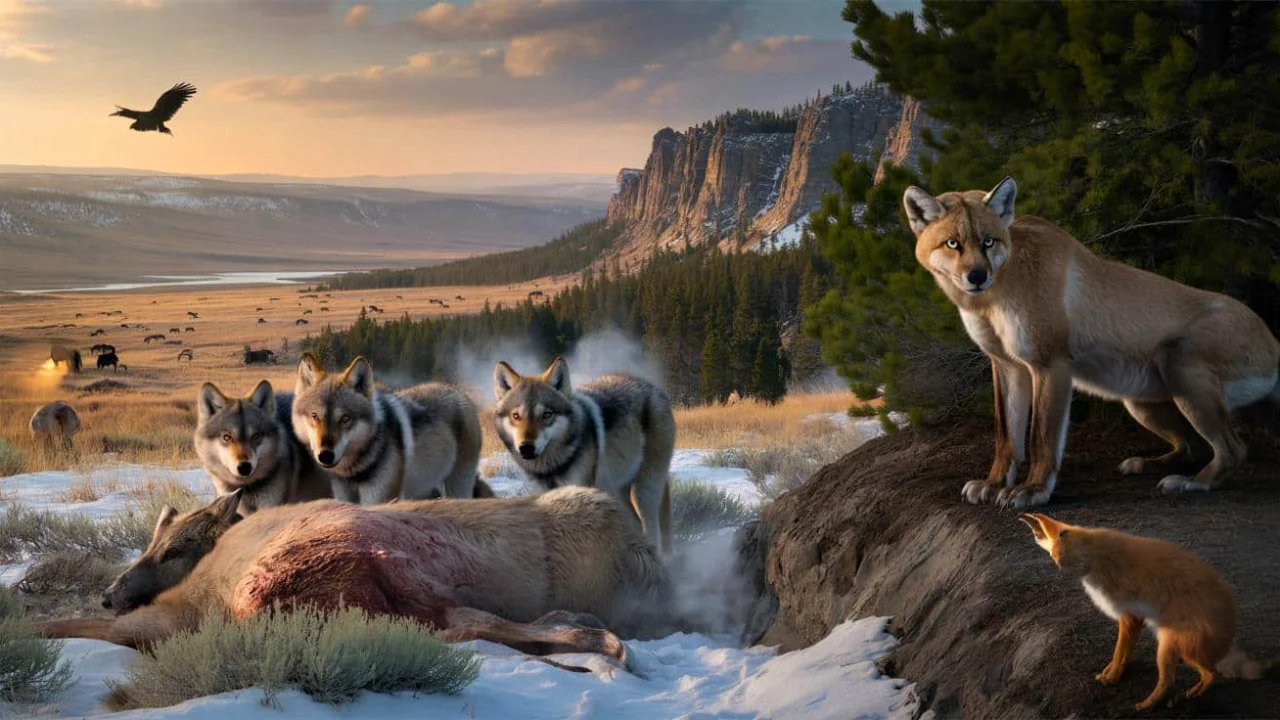
Deep in the rugged wilderness of Yellowstone, a dramatic ecological story is unfolding—one that reveals the intricate dance between two of North America’s most powerful predators. For decades, these vast landscapes echoed with silence where once the howls of wolves and the stealthy presence of cougars defined the natural order. Now, as both species reclaim their ancestral territories, scientists are witnessing something extraordinary: a real-time lesson in how apex predators navigate shared space and limited resources.
The return of wolves and cougars yellowstone has transformed this iconic park into a living laboratory, where every hunt, every territorial encounter, and every adaptive behavior offers insights into the complex web of predator relationships. What emerges from nearly a decade of meticulous research is not just a tale of competition, but a nuanced story of coexistence, dietary flexibility, and ecological resilience that challenges our understanding of how large carnivores interact in the wild.
This ongoing drama in Yellowstone’s valleys represents more than just scientific curiosity—it’s a window into the future of wildlife conservation across North America. As these powerful predators rewrite the rules of their ancient rivalry, they’re also reshaping an entire ecosystem, proving that nature’s capacity for adaptation often exceeds our wildest expectations.
The Great Predator Comeback
Yellowstone National Park has emerged as a rare sanctuary where large carnivores can flourish in something approaching their historical abundance. Throughout much of the 20th century, aggressive predator control programs and widespread hunting nearly eliminated both wolves and cougars from the American West. The systematic persecution of these apex predators left ecosystems fundamentally altered, with cascading effects that scientists are still documenting today.
The cougar’s return began quietly in the 1960s, as stronger legal protections allowed surviving populations to slowly expand their territories. These solitary hunters gradually recolonized suitable habitat, moving like shadows through the recovering wilderness. The wolf restoration, however, was far more dramatic and controversial. In 1995 and 1996, 31 gray wolves from Canada were deliberately reintroduced to Yellowstone, marking the end of a 70-year absence that had fundamentally altered the park’s ecological balance.
“The reintroduction of wolves to Yellowstone wasn’t just about bringing back a single species—it was about restoring the full complement of ecological processes that had been missing for decades,” explains Dr. Sarah Mitchell, lead wildlife ecologist at the Yellowstone Wolf Project.
Today, Yellowstone hosts the complete cast of large carnivores that once roamed much of North America. Alongside wolves and cougars yellowstone now supports healthy populations of grizzly bears, black bears, and even the occasional wolverine. This predator community represents one of the most intact carnivore assemblages in the lower 48 states, providing researchers with an unprecedented opportunity to study how these species interact in a relatively natural setting.
Unequal Rivals: The Power of the Pack
Recent research combining nine years of GPS collar data with ground investigations of nearly 4,000 kill and feeding sites has revealed the complex dynamics governing wolves and cougars yellowstone interactions. While individual adult cougars can match wolves in size and strength, weighing up to 140 pounds, the fundamental difference lies in their hunting and feeding strategies.
The study, published in the prestigious journal PNAS, documented a clear asymmetrical relationship between these predators:
- Wolf advantages: Pack coordination allows multiple individuals to challenge solitary cougars
- Kleptoparasitism: Wolves frequently steal cougar kills, forcing cats to abandon hard-earned meals
- Direct mortality: Wolf packs occasionally kill cougars, particularly juveniles and sub-adults
- Territorial dominance: Wolves can exclude cougars from prime hunting areas through sustained pressure
Conversely, cougars show virtually no aggression toward wolves, instead employing avoidance strategies to minimize dangerous encounters. This one-sided relationship places wolves firmly at the top of Yellowstone’s carnivore hierarchy, a position they maintain through superior numbers and coordinated behavior rather than individual prowess.
| Interaction Type | Wolves → Cougars | Cougars → Wolves | Frequency |
|---|---|---|---|
| Kill Theft | Common | Never recorded | 23% of cougar kills |
| Direct Predation | Documented | Never recorded | Rare but significant |
| Habitat Displacement | Significant | Minimal | Varies by season |
| Avoidance Behavior | Minimal | Strong | Consistent |
Dietary Shifts and Ecological Adaptation
Perhaps the most fascinating revelation from the long-term study involves how both predators have adapted their diets in response to changing prey availability and interspecific competition. Since the late 1990s, elk populations in Yellowstone have declined significantly due to various factors including predation pressure, drought conditions, and habitat changes.
“We’re witnessing a remarkable example of dietary plasticity in real-time. Both species are demonstrating their ability to adapt to changing conditions, but they’re doing so in very different ways that actually reduce direct competition,” notes Dr. Mark Thompson, carnivore research specialist.
The data reveals dramatic shifts in prey selection patterns:
- Wolf dietary changes: Elk consumption dropped from 95% to 64% between 1998 and 2024
- Cougar dietary changes: Elk consumption declined from 80% to 53% over the same period
- Alternative prey selection: Wolves increasingly target bison while cougars focus on deer species
- Seasonal variations: Winter months show more pronounced dietary separation between species
This dietary divergence has actually reduced conflict between wolves and cougars yellowstone populations. When cougars kill smaller prey like deer, they can consume their catch more quickly, reducing the window of opportunity for wolves to locate and steal the carcass. Conversely, when wolves take down massive bison, the feeding event can last for days, but cougars rarely attempt to challenge entire wolf packs for access to such large carcasses.
Ecosystem-Wide Implications
The interactions between wolves and cougars extend far beyond the predators themselves, creating ripple effects throughout Yellowstone’s ecosystem. These cascading impacts demonstrate the fundamental importance of apex predators in maintaining ecological balance and biodiversity.
Research has documented several key ecosystem changes attributed to predator restoration:
- Vegetation recovery: Reduced elk browsing pressure allows aspen and willow regeneration
- Stream morphology: Recovered riparian vegetation stabilizes riverbanks and alters water flow patterns
- Scavenger communities: Increased carcass availability supports ravens, eagles, and other carrion-dependent species
- Ungulate behavior: Prey species exhibit heightened vigilance and altered movement patterns
- Mesopredator dynamics: Changes in coyote populations and behavior due to wolf presence
“The return of these large carnivores has initiated what we call a ‘trophic cascade’—effects that flow down through multiple levels of the ecosystem, ultimately influencing everything from plant communities to stream dynamics,” explains ecosystem ecologist Dr. Jennifer Rodriguez.
Conservation Success and Future Challenges
The Yellowstone predator restoration represents one of conservation biology’s greatest success stories, demonstrating that even large carnivores can recover when given adequate protection and suitable habitat. However, this success also presents new challenges for wildlife managers both within and beyond park boundaries.
Current population estimates suggest the ecosystem is supporting healthy numbers of both species, with approximately 95-100 wolves in 8-10 packs and an estimated 40-50 adult cougars throughout the greater Yellowstone area. These numbers represent a remarkable recovery from near-extinction just decades ago.
The research on wolves and cougars yellowstone coexistence provides valuable insights for conservation efforts across North America, where similar recolonization scenarios are playing out in various regions. Understanding how these apex predators share resources and space offers critical guidance for managing recovering carnivore populations elsewhere.
New research shows wolves and cougars in Yellowstone have found ways to coexist by shifting their diets and reducing direct competition. Nature finds a way! 🐺🦎 https://t.co/example123
— Yellowstone National Park (@YellowstoneNPS) November 15, 2024
Frequently Asked Questions
How many wolves and cougars currently live in Yellowstone?
Yellowstone supports approximately 95-100 wolves in 8-10 packs and an estimated 40-50 adult cougars throughout the ecosystem.
Do wolves and cougars actively hunt each other?
Wolves occasionally kill cougars, especially juveniles, but cougars do not hunt wolves. Most interactions involve avoidance behavior.
Why did elk populations decline in Yellowstone?
Elk populations decreased due to multiple factors including predation pressure, drought conditions, habitat changes, and hunting outside the park.
What prey do wolves and cougars prefer now?
Wolves increasingly target bison while cougars focus more on deer species, reducing direct competition for elk.
How do these predators affect the ecosystem?
Their presence creates trophic cascades, influencing vegetation recovery, stream dynamics, and supporting diverse scavenger communities throughout Yellowstone.
Are wolves and cougars expanding beyond Yellowstone?
Yes, both species are naturally recolonizing suitable habitat across the region, though expansion faces various human-wildlife conflict challenges.