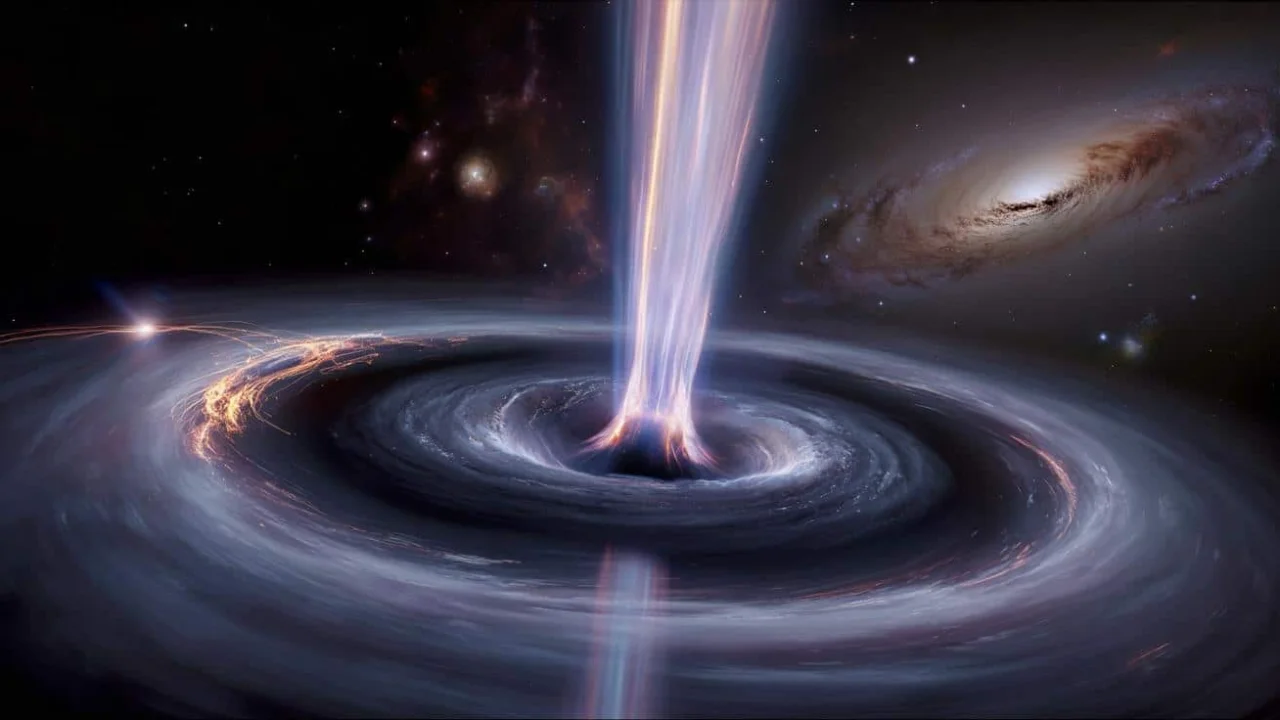
A Cosmic Feeding Frenzy Unlike Anything We’ve Seen Before
In the vast darkness of space, billions of light-years from Earth, something extraordinary is happening. A supermassive black hole has been putting on one of the most spectacular cosmic shows ever recorded, and it shows no signs of slowing down. What started as a routine stellar death in 2018 has evolved into a phenomenon so energetic that scientists have dubbed it “Jetty McJetface” – a playful name for what might be one of the most powerful engines in the known universe.
This isn’t just another distant astronomical event that briefly captures headlines before fading into obscurity. The black hole outburst known as Jetty McJetface has been defying every expectation, growing brighter and more powerful year after year. While most cosmic events of this type burn bright and fade quickly, this particular spectacle has been steadily ramping up its energy output for over five years, challenging our fundamental understanding of how black holes behave when they consume stellar material.
The emotional weight of witnessing such raw cosmic power is difficult to convey. Here is a force so immense that it has torn apart an entire star and converted its remains into a jet of material traveling at nearly the speed of light. The energy being released is so vast that it dwarfs anything in human experience – imagine a trillion Death Stars from Star Wars firing simultaneously, and you’re still nowhere close to comprehending the scale of this black hole outburst.
What makes this discovery particularly profound is how it reveals the universe’s capacity for violence and beauty simultaneously. The same gravitational forces that create such devastating destruction also generate the most luminous and energetic phenomena we can observe, painting cosmic landscapes with jets of plasma that stretch across millions of light-years.
The Anatomy of Stellar Destruction
The catastrophic event that created Jetty McJetface began when an unsuspecting star wandered too close to the supermassive black hole designated AT2018hyz. What followed was a textbook example of what astronomers call a tidal disruption event, though this particular case would prove to be anything but textbook.
Key characteristics of this stellar destruction include:
- Spaghettification Process: The star was stretched into long, thin strands of gas by the black hole’s immense gravitational gradient
- Accretion Disk Formation: Part of the stellar material formed a swirling disk around the black hole, heating to millions of degrees
- Jet Launch Mechanism: Magnetic fields near the black hole accelerated some material to relativistic speeds
- Energy Release Scale: The total energy output exceeds 10^44 joules, making it visible across cosmic distances
- Duration Anomaly: Unlike typical events that fade within months, this outburst continues strengthening after five years
Breaking Records in Deep Space
Recent observations published in the Astrophysical Journal have confirmed that Jetty McJetface is shattering records across multiple categories. The radio signals emanating from this black hole outburst have grown approximately 50 times brighter since 2019, indicating that the jet mechanism is not only sustained but actively intensifying.
| Measurement Category | Jetty McJetface Value | Typical TDE Range |
|---|---|---|
| Duration of Activity | 5+ years (ongoing) | 6 months – 2 years |
| Radio Brightness Increase | 50x since 2019 | Typically decreases |
| Jet Velocity | ~99% speed of light | 80-95% speed of light |
| Total Energy Output | >10^44 joules | 10^42-10^43 joules |
| Peak Brightness Prediction | Expected around 2027 | Usually within first year |
Expert Insights on This Unprecedented Phenomenon
Leading astronomers worldwide have been captivated by the unusual behavior of this black hole outburst. Their observations and theories are helping reshape our understanding of these extreme cosmic events.
“What we’re seeing with Jetty McJetface completely overturns our expectations about tidal disruption events. The fact that it’s still brightening after five years suggests we’re witnessing a feeding mechanism that’s far more efficient and long-lasting than anything in our current models. This could represent a entirely new class of cosmic phenomena.”
The international team tracking this event has employed multiple observatories across the globe, from radio telescopes to X-ray satellites, creating an unprecedented multi-wavelength view of the ongoing spectacle.
“The energy scales involved here are almost incomprehensible. When we calculate the total power output, we’re looking at something that makes our Sun look like a flickering candle by comparison. Yet somehow, this black hole has maintained and even increased this output for years. It’s rewriting the textbooks on stellar destruction.”
The Science Behind the Spectacle
Understanding why Jetty McJetface behaves so differently from other tidal disruption events requires delving into the complex physics of black hole accretion. Several factors contribute to this extraordinary longevity and brightness:
- Magnetic Field Configuration: The black hole’s magnetic field may be exceptionally well-organized, creating a more efficient jet-launching mechanism
- Stellar Mass and Composition: The destroyed star might have been unusually massive or had a unique internal structure that provides sustained fuel
- Black Hole Spin Rate: A rapidly rotating black hole can extract more energy from infalling material through the Penrose process
- Accretion Disk Stability: The formation of an unusually stable and long-lived accretion disk could explain the sustained energy output
- Jet Collimation: Highly focused jets can appear brighter and maintain their intensity over greater distances
“This isn’t just about one unusual black hole anymore – Jetty McJetface is teaching us about the fundamental limits of energy extraction in the universe. The mechanisms we’re observing here could help explain some of the most energetic phenomena we see in distant galaxies.”
Implications for Our Understanding of the Universe
The continued brightening of this remarkable black hole outburst has implications that extend far beyond a single destroyed star. Astronomers are using these observations to test theories about black hole physics, jet formation, and the role of magnetic fields in cosmic acceleration processes.
The event is also providing insights into how supermassive black holes might have grown so rapidly in the early universe. If similar long-duration feeding events were common in cosmic history, they could help explain how billion-solar-mass black holes formed when the universe was still young.
Current modeling suggests that Jetty McJetface will continue brightening until approximately 2027, giving researchers an unprecedented seven-year window to study the evolution of a relativistic jet in real-time. This extended observation period is already yielding data that couldn’t be obtained from shorter-duration events.
The Future of Jetty McJetface
As we look toward the predicted peak in 2027, astronomers are preparing for what could be an even more spectacular phase of this cosmic drama. Advanced telescopes coming online in the next few years will provide even more detailed observations of the jet structure and evolution.
The naming of this phenomenon as “Jetty McJetface” reflects both the scientific community’s sense of humor and the public’s engagement with cosmic discoveries. Like the famous “Boaty McBoatface” that inspired its moniker, this playful name has helped bring attention to serious scientific research and the wonder of astronomical discovery.
Frequently Asked Questions
What exactly is Jetty McJetface?
A supermassive black hole outburst caused by a star being torn apart and converted into an extremely powerful relativistic jet.
How bright is this black hole outburst compared to normal cosmic events?
It’s among the most energetic known objects, releasing over a trillion times more energy than fictional superweapons.
Why is this event so unusual compared to other black hole feeding events?
Most tidal disruption events fade within months, but Jetty McJetface has been growing brighter for over five years.
Can this black hole outburst affect Earth in any way?
No, it’s billions of light-years away and poses absolutely no threat to our planet or solar system.
When will Jetty McJetface reach its peak brightness?
Current models predict the outburst will reach maximum intensity around 2027, then gradually begin to fade.
How do scientists study such distant cosmic events?
Multiple telescopes observe different wavelengths of light, from radio waves to X-rays, creating a comprehensive view of the phenomenon.