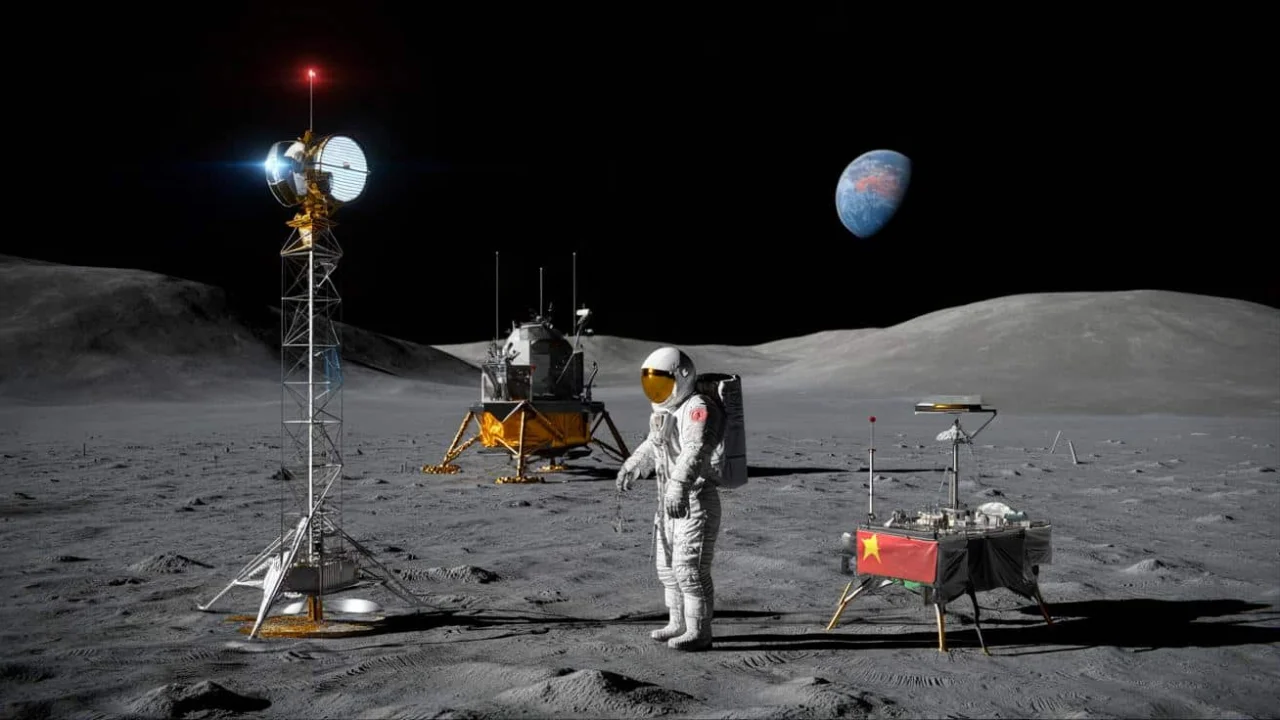
“The precision of timekeeping on the moon isn’t just an academic exercise—it’s a fundamental infrastructure requirement that will determine whether future lunar missions succeed or fail catastrophically,” says Dr. Michael Harrison, a space navigation specialist at the European Space Agency.
China has just unveiled the world’s first operational lunar clock system, addressing one of the most overlooked challenges facing humanity’s return to the moon. While most people focus on rockets and spacesuits, the subtle effects of Einstein’s relativity are quietly creating a timing crisis that could derail international lunar operations before they even begin.
The Chinese LTE440 system represents a breakthrough in addressing time dilation effects that make lunar clocks run 56 microseconds faster each Earth day. This seemingly tiny difference compounds into navigation errors, communication failures, and safety hazards that could prove deadly for astronauts living months away from Earth.
Einstein’s Relativity Creates Lunar Timing Crisis
Einstein’s general relativity predicts that time flows differently in varying gravitational fields. Earth’s stronger gravity makes time pass more slowly compared to the moon’s weaker gravitational environment. This creates a relentless drift where lunar clocks gradually outpace Earth timepieces.
The effect accumulates exponentially. What starts as 56 microseconds per day becomes nearly 21 milliseconds per year. For precision navigation systems that rely on nanosecond accuracy, this drift transforms into meter-level positioning errors and communication synchronization failures.
| Time Period | Cumulative Drift | Navigation Impact |
|---|---|---|
| 1 Day | 56 microseconds | 17 meters error |
| 1 Week | 392 microseconds | 118 meters error |
| 1 Month | 1.68 milliseconds | 504 meters error |
| 1 Year | 20.44 milliseconds | 6.1 kilometers error |
International Space Agencies Face Time Zone Wars
Multiple nations developing competing lunar time standards threatens to create chaos in space operations. Without coordination, missions could literally disagree about when critical events occur.
- Communication Windows: Spacecraft arriving at different “times” despite following identical schedules
- Docking Operations: Timing mismatches preventing safe rendezvous between vehicles
- Emergency Response: Delayed rescue operations due to temporal coordination failures
- Scientific Experiments: Synchronized observations becoming impossible across international teams
- Resource Scheduling: Overlapping demands for shared infrastructure like landing pads
LTE440 System Delivers Thousand-Year Precision
China’s Purple Mountain Observatory and University of Science and Technology developed the lunar clock to maintain accuracy across millennium-long timeframes. The LTE440 system processes complex relativistic calculations in real-time, converting Earth time into lunar-appropriate timestamps.
- Gravitational Corrections: Accounts for Earth-moon gravity differences affecting time flow
- Distance Variables: Adjusts for changing Earth-moon separation throughout orbital cycles
- Solar System Motion: Incorporates Earth-moon system movement around the sun
- Computational Efficiency: Runs on modest onboard computers rather than ground-based supercomputers
- Long-term Stability: Maintains precision across centuries without manual recalibration
“We’re not just building a clock—we’re establishing the temporal foundation that will support permanent human presence beyond Earth,” explains Dr. Sarah Chen, a relativity physicist at the International Space University.
NASA and ESA Develop Competing Standards
American and European agencies are simultaneously developing their own lunar timekeeping systems, creating potential conflicts for international cooperation. NASA’s Coordinated Lunar Time (LTC) aims to link directly with Earth’s UTC system, while Europe explores navigation-focused approaches.
| Agency | System Name | Key Feature | Target Application |
|---|---|---|---|
| China | LTE440 | Long-term precision model | Permanent base operations |
| NASA (US) | Coordinated Lunar Time | UTC integration | Earth-moon synchronization |
| ESA (Europe) | Lunar GNSS concepts | Navigation infrastructure | LunaNet telecommunications |
Daily Life Implications for Lunar Astronauts
Future lunar residents will depend on precise timing for survival activities that Earth-dwellers take for granted. Medical consultations with Earth doctors, supply mission coordination, and robotic equipment scheduling all require synchronized timeframes.
Consider an international lunar base scenario: crew members must coordinate live medical consultations, autonomous rover meetings with cargo landers, and orbital resupply timing. Each activity demands synchronized time between Earth networks, lunar orbiters, and local equipment operating under different relativistic conditions.
Communication delays already create 1.3-second gaps between Earth and moon. Adding temporal drift from unsynchronized clocks transforms routine operations into complex puzzles requiring constant manual corrections.
“The lunar clock represents the same evolutionary step that GPS represented for Earth navigation—transforming theoretical physics into practical infrastructure that everyone will depend on,” notes Dr. James Rodriguez, former NASA mission planner.
Technical Architecture Behind LTE440
The Chinese system builds upon established astronomical time standards while creating practical engineering solutions. LTE440 bridges abstract Barycentric Coordinate Time (TCB) with mission-ready timestamps that spacecraft computers can process efficiently.
Rather than simple conversion tables, LTE440 employs sophisticated algorithms that calculate lunar time equivalents dynamically. This approach handles the complex interactions between Earth’s rotation, lunar orbit variations, and solar system dynamics that static conversion methods cannot accommodate.
The system’s genius lies in computational efficiency—compressing heavyweight relativistic calculations into streamlined processes that run on standard spacecraft hardware rather than requiring dedicated supercomputing resources.
Frequently Asked Questions
Why does time run faster on the moon than Earth?
Einstein’s relativity shows that weaker gravity makes time flow faster, so lunar clocks gain 56 microseconds daily.
How accurate is China’s LTE440 lunar clock system?
LTE440 maintains precision for thousand-year timeframes, handling all major relativistic effects affecting Earth-moon timing.
Will different countries use incompatible lunar time standards?
Currently yes—China, NASA, and ESA are developing separate systems that could create coordination problems.
How do tiny timing errors cause major navigation problems?
Navigation systems multiply microsecond errors into meter-level position mistakes that compound over time.
When will lunar clocks become necessary for space missions?
NASA’s Artemis program and China’s lunar base plans require precise timing within the next decade.
Can lunar clocks work with existing Earth time systems?
Yes, but only with proper conversion algorithms like LTE440 that account for relativistic differences.
“The nation that establishes the standard for lunar timekeeping will essentially set the tempo for humanity’s expansion into the solar system—it’s infrastructure as geopolitical strategy,” concludes Dr. Chen, emphasizing that China’s LTE440 system positions them at the forefront of this critical technological frontier.