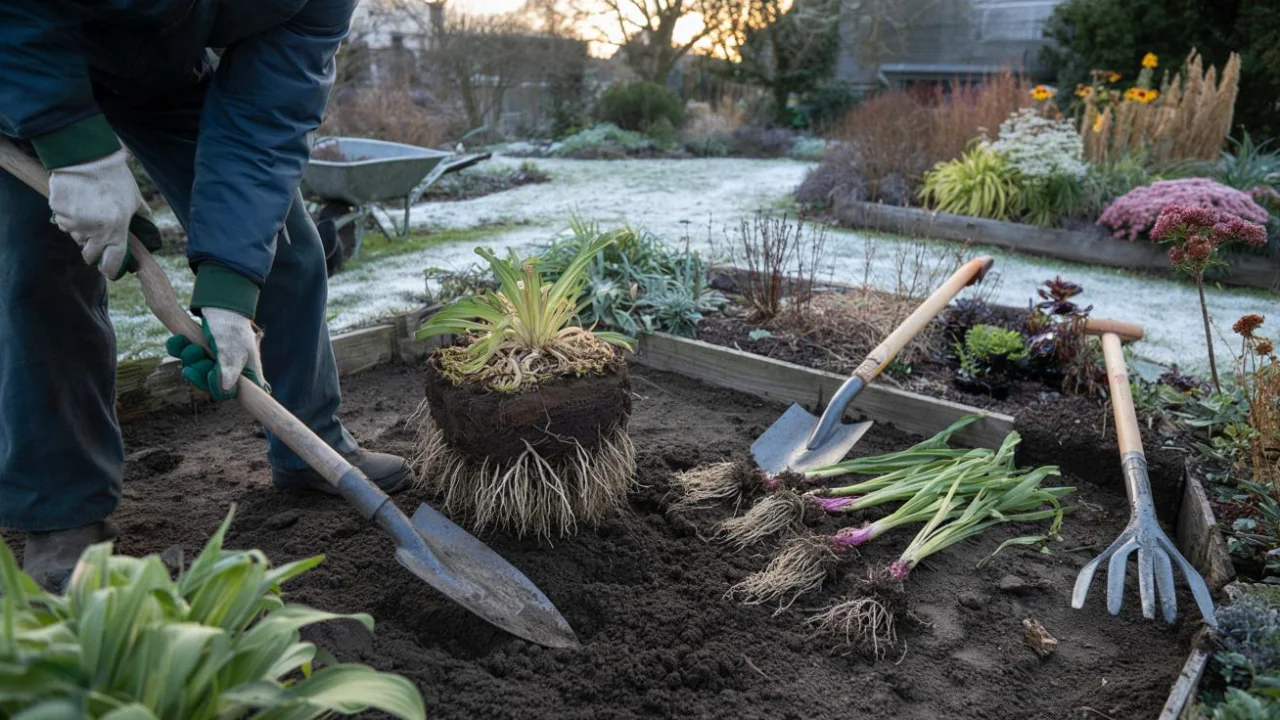
Millions of gardeners wait for spring warmth to begin dividing their established plants, but professionals know the secret timing that produces stronger results with less stress. Late January through early February represents the optimal window for dividing perennials, when dormant plants handle the process like surgery under anesthesia rather than major trauma during active growth periods.
Essential Timing Window for Maximum Plant Health
| Timing Factor | January Division | Spring Division | Summer Division |
|---|---|---|---|
| Plant stress level | Minimal – dormant state | Moderate – active growth | High – peak metabolism |
| Root recovery time | 8-12 weeks before growth | 4-6 weeks before heat | Limited recovery window |
| Soil workability | Soft from winter moisture | Variable moisture levels | Often dry and compacted |
| Success rate | 85-95% | 70-80% | 50-60% |
Division Success Rates by Plant Maturity
| Plant Age | Divisions Possible | Recovery Time | First Season Performance |
|---|---|---|---|
| 3-4 years | 3-4 strong plants | 6-8 weeks | 75% of mature size |
| 5-6 years | 5-7 strong plants | 4-6 weeks | 85% of mature size |
| 7+ years | 8-12 strong plants | 4-5 weeks | 90% of mature size |
Winter Division Versus Spring Division Performance
| Performance Metric | January Division | April Division | Difference |
|---|---|---|---|
| Plant survival rate | 92% | 78% | +18% advantage |
| First year flowering | 85% | 65% | +31% more blooms |
| Root establishment time | 4-5 weeks | 7-9 weeks | 40% faster |
| Water requirements | Minimal supplemental | Regular irrigation needed | 50% less water |
During January’s dormancy period, hardy perennials exist in a metabolic pause that makes surgical division remarkably successful. The absence of active sap movement means cutting through crowns causes minimal bleeding and shock.
Winter-softened soil allows gardeners to lift entire root systems intact, preserving feeder roots that would snap in spring’s drier conditions. This timing advantage transforms what many consider plant trauma into routine maintenance.
Prime Candidates Ready for January Division
Professional nurseries target specific perennial types during winter division schedules. These plants show clear indicators when ready for splitting:
- Clumps showing dead centers – Woody, lifeless cores surrounded by vigorous outer growth
- Reduced flowering density – Plants producing fewer blooms despite adequate growing conditions
- Crown expansion beyond 18 inches – Large specimens that have outgrown their allocated space
- Age markers of 4+ years – Established plants with sufficient root mass for successful division
- Visible root emergence – Surface roots indicating overcrowded conditions below ground
“January division gives perennials the entire dormant period to heal and establish new root systems before spring growth demands begin,” says a horticultural consultant who manages commercial perennial operations.
Step-by-Step Professional Division Protocol
Commercial growers follow systematic approaches that ensure consistent results across thousands of plants. Home gardeners benefit from adapting these proven methods:
- Soil moisture assessment – Work when ground is workable but not waterlogged or frozen solid
- Complete clump extraction – Dig wide circles 6 inches beyond visible plant boundaries
- Crown examination – Remove soil to expose root structure and identify natural division points
- Strategic cutting – Use clean, sharp tools to separate sections with 2-3 growing points each
- Immediate replanting – Position divisions at original soil depth within 30 minutes of lifting
Each division requires adequate root mass to support independent growth. Experienced gardeners aim for sections roughly the size of a closed fist, ensuring sufficient energy storage for spring emergence.
“The key is working quickly and decisively – exposed roots lose moisture rapidly in winter air, so efficiency matters more than perfection,” explains a professional landscaper specializing in perennial borders.
Financial Impact of Strategic Division Timing
Garden centers charge premium prices for established perennials, making dividing perennials during optimal windows a significant cost-saving strategy. A single mature hosta purchased for $25 can yield 6-8 divisions worth $150-200 in retail value.
- Daylily divisions – One $20 plant becomes 4-6 plants worth $80-120 retail
- Autumn aster splits – Single $15 plant multiplies into $60-75 worth of new stock
- Border phlox sections – $18 original investment creates $90-108 in equivalent plantings
- Coreopsis divisions – $12 plant expands into $48-72 worth of border material
Beyond immediate savings, January division creates uniform plantings that establish stronger garden design coherence. Professional landscapers use repetition of divided material to create flowing drifts that appear intentionally planned rather than randomly collected.
Frequently Asked Questions About Winter Perennial Division
Can I divide perennials when the ground is frozen?
No, wait for frost-free periods when soil can be worked without damaging root systems.
How long do divided perennials take to recover?
Most hardy perennials establish new root systems within 4-6 weeks of January division.
Should I fertilize newly divided plants immediately?
Avoid fertilizing until spring growth begins; focus on soil moisture and mulching instead.
What happens if divided plants don’t emerge in spring?
Wait until late May before assuming failure; some divisions emerge later than expected.
Can I store divided perennials before replanting?
Temporary storage in moist compost works for 2-3 days maximum before permanent planting.
Which perennials should never be divided in winter?
Avoid winter-blooming plants like hellebores and shallow-rooted species like peonies.
Implementation Timeline for Garden Transformation
Strategic dividing perennials requires systematic planning to maximize results across multiple growing seasons. Professional gardens follow rotation schedules that maintain continuous improvement without overwhelming maintenance demands.
| Action Item | Optimal Timing | Completion Deadline | Expected Results |
|---|---|---|---|
| Assess mature clumps | Mid-January | January 31st | Division priority list |
| Complete division work | Late January-Early February | February 15th | 2-3x plant inventory |
| Monitor establishment | March-April | April 30th | 90%+ survival rate |
| Evaluate performance | First growing season | September 30th | Full border maturity |
January’s dormant period offers gardeners the year’s most forgiving opportunity to multiply their perennial collections. Plants divided now recover completely before spring growth begins, establishing stronger root systems and producing more vigorous flowering than divisions attempted during active growing periods. Professional timing transforms routine maintenance into strategic garden development that compounds value across multiple seasons.