The Dawn of Lunar Timekeeping: A Revolutionary Leap for Space Exploration
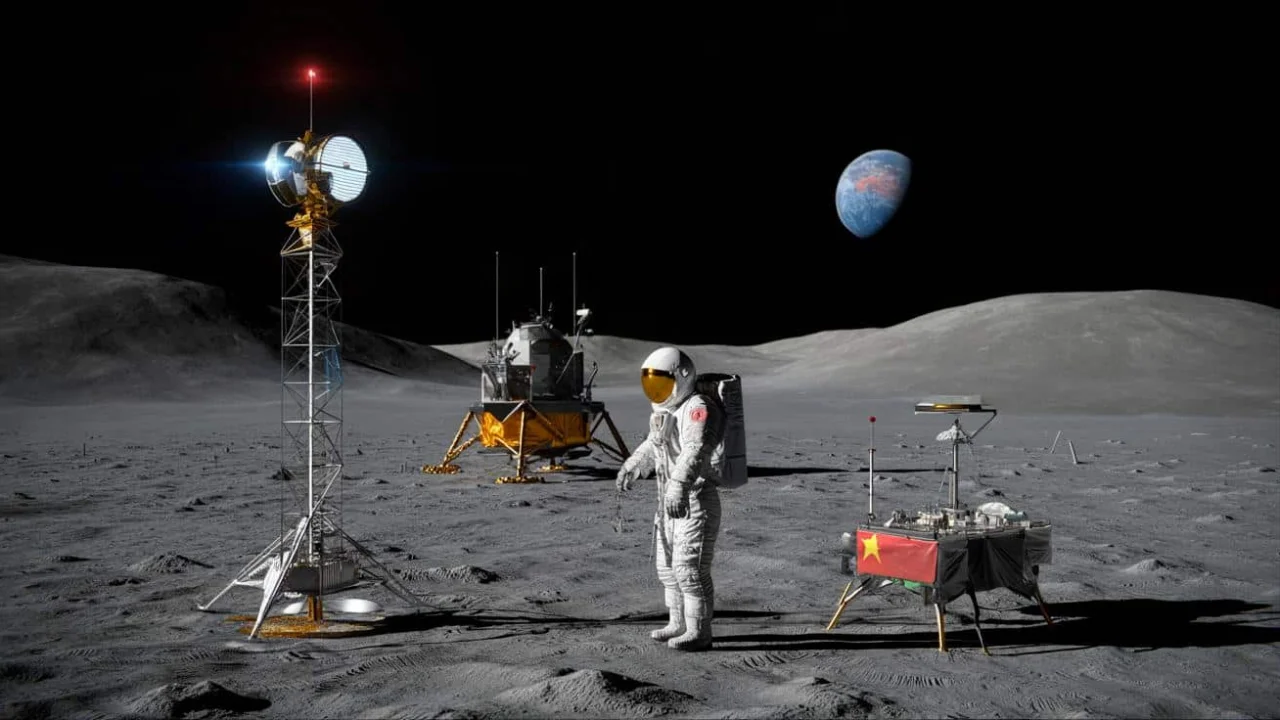
Imagine standing on the surface of the moon, looking up at Earth hanging like a blue marble in the black sky. Your wristwatch ticks steadily, but unbeknownst to you, it’s racing ahead of identical clocks back on Earth. This isn’t science fiction – it’s Einstein’s relativity in action, and it’s about to become a critical challenge as humanity prepares for permanent lunar settlements.
The implications are staggering. Every day, every hour, every minute spent on the moon creates a temporal drift that could spell disaster for navigation systems, communication networks, and the very safety of astronauts. What starts as a barely perceptible 56 microseconds per day could cascade into mission-critical failures over months and years of lunar operations.
This is precisely why China’s groundbreaking revelation of the world’s first practical lunar clock system represents more than just a technological achievement – it’s a lifeline for humanity’s cosmic ambitions. The LTE440 system, developed by brilliant minds at Purple Mountain Observatory and the University of Science and Technology of China, promises to solve one of space exploration’s most insidious problems before it derails our dreams of lunar civilization.
As multiple nations race to establish permanent bases on the moon, including NASA’s ambitious Artemis program and the joint Russian-Chinese International Lunar Research Station, the need for precise, synchronized timekeeping has never been more urgent. The stakes couldn’t be higher, and China has just thrown down the gauntlet with a solution that could reshape our relationship with time itself across the cosmos.
Einstein’s Cosmic Curveball: Why Time Behaves Differently on the Moon
Albert Einstein’s theory of general relativity reveals one of the universe’s most counterintuitive truths: gravity doesn’t just bend space – it warps time itself. On the lunar surface, where gravity is approximately one-sixth that of Earth’s, this relativistic effect creates a phenomenon that would have seemed impossible to earlier generations of scientists.
The mechanics are elegantly simple yet profoundly complex. Earth’s stronger gravitational field creates what physicists call a deeper “gravity well,” causing time to flow more slowly relative to locations with weaker gravitational fields. The moon, with its gentler gravitational embrace, allows time to tick along at a slightly faster pace.
“The difference might seem negligible – just 56 microseconds per day – but in the world of precision navigation and spacecraft operations, this tiny discrepancy grows into a monster that can derail entire missions,” explains Dr. Sarah Chen, a relativistic physicist at the International Space Consortium. “It’s like having a compass that’s off by just one degree – harmless for a short walk, catastrophic for a transcontinental journey.”
This temporal drift accumulates relentlessly. Over a year, lunar clocks would gain approximately 20.4 milliseconds compared to Earth time. While this might seem insignificant to casual observers, it represents a timing error that could send spacecraft off course by hundreds of kilometers or cause critical communication systems to fail at precisely the wrong moment.
The High-Stakes Problem: Why Microseconds Matter in Space
The challenges posed by lunar time dilation extend far beyond academic curiosity. As space agencies worldwide prepare for extended lunar missions, the practical implications of this temporal mismatch become increasingly severe:
- Navigation Catastrophes: GPS-style positioning systems rely on nanosecond precision. Even tiny timing errors can translate into massive positional inaccuracies, potentially sending rovers over cliffs or causing spacecraft to miss their landing zones entirely.
- Communication Breakdowns: Data transmission protocols depend on synchronized clocks to maintain signal integrity. Time drift can cause packet loss, corrupted data streams, and complete communication blackouts during critical mission phases.
- Life Support Failures: Automated systems controlling oxygen generation, water recycling, and power distribution require precise timing coordination. Unsynchronized clocks could trigger false alarms or, worse, prevent safety systems from activating when needed.
- Scientific Data Corruption: Research experiments on the moon often require precise timing correlation with Earth-based observations. Time drift could invalidate months or years of carefully collected scientific data.
- Mission Coordination Chaos: Multiple agencies operating on the lunar surface need shared time standards for safe operations. Without synchronized clocks, spacecraft could collide or interfere with each other’s activities.
China’s Technological Masterstroke: The LTE440 System
The Chinese research team’s solution represents a quantum leap in practical space timekeeping. The LTE440 system, whose name derives from “Lunar Time Ephemeris” with a reference to the specific algorithmic model version, embodies years of painstaking research into relativistic effects and their real-world applications.
| Feature | Specification | Benefit |
|---|---|---|
| Accuracy Timespan | 1,000+ years | Long-term mission planning and permanent settlements |
| Time Correction | Real-time algorithmic adjustment | No manual recalibration required |
| Reference Standard | Barycentric Coordinate Time (TCB) | Universal compatibility with international space standards |
| Processing Speed | Engineering-ready algorithm | Instant time calculations for mission-critical operations |
| Relativistic Factors | Multiple gravitational effects accounted | Comprehensive accuracy across varying lunar conditions |
Unlike simple conversion tables or static correction factors, the lunar clock system operates as a sophisticated software model that continuously calculates the precise lunar equivalent of Earth time. This dynamic approach ensures accuracy even as gravitational conditions vary slightly due to the moon’s elliptical orbit and other celestial influences.
“What makes LTE440 revolutionary is its ability to bridge the gap between theoretical physics and practical engineering needs,” notes Dr. Michael Rodriguez, a former NASA mission planner now working with commercial space ventures. “Previous approaches required complex manual calculations or simplified approximations. This system delivers precision automatically, in real-time, exactly when and where mission controllers need it most.”
Technical Deep Dive: How LTE440 Conquers Relativistic Complexity
The engineering brilliance of China’s lunar clock lies not just in its accuracy, but in its practical implementation. The system builds upon the International Astronomical Union’s Barycentric Coordinate Time (TCB) standard, which describes temporal relationships across the entire solar system relative to its center of mass.
LTE440 serves as an intelligent intermediary, translating between these abstract cosmic time standards and the concrete needs of lunar missions. The system accounts for multiple relativistic effects simultaneously:
- Gravitational Time Dilation: The primary effect caused by differing gravitational field strengths between Earth and moon
- Orbital Velocity Effects: Special relativistic corrections due to the moon’s orbital motion around Earth
- Solar System Dynamics: Subtle influences from the sun’s gravity and the Earth-moon system’s motion through space
- Tidal Variations: Minor corrections for the moon’s elliptical orbit and libration effects
The algorithm operates continuously, making thousands of micro-adjustments per second to maintain synchronization accuracy. This real-time approach eliminates the need for periodic manual recalibrations that could introduce human error or create temporary timing gaps during critical mission phases.
Global Implications: A New Standard for Space Exploration
China’s breakthrough arrives at a pivotal moment in space exploration history. NASA’s Artemis program aims to establish sustainable lunar operations by the late 2020s, while the Chinese-Russian International Lunar Research Station promises to create a permanent scientific presence on the moon’s south pole. European, Indian, and private companies are also racing to develop lunar capabilities.
“The beauty of the LTE440 system is its potential for international adoption,” observes Dr. Elena Kowalski, director of the International Space Timing Consortium. “Time standards, unlike territorial claims or resource rights, benefit everyone when they’re universally adopted. A shared lunar time system could become the foundation for peaceful, coordinated development of the moon.”
The implications extend beyond mere convenience. Standardized lunar timekeeping could enable:
– Coordinated multi-agency missions without timing conflicts
– Shared emergency response protocols across different national operations
– Unified scientific databases with precisely correlated timestamps
– Commercial lunar ventures with interoperable systems
Looking Forward: The Future of Cosmic Timekeeping
As humanity prepares to become a truly spacefaring civilization, the challenge of time synchronization will only grow more complex. Mars missions will face even greater relativistic effects, while operations in asteroid belts or around gas giants will require entirely new temporal frameworks.
China’s lunar clock represents just the first step in developing comprehensive cosmic time standards that could eventually span the solar system and beyond. The algorithms and methodologies developed for LTE440 provide a template for addressing similar challenges on Mars, Europa, Titan, and other destinations where humans may eventually establish permanent outposts.
The success of this system could also accelerate the development of autonomous spacecraft that operate independently across vast distances, making their own navigation decisions based on precise local timekeeping without constant communication with Earth-based mission control.
Frequently Asked Questions
Why does time run differently on the moon compared to Earth?
Einstein’s general relativity shows that gravity affects time flow. The moon’s weaker gravity makes time tick slightly faster.
How much faster does time move on the lunar surface?
Lunar clocks gain approximately 56 microseconds per day compared to identical clocks on Earth’s surface.
What makes China’s LTE440 system different from previous approaches?
LTE440 provides real-time algorithmic corrections rather than static conversion tables, maintaining accuracy automatically for over 1,000 years.
Will other space agencies adopt China’s lunar timekeeping system?
International adoption would benefit all lunar missions by providing standardized time coordination for safety and scientific collaboration.
How does lunar time drift affect spacecraft navigation?
Tiny timing errors accumulate into major positional inaccuracies, potentially causing spacecraft to miss targets by hundreds of kilometers.
Could similar systems work for Mars missions?
Yes, the LTE440 methodology could be adapted for Mars, though different relativistic calculations would be required.
The unveiling of the world’s first practical lunar clock marks a pivotal moment in humanity’s cosmic journey. As we stand on the threshold of becoming a multi-planetary species, China’s LTE440 system provides the temporal precision necessary to navigate safely between worlds. The microseconds may be tiny, but their impact on our spacefaring future will be immense.