The Discovery That Changed Everything
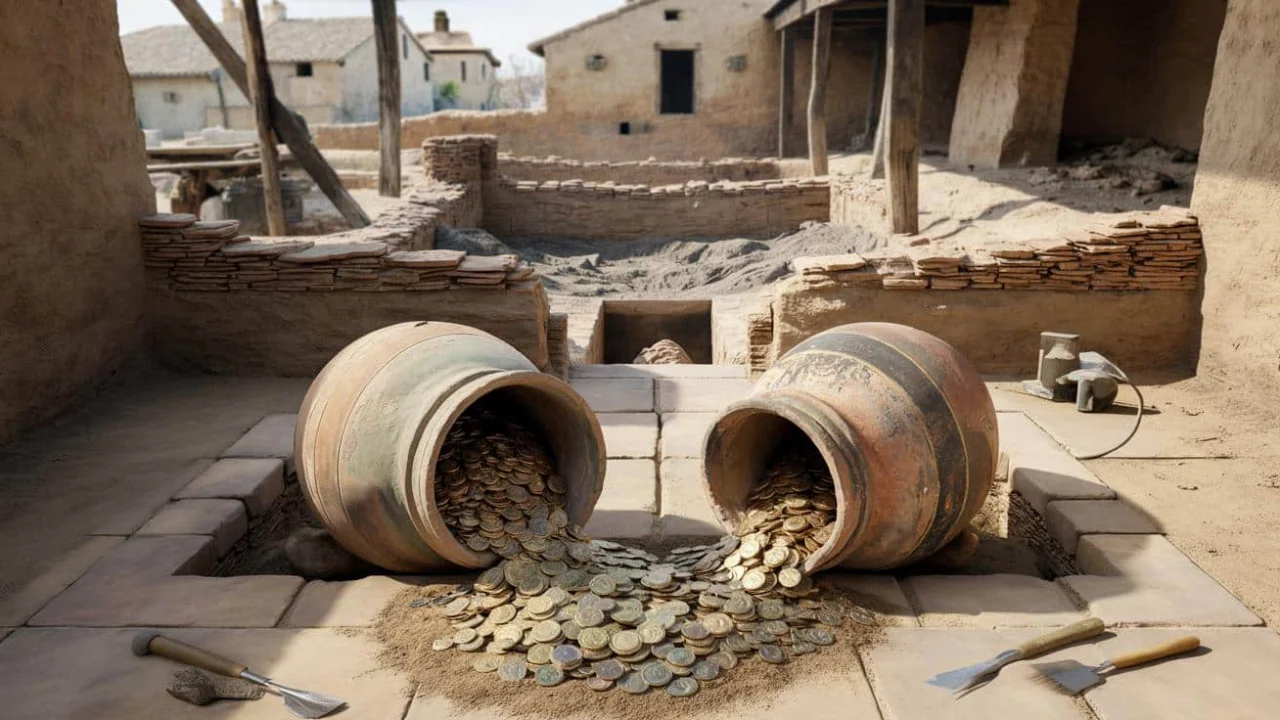
The silence of a French morning was broken not by church bells, but by the careful scraping of archaeological tools against ancient clay. In the small village of Senon, northeastern France, what began as a routine excavation transformed into one of the most significant roman coins discoveries of the decade. Beneath the floor of a late Roman house, three massive ceramic vessels emerged from the earth, their mouths sealed with the weight of centuries and their bellies heavy with treasure.
The emotional weight of this discovery extends far beyond mere monetary value. These weren’t just pots filled with ancient currency – they were time capsules containing the hopes, fears, and survival instincts of a family living on the edge of empire nearly two millennia ago. Each amphora tells a story of ordinary people making extraordinary decisions, choosing to bury their life savings beneath their own living room floor rather than risk losing everything to the chaos that would eventually consume their world.
As archaeologists carefully lifted each coin from its 1,800-year resting place, they weren’t just uncovering bronze and silver – they were touching the last physical remnants of dreams deferred, plans interrupted, and lives cut short by forces beyond any individual’s control. The weight of 38 kilograms of coins in the first jar alone represents not just wealth, but the accumulated labor, trade, and careful saving of an entire household.
The tragedy embedded in this discovery cannot be overstated. These roman coins were never meant to remain buried forever. They were hidden with the intention of retrieval, placed carefully in accessible locations within the family home. Yet the fires that swept through this settlement were so complete, so devastating, that no one ever returned to claim what they had fought so hard to preserve.
The Archaeological Context of Roman Gaul
The Senon discovery sits within the broader landscape of Roman Gaul, a frontier region that represented both the height of imperial prosperity and the constant threat of instability. Led by France’s National Institute for Preventive Archaeological Research (INRAP), the excavation revealed not just individual hoards, but an entire domestic complex that provides unprecedented insight into late Roman life.
The house itself speaks to considerable wealth and sophistication. Stone construction, underfloor heating systems, basements, and small workshops with specialized stoves all point to owners who were well-integrated into the Roman economic system. Nearby military fortifications suggest a population that included soldiers, craftsmen, and traders – people accustomed to handling cash and acutely aware of political and economic volatility.
“What makes Senon extraordinary is not just the quantity of coins, but their context. We can see exactly how these families integrated their savings into their daily domestic lives. These weren’t emergency measures – they were sophisticated household financial systems.”
Dr. Marie Perrin, Lead Archaeologist, INRAP
The Mechanics of Ancient Money Storage
The three amphorae functioned as built-in safes, their design revealing considerable thought and planning. Each vessel was sunk into carefully cut pits in the floor, with necks positioned level with the surface. This arrangement provided both security and accessibility – the coins were hidden from casual observation but remained within easy reach for deposits or withdrawals.
The contents discovered so far are staggering:
- First amphora: Approximately 38 kilograms (83 pounds) containing an estimated 23,000-24,000 individual coins
- Second amphora: Roughly 50 kilograms (110 pounds) with an estimated 18,000-19,000 coins based on initial sampling
- Third amphora: Empty pit with only three stray coins, suggesting successful ancient retrieval
- Evidence of ongoing use: Single coins adhered to jar rims indicate regular deposits over extended periods
- Strategic placement: All vessels positioned for easy household access while maintaining security
Regional Pattern of Coin Hoarding
The Senon discovery fits within a broader regional pattern that illuminates the economic and social conditions of late Roman Gaul. Archaeological records document approximately 30 known hoards from the surrounding area, suggesting widespread practices of coin accumulation and storage during this period.
| Hoard Location | Approximate Date | Coin Count | Context | Recovery Status |
|---|---|---|---|---|
| Senon – Amphora 1 | 3rd century CE | 23,000-24,000 | Domestic floor burial | Unrecovered |
| Senon – Amphora 2 | 3rd century CE | 18,000-19,000 | Domestic floor burial | Unrecovered |
| Senon – Amphora 3 | 3rd century CE | Unknown (removed) | Domestic floor burial | Recovered in antiquity |
| Regional average | 2nd-4th century CE | 500-5,000 | Various | Mixed |
Evidence of Long-term Savings Strategies
Perhaps the most intriguing aspect of the Senon discovery lies in the evidence for sustained, planned saving rather than emergency hiding. The presence of individual roman coins stuck to the rims of buried amphorae provides compelling evidence that these vessels continued to receive deposits even after their initial burial.
“The rim coins are the smoking gun. They could only have been added after burial, which means these weren’t panic hoards but functioning household banks. We’re seeing Roman families managing their wealth with remarkable sophistication.”
Professor James Mitchell, Roman Economic History, University of Edinburgh
This pattern suggests several important conclusions about late Roman household economics:
- Systematic saving: Families regularly added to their buried reserves over extended periods
- Accessible storage: The floor-level positioning allowed for easy deposits without full excavation
- Planned liquidity: One amphora’s ancient removal suggests successful planned withdrawals
- Risk management: Multiple vessels spread risk while maintaining household control
- Long-term thinking: The system required confidence in both hiding places and future retrieval opportunities
The Final Catastrophe
The end came in fire – not once, but twice. Archaeological evidence points to two separate conflagrations that ultimately destroyed the settlement and sealed the fate of the buried roman coins. The first fire may have prompted the burial of the hoards; the second ensured they would never be recovered.
The thermal evidence preserved in the archaeological record tells a story of complete destruction. Burned timbers, collapsed roofing materials, and fire-damaged artifacts all point to blazes hot enough and extensive enough to force permanent abandonment. Whether these fires resulted from military action, civil unrest, or accident, their impact was absolute.
“The fire damage is consistent with either systematic destruction or catastrophic accident. Either way, it was complete enough to prevent any return. These families lost everything – their homes, their community, and ultimately their carefully hidden savings.”
Dr. Sarah Blanchard, Roman Settlement Archaeology, Sorbonne University
Incredible Roman coin discovery in France! 40,000+ coins found in 1,800-year-old ‘piggy banks’ buried under house floor. These weren’t emergency hoards – evidence shows families were actively adding coins over time. #RomanArchaeology #Numismatics
— Archaeological News (@ArchNewsDaily) Date
Implications for Roman Economic Understanding
The Senon discovery fundamentally challenges traditional interpretations of Roman coin hoarding. Rather than viewing buried treasure as evidence of crisis and instability, this find suggests sophisticated household financial management adapted to uncertain times. The scale and systematic nature of these deposits indicate that ordinary Roman families possessed both significant wealth and the financial literacy to manage it effectively.
The implications extend beyond individual households to broader questions about Roman economic development. The concentration of wealth in rural Gaul, the integration of military and civilian populations in economic activity, and the development of domestic financial infrastructure all receive new illumination from this discovery.
Ongoing Research and Analysis
The process of analyzing tens of thousands of individual coins represents a monumental undertaking that will likely continue for years. Each coin must be carefully cleaned, catalogued, dated, and analyzed for wear patterns, metal composition, and minting details. This painstaking work will ultimately reconstruct not just the chronology of the hoards, but the economic networks and trade relationships that brought these roman coins to a small Gallic village.
Advanced techniques including X-ray fluorescence spectroscopy, digital imaging, and database correlation will help researchers trace the geographic origins of individual coins, reconstruct circulation patterns, and understand the economic integration of frontier regions into the broader imperial system.
Frequently Asked Questions
How were the Roman coin hoards discovered at Senon?
Archaeologists found three ceramic amphorae buried in house floor during routine excavation by INRAP.
Why did Roman families bury coins under their floors?
Floor burial provided security while maintaining accessibility for regular deposits and withdrawals over time.
How many coins were found in the Senon hoards?
Approximately 41,000-43,000 coins total across two intact amphorae, with third vessel removed in antiquity.
What caused the abandonment of the Roman settlement?
Two devastating fires completely destroyed the settlement, preventing residents from ever returning for buried savings.
Are coin hoards common in Roman Gaul?
Yes, about 30 documented hoards exist regionally, indicating widespread coin accumulation during late Roman period.
What makes the Senon discovery unique among Roman finds?
Perfect domestic context preservation shows exactly how Roman families integrated savings into daily household life.
Legacy of the Lost Savings
As research continues and the full extent of the Senon discovery becomes clear, these 1,800-year-old “piggy banks” serve as powerful reminders of both human ambition and fragility. The families who carefully buried their life savings beneath their living room floor were neither naive nor primitive – they were sophisticated economic actors adapting to the realities of life on the Roman frontier.
Their tragedy becomes our opportunity to understand not just how Romans handled money, but how ordinary people navigated extraordinary times. In every carefully placed coin, in every thoughtful deposit added to the rim of a buried jar, we see evidence of hope, planning, and the fundamental human belief that tomorrow might be better than today – even when tomorrow never came.