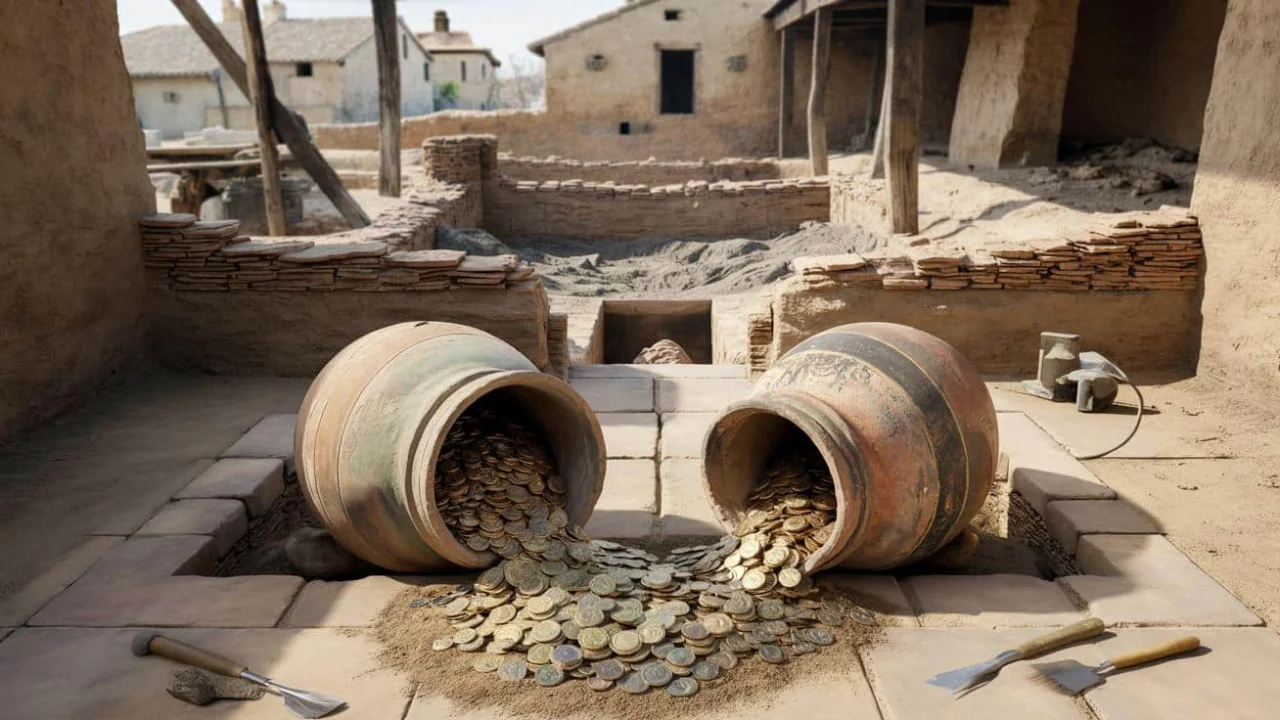
In the quiet countryside of northeastern France, archaeologists have made a discovery that brings the ancient world rushing back to life. Beneath the floor of a Roman house in the village of Senon, three massive ceramic vessels emerge from the earth like time capsules, each one packed with thousands upon thousands of coins that haven’t seen daylight for nearly 1,800 years. These weren’t just random treasures lost to time—they were the carefully planned savings of Roman families, their life’s work buried beneath their own living room floor in what may be history’s most sophisticated piggy bank system.
The emotional weight of this discovery strikes deep when you imagine the final moments of these ancient savers. As fires ravaged their settlement and forced them to flee, they left behind not just their homes but their dreams, their security, and their future—all contained within those sealed roman money jars. For nearly two millennia, these vessels waited in darkness, preserving not just bronze and silver, but the hopes and fears of people who lived, loved, and planned for tomorrow just as we do today.
What makes this discovery so profoundly moving is the human story it tells. These weren’t wealthy nobles with vast treasures, but ordinary families who saved coin by coin, adding to their buried roman money jars over months and years. The archaeologists found evidence that some coins were added after the jars were already buried—single coins stuck to the rims that could only have gotten there if someone had lifted the floor stones, opened the vessels, and added their latest earnings to the growing hoard below.
Now, as researchers carefully count each coin and map every detail, they’re not just uncovering ancient currency—they’re revealing the beating heart of Roman domestic life, where financial security meant having your savings literally under your feet, where trust was measured in bronze and silver, and where the simple act of dropping a coin into a buried jar represented hope for the future.
The Remarkable Discovery at Senon
The excavation at Senon, led by France’s National Institute for Preventive Archaeological Research (INRAP), has revealed one of the most significant domestic archaeological finds in recent French history. The site, located in what was once Roman Gaul, contained a residential district with sophisticated stone houses, complete with underfloor heating systems, basements, and small workshops.
The three roman money jars were discovered embedded directly into the floor of a Roman house, their necks positioned level with the floor surface to create accessible but secure storage. The scale of these hoards is breathtaking:
- First amphora: Approximately 38 kilograms (83 pounds) of coins, estimated at 23,000-24,000 individual pieces
- Second vessel: Roughly 50 kilograms (110 pounds) with an estimated 18,000-19,000 coins based on initial sampling
- Third amphora: Found empty with only three stray coins, suggesting it was recovered in antiquity before the final disaster
- Combined total: Over 40,000 coins representing decades of accumulated savings
- Age: Approximately 1,800 years old, dating to the later Roman period
Context and Archaeological Significance
The Senon discovery sits within a landscape already rich with Roman coin hoards—approximately 30 documented hoards exist in the wider region. However, this find is unique because the roman money jars remained in their original domestic context, allowing archaeologists to understand exactly how Roman families integrated their savings into their daily living spaces.
“What makes Senon extraordinary is not just the quantity of coins, but the fact that we can reconstruct the exact domestic context. These weren’t emergency hoards hastily buried during a crisis—they were sophisticated, long-term savings systems built into the architecture of the home itself,” explains Dr. Marie Dufresne, lead archaeologist for INRAP.
The discovery provides unprecedented insight into Roman domestic financial practices. The positioning of the amphorae—with necks flush to the floor surface—demonstrates a level of planning and integration that suggests these weren’t temporary measures but permanent household features designed for ongoing use.
Evidence of Long-Term Savings Strategy
Archaeological evidence suggests these weren’t panic hoards but carefully maintained savings accounts. Key indicators include:
- Single coins found adhered to the jar rims, indicating deposits made after burial
- Systematic arrangement within the domestic space
- Professional burial technique with precise floor-level positioning
- Evidence of regular access and maintenance over extended periods
- Integration with household architecture and daily life patterns
The Roman Financial Landscape
| Aspect | Senon Discovery | Historical Context |
|---|---|---|
| Total Coins | 40,000+ pieces | Largest domestic hoard in region |
| Time Period | Late Roman (3rd-4th century CE) | Period of economic instability |
| Weight | 88+ kilograms total | Equivalent to several years’ wages |
| Storage Method | Built-in floor amphorae | Unique domestic integration |
| Preservation | Original context maintained | Rare for archaeological finds |
Regional and Historical Significance
The Senon site represents more than individual family savings—it reflects the broader economic and social dynamics of Roman Gaul. The region was a prosperous frontier area with established trade routes, military garrisons, and thriving agricultural estates. The presence of a nearby Roman fortification suggests the local population included soldiers, craftsmen, and traders—all groups who would have dealt regularly in cash transactions and understood the need for secure savings methods.
“The sophistication of these domestic savings systems tells us that even ordinary Roman families had developed complex strategies for financial security. This wasn’t simply about hiding money—it was about creating accessible, secure, long-term storage that could be maintained and expanded over years or even decades,” notes Professor James Harrison, specialist in Roman economic history at Oxford University.
The Final Catastrophe
The abandonment of these carefully maintained savings reveals the tragic end of this Roman settlement. Evidence suggests that two devastating fires swept through the area, forcing residents to flee so quickly that they couldn’t recover their buried wealth. The fact that one amphora was found empty suggests that some families may have managed partial recovery during the crisis, but the majority of the hoards remained untouched until modern archaeological excavation.
The discovery of coins stuck to jar rims provides poignant evidence of the owners’ final additions to their savings—perhaps made in the days or weeks before disaster struck, when life still seemed normal and the future still held promise.
Modern Archaeological Techniques
The excavation of these roman money jars requires extraordinary care and sophisticated techniques:
- 3D mapping of each coin’s position before removal
- Detailed photographic documentation of all archaeological layers
- Spectroscopic analysis to determine coin compositions and origins
- Digital reconstruction of the domestic spaces and their relationship to the hoards
- Comparative analysis with other regional finds to establish broader patterns
- Conservation treatments to preserve both coins and ceramic vessels
“Every coin tells a story—not just of imperial policies and economic trends, but of individual decisions made by people planning their futures. When we find these coins still in their original positions, we’re essentially reading the financial diaries of ancient families,” explains Dr. Catherine Moreau, numismatic specialist working on the Senon collection.
Implications for Understanding Roman Domestic Life
The Senon discovery fundamentally changes our understanding of how Roman families managed their finances. Rather than viewing coin hoards as emergency measures, this find demonstrates that buried savings were integrated into normal domestic architecture and daily routines. The roman money jars represent a sophisticated understanding of security, accessibility, and long-term financial planning that rivals modern banking concepts.
The positioning and maintenance of these vessels suggests that Roman families developed complex strategies for balancing security with convenience—creating systems that were both accessible enough for regular deposits and secure enough to protect substantial accumulated wealth.
Frequently Asked Questions
How were the roman money jars discovered at Senon?
Archaeologists found them during routine excavation, buried beneath the floor of a Roman house with necks positioned at floor level.
Why were the coins left behind if they were so valuable?
Two devastating fires forced rapid evacuation, leaving families unable to recover their buried savings before fleeing the settlement permanently.
How much would these coins be worth today?
The archaeological and historical value far exceeds monetary worth, representing priceless insights into Roman domestic financial practices and daily life.
Were these emergency hoards or regular savings?
Evidence suggests long-term savings accounts, with coins added regularly over time rather than emergency deposits during crisis periods.
What happened to the third empty amphora?
It was apparently recovered in antiquity, possibly during the initial crisis, leaving only three scattered coins in the empty pit.
How common were buried coin hoards in Roman times?
The Senon region alone contains about 30 documented hoards, indicating widespread use of buried savings throughout the Roman period.
Legacy and Future Research
The Senon discovery opens new avenues for understanding Roman domestic economics and social structures. As researchers continue analyzing the thousands of coins, each piece adds to our understanding of trade patterns, imperial policies, and individual family strategies for financial security. The find also demonstrates the importance of archaeological context—these roman money jars tell their story not just through the coins themselves, but through their preservation in the exact spaces where Roman families lived, worked, and planned for their futures.
The emotional resonance of this discovery extends far beyond academic interest. In these ancient savings systems, we see reflections of our own hopes, fears, and financial planning strategies. The Roman families of Senon weren’t so different from us—they saved for security, planned for the future, and trusted in their own ability to build something lasting. Their buried treasures, preserved through fire and time, now serve as bridges connecting us across nearly two millennia of human experience.