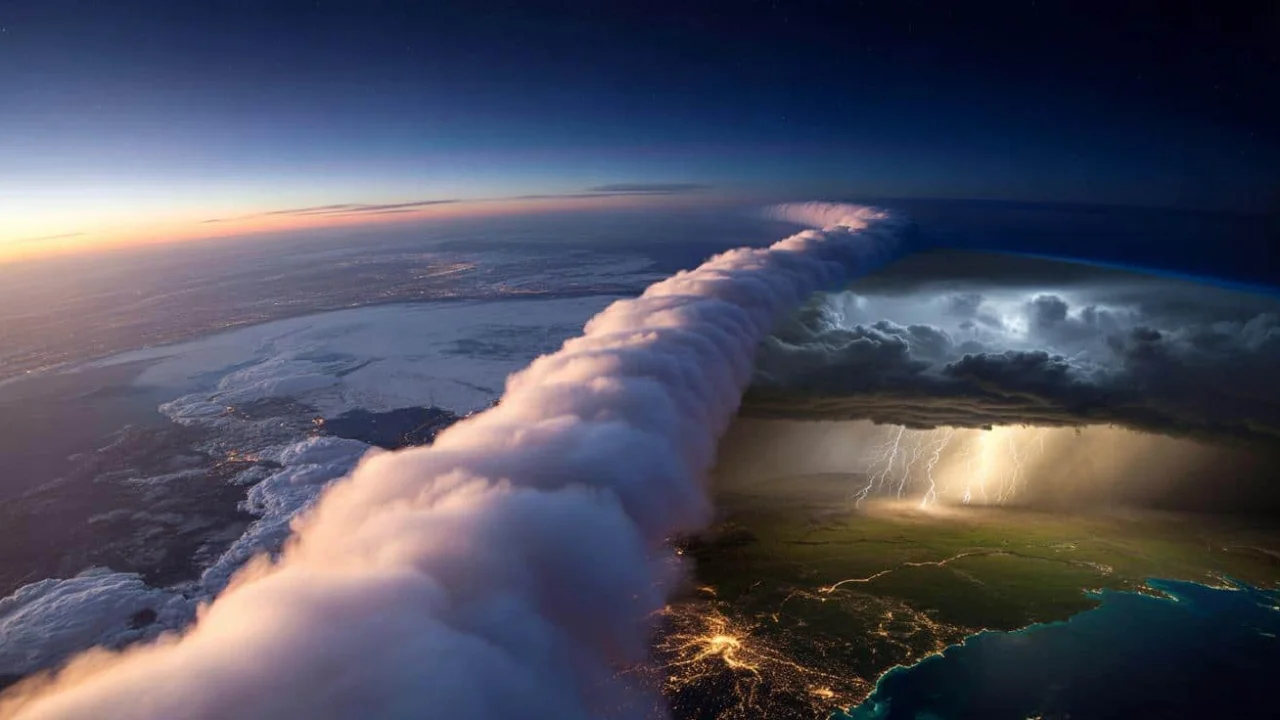
The first whisper of chaos came not from a dramatic storm, but from a subtle shift in the wind patterns high above our heads. Meteorologists across North America and Europe found themselves staring at their computer models in quiet disbelief this January, watching the jet stream realignment unfold weeks earlier than nature’s usual schedule. What they saw was both fascinating and deeply unsettling: the atmospheric river that governs our weather was bending, twisting, and meandering like a snake disturbed from its winter slumber.
In weather centers from Chicago to London, forecasters began sharing screenshots with colleagues, their messages tinged with scientific curiosity and growing concern. “January acting like late March,” one meteorologist texted, referring to the unusual loops and waves appearing in the jet stream. These aren’t just abstract patterns on a computer screen—they’re the blueprints for the weather chaos already beginning to unfold across continents.
The signs are everywhere if you know where to look. Tornado sirens wailing across Midwest states that should be buried in snow. European cities experiencing “temperature whiplash”—waking to near-freezing conditions and ending the day in almost mild air. Record-breaking temperatures, both hot and cold, sometimes occurring just days apart in the same region. The atmosphere is clearly experimenting with something new, and we’re all unwilling participants in this meteorological trial run.
What makes this early jet stream realignment particularly alarming is its timing. The jet stream typically follows predictable seasonal patterns, helping meteorologists forecast weather weeks or even months in advance. When this aerial highway shifts its course ahead of schedule, it throws the entire climate prediction system into disarray, leaving millions of people unprepared for weather that defies seasonal expectations.
The Science Behind the Sky’s Highway
The jet stream operates like a massive river of air, flowing about 10 kilometers above Earth’s surface at speeds that can exceed 400 kilometers per hour. This atmospheric conveyor belt is powered by the temperature difference between cold polar air and warmer air near the equator. When that contrast is strong, the jet stream flows relatively straight from west to east, keeping weather patterns organized and predictable.
However, climate change is fundamentally altering this delicate balance. As the Arctic warms faster than other regions, the temperature gradient that drives the jet stream weakens. This phenomenon, known as Arctic amplification, causes the jet stream to slow down and develop larger, more persistent waves and loops. These meanders can trap weather systems in place for days or weeks, leading to extreme events like heat domes, persistent droughts, or unprecedented flooding.
“We’re seeing the jet stream behave in ways that challenge our understanding of seasonal weather patterns. This early realignment suggests that climate change is accelerating the breakdown of traditional atmospheric circulation patterns faster than we anticipated,” explains Dr. Jennifer Francis, a senior scientist at the Woodwell Climate Research Center who has studied jet stream behavior for over two decades.
The early January jet stream realignment represents more than just an interesting meteorological anomaly—it’s a harbinger of a climate system in transition. When the jet stream develops these early-season loops and waves, it can create what scientists call “blocking patterns” that persist for weeks, essentially parking weather systems over regions ill-equipped to handle prolonged extreme conditions.
Immediate Impacts Across Continents
The effects of this premature atmospheric shift are already cascading through communities across multiple continents. In North America, the realigned jet stream has created narrow corridors of violent weather that seem to ignore traditional seasonal boundaries. Areas that typically experience steady winter conditions are instead dealing with dramatic temperature swings, severe thunderstorms, and even tornado activity—phenomena more associated with spring and summer months.
- Temperature Extremes: Cities experiencing 40-degree temperature swings within 48-hour periods
- Precipitation Chaos: Rain, snow, and ice storms occurring simultaneously in neighboring regions
- Wind Patterns: Sustained high winds in areas not prepared for such conditions
- Storm Intensity: Severe weather events displaying unusual persistence and strength
- Seasonal Confusion: Wildlife and agricultural systems responding to mixed seasonal signals
European meteorological services are reporting similar disruptions, with the early jet stream realignment contributing to unprecedented weather variability across the continent. The phenomenon is creating what experts describe as “micro-climates of chaos”—small geographic areas experiencing radically different conditions despite their proximity to one another.
Weather Prediction in Crisis
| Traditional January Pattern | Current Realigned Pattern | Impact on Forecasting |
|---|---|---|
| Steady west-to-east flow | Large loops and meanders | Reduced forecast accuracy beyond 5 days |
| Predictable storm tracks | Erratic, persistent systems | Difficulty predicting storm intensity |
| Regional temperature consistency | Extreme temperature gradients | Localized forecast failures |
| Seasonal weather alignment | Mixed seasonal signals | Long-range forecasts unreliable |
The forecasting challenges created by this early jet stream shift extend far beyond inconvenient weather surprises. Agricultural planning, energy distribution, transportation systems, and emergency preparedness all depend on reasonably accurate weather predictions. When the fundamental patterns that drive these predictions change unexpectedly, the ripple effects touch virtually every aspect of modern society.
“We’re operating in uncharted territory. The models we’ve relied on for decades are based on historical patterns that may no longer apply. This early jet stream realignment forces us to reconsider how we approach both short-term weather forecasting and long-term climate planning,” states Dr. Michael Ventrice, a meteorological scientist with The Weather Company.
Preparing for Unpredictable Weather
Given the uncertainty introduced by this premature atmospheric reorganization, individuals and communities must adapt their approach to weather preparedness. Traditional seasonal planning—buying snow tires in November, preparing air conditioners in May—may no longer provide adequate protection against nature’s increasingly erratic behavior.
Emergency management officials are recommending what they call “scenario-based preparedness”—planning for multiple possible weather outcomes rather than relying on historical patterns. This approach acknowledges that the early jet stream realignment makes traditional forecasting less reliable, requiring more flexible and comprehensive preparation strategies.
- Multi-season emergency kits: Prepare for both winter and severe weather conditions simultaneously
- Flexible travel planning: Monitor weather conditions continuously rather than relying on long-range forecasts
- Home weatherization: Ensure buildings can handle both extreme cold and severe storms
- Communication systems: Maintain multiple ways to receive emergency weather information
- Community networks: Establish neighborhood support systems for weather emergencies
- Supply chain awareness: Expect potential disruptions to food, fuel, and other essential deliveries
The economic implications of this atmospheric disruption are already becoming apparent. Airlines are reporting increased flight disruptions due to unpredictable wind patterns. Agricultural sectors are struggling to adapt planting and harvesting schedules to increasingly erratic weather windows. Energy companies are finding it more difficult to predict heating and cooling demands, leading to supply imbalances and price volatility.
Long-term Climate Implications
While the immediate focus remains on navigating this winter’s unusual weather patterns, climate scientists are deeply concerned about what this early jet stream realignment might signal for future seasons and years. If the atmospheric circulation patterns that have governed Earth’s weather for millennia are shifting permanently, the implications extend far beyond a single chaotic winter.
“What we’re witnessing may be a preview of the new normal. If jet stream instability becomes more frequent and occurs earlier in seasonal cycles, we’ll need to fundamentally rethink how we design infrastructure, plan agriculture, and prepare communities for weather-related challenges,” warns Dr. Katharine Hayhoe, chief scientist for The Nature Conservancy and professor at Texas Tech University.
The cascading effects of persistent jet stream disruption could reshape everything from global food production to migration patterns. Regions that have relied on predictable seasonal weather for agriculture, tourism, and economic planning may find themselves forced to adapt to a new reality of chronic uncertainty and increased weather volatility.
Frequently Asked Questions
What exactly is jet stream realignment?
It’s when the high-altitude air currents that control weather patterns shift from their normal paths earlier than expected.
How does this affect local weather forecasting?
It reduces forecast accuracy, especially beyond five days, making weather predictions less reliable for planning purposes.
Is this jet stream change permanent?
Scientists aren’t certain yet, but evidence suggests these disruptions may become more frequent as climate change continues.
Why is January realignment particularly concerning?
January patterns typically remain stable, so early changes suggest accelerating atmospheric disruption throughout the year.
Can individual communities prepare for this uncertainty?
Yes, through scenario-based planning that prepares for multiple weather possibilities rather than historical seasonal patterns.
What should people do differently this winter?
Monitor weather more frequently, prepare for varied conditions, and avoid relying solely on long-range forecasts.
As this unprecedented January unfolds, the early jet stream realignment serves as a stark reminder that our planet’s climate system is entering uncharted territory. The atmospheric highway that has guided weather patterns for generations is taking detours nobody mapped, leaving meteorologists, emergency planners, and ordinary citizens scrambling to adapt to a new reality where the sky itself seems to be improvising. The question is no longer whether we can predict the weather with certainty, but whether we can learn to thrive in a world where uncertainty itself has become the only constant.