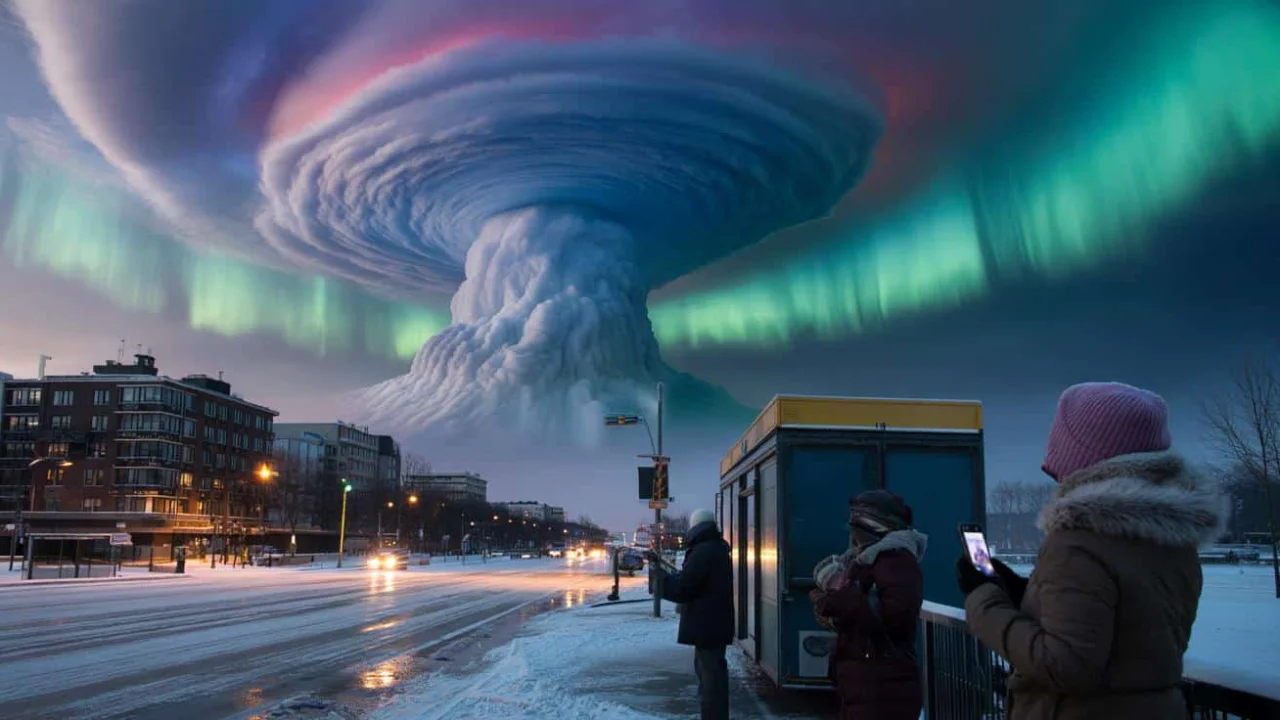
The wind had that strange, metallic taste this morning. Not just cold, but sharp, almost electric. People waiting for buses huddled closer than usual, breath hanging in the air a bit longer, as if the sky itself were exhaling slowly. On phone screens, the same alert kept popping up: “polar vortex anomaly,” “unusual speed,” “configuration not seen in decades.” It sounds like the plot of a disaster movie, until you realize the map on TV is your own country, your own town, your own thin apartment windows.
No one quite knows if they should just grab a thicker scarf or start rethinking their whole winter. Something is off this time. The polar vortex anomaly that isn’t playing by the old rules anymore has meteorologists scrambling to recalibrate decades of forecasting models. When seasoned weather experts start using words like “unprecedented” and “concerning,” it’s time to pay attention.
This isn’t just another winter story about bundling up and sipping hot cocoa. This is about fundamental shifts in atmospheric patterns that govern how millions of people live, work, and survive the coldest months of the year. The comfortable predictability of seasonal weather is cracking apart, leaving communities across multiple continents wondering what comes next.
The ripple effects reach far beyond weather apps and evening news segments. Agricultural regions face crop damage estimates in the billions. Energy grids strain under unprecedented demand spikes. Transportation networks shut down without warning. Emergency services prepare for scenarios that existed only in theoretical models just months ago.
The Science Behind the Chaos
Meteorologists have been staring at the same swirl of purple and blue for days now, and the word they keep repeating is “anomalous.” The polar vortex, that giant ring of ferocious winds spinning around the Arctic, is diving south again, but not in the leisurely, predictable way that shows up in old textbooks. This one is shifting configuration so fast that forecast models are struggling to catch up. What usually unfolds over weeks is happening in days.
On the latest satellite loops, the jet stream looks like a frayed ribbon. One arm plunges down toward North America, another buckles over Europe, while Asia faces a different kind of pressure squeeze. Forecasters in the U.S. describe “snapping” cold fronts that can swing from mild to polar in less than 36 hours. In some regions, projected temperatures sit 15–20°C below seasonal norms, a gap big enough to close schools and freeze pipes that never used to freeze.
“From a forecasting perspective, this event is unnerving,” admits Dr. Lena Ortiz, a climate dynamics researcher who’s spent 20 years looking at winter patterns. “The speed of the vortex displacement, the way the jet stream is contorting, it all nudges us outside the comfort zone of our historical data. We’re not flying blind, but our old maps are fading.”
Climate scientists say this isn’t just a freak headline; it’s a clash between long-term warming and short-term chaos. As the Arctic heats faster than the rest of the planet, the temperature difference between the pole and mid-latitudes narrows. That can weaken the polar vortex anomaly and make it wobblier, sending tendrils of brutal cold south and pulling warm air north.
Regional Impact Analysis
| Region | Temperature Drop (°C) | Wind Speed (km/h) | Duration Estimate | Risk Level |
|---|---|---|---|---|
| Northern Plains | -18 to -22 | 65-85 | 5-7 days | Extreme |
| Great Lakes | -15 to -19 | 55-75 | 4-6 days | High |
| Northeast Corridor | -12 to -16 | 45-65 | 3-5 days | High |
| Southeast | -8 to -12 | 35-55 | 2-4 days | Moderate |
| Western Europe | -10 to -14 | 40-60 | 3-5 days | Moderate |
The current anomaly, with its odd speed and shape, sits right in that uncomfortable zone where past data offers less guidance. Old climate records still exist, yet they’re suddenly less of a map and more of a memory. A winter that once followed steady patterns now feels more like a roulette table.
Survival Strategies for Unpredictable Weather
When forecasts flip this fast, the most practical move isn’t panic, it’s shortening your planning horizon. Think in 72-hour chunks. Keep an eye on three-day temperature swings, not just the “next weekend” outlook. That’s when these vortex lobes tend to snap.
Essential preparation items include:
- Layered clothing ready by the door, not buried in a closet
- Charged power bank and flashlight where you can actually find them
- Basic pantry stock for 2–3 days of staying home if roads glaze over
- Digital thermometers to spot cold spots in your home before pipes freeze
- Battery-powered or hand-crank radio for emergency updates
- Extra blankets and sleeping bags accessible in main living areas
A simple habit helps: check the hourly forecast at breakfast and again before bed, especially if you commute, have kids in school, or live in a drafty home. One small adjustment today can spare you a crisis tomorrow.
“We’re seeing atmospheric behavior that challenges our fundamental understanding of winter patterns,” explains Dr. Marcus Chen, lead meteorologist at the National Weather Service’s Climate Prediction Center. “The polar vortex anomaly isn’t just breaking records—it’s rewriting the playbook for how we approach seasonal forecasting.”
Economic and Infrastructure Impacts
The financial implications stretch far beyond individual heating bills. Energy markets are experiencing volatility not seen since the oil crises of the 1970s. Natural gas prices have spiked 40% in some regions as utilities scramble to meet unprecedented demand. Electric grids, designed for predictable seasonal loads, strain under the sudden surge of space heaters, heated garages, and emergency warming centers.
Transportation networks face cascading failures:
- Airlines cancel thousands of flights as jet fuel gels at unusual altitudes
- Railway systems shut down when rapid temperature changes crack steel rails
- Highway departments exhaust salt and sand reserves weeks ahead of schedule
- Shipping ports close as waterways freeze in unprecedented patterns
- Trucking companies reroute cargo around impassable mountain passes
Agricultural sectors brace for billions in losses as the anomaly threatens livestock, damages greenhouse structures, and kills fruit trees that had adapted to milder recent winters. Insurance companies activate catastrophe response teams typically reserved for hurricanes and wildfires.
Global Weather Pattern Disruptions
This isn’t a localized phenomenon. The polar vortex disruption sends atmospheric waves around the globe, creating a domino effect of weather chaos. While North America shivers under arctic air, parts of Alaska experience temperatures 15°C above normal. Siberian communities that typically endure -40°C winters find themselves dealing with unprecedented ice storms as warmer air collides with polar masses.
European weather stations report “whiplash” patterns where temperatures swing 20°C within 48 hours. The disruption affects monsoon patterns in Asia, desert rainfall in Australia, and even hurricane development probabilities for the coming year. Climate models designed to track these interactions are being pushed beyond their tested limits.
“We’re witnessing the atmosphere in transition,” notes Dr. Sarah Martinez, a climatologist at the International Weather Research Institute. “The old rules still apply, but they’re being bent and stretched in ways that make prediction incredibly challenging. This polar vortex event might be the new normal rather than an exception.”
Community Response and Adaptation
Communities across affected regions are developing rapid response protocols that didn’t exist five years ago. Emergency services coordinate with social media platforms to push real-time updates about warming centers, road conditions, and power outages. Schools implement flexible closure policies that account for hourly weather changes rather than overnight decisions.
Local governments establish neighborhood check-in systems for vulnerable populations, recognizing that traditional emergency response timelines don’t match the speed of these anomalous events. Hardware stores report unprecedented sales of insulation materials, pipe wrapping, and backup heating systems as residents attempt to weather-proof homes originally designed for different climate patterns.
Urban planners begin incorporating “polar vortex resilience” into building codes and infrastructure development. The concept of “normal” winter weather is being actively redefined in real-time as communities adapt to atmospheric behavior that challenges decades of established patterns.
Frequently Asked Questions
What exactly is a polar vortex anomaly?
It’s when the polar vortex behaves unpredictably, changing speed and position faster than normal patterns suggest.
How long will this weather event last?
Current models suggest 5-10 days for the acute phase, but atmospheric effects could linger weeks.
Is this related to climate change?
Arctic warming may weaken polar vortex stability, making anomalous behavior more likely but not guaranteed.
Should I prepare differently than for normal winter storms?
Yes, focus on rapid temperature changes and longer potential power outages than typical winter events.
Will this happen again this winter?
Unknown. Current atmospheric patterns suggest higher probability of additional anomalous events through March.
How accurate are the current forecasts?
Confidence decreases beyond 72 hours due to the unprecedented nature of current atmospheric dynamics.
We’ve all been there, that moment when you step outside in sneakers and a light jacket, only to discover the world turned into an icebox overnight. During a polar vortex anomaly, that gap between what you expect and what’s really out there grows wider. People often underestimate wind chill, forget about black ice after a brief thaw, or think, “I’ll be fine, it’s just a short walk.” Let’s be honest: nobody really updates their winter “grab-and-go” gear every single day. This is the season to bend that rule a little.
The uncomfortable truth is that our relationship with winter weather is changing faster than our ability to adapt. Infrastructure, emergency protocols, and even personal habits developed over decades of relatively predictable patterns now face atmospheric behavior that defies historical precedent. As this polar vortex anomaly continues to evolve, communities worldwide are learning to navigate a new reality where the weather doesn’t follow the old rules, and adaptation becomes a daily rather than seasonal necessity.