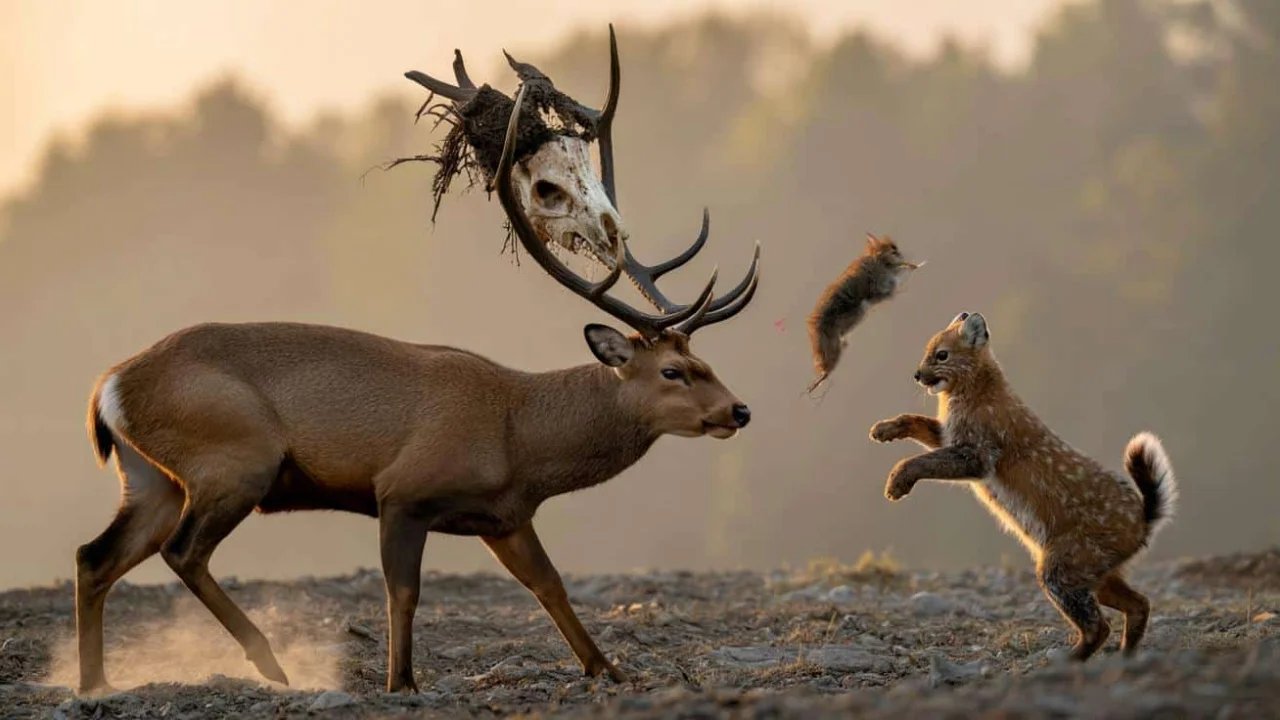
“These images force us to confront nature’s most uncomfortable truths while celebrating its raw beauty,” says Dr. Sarah Matthews, a wildlife behavior specialist at Oxford University. “The deer photograph, in particular, shows how survival can become a burden – literally.”
The latest shortlist for the Wildlife Photographer of the Year Nuveen People’s Choice Award has sparked intense conversations about nature’s darker side. Among the 25 finalist images, two photographs stand out for their haunting portrayal of animal life: a sika deer dragging the rotting head of its defeated rival, and a young lynx casually tossing its prey through the air like a plaything.
These aren’t your typical wildlife calendar shots. They capture moments that make viewers simultaneously fascinated and disturbed, revealing the brutal realities that exist alongside nature’s beauty. The selection committee’s decision to include such unflinching documentation of animal behavior reflects a growing trend in wildlife photography toward authentic storytelling rather than sanitized nature portraits.
The controversy surrounding these images highlights a fundamental shift in how wildlife photography is perceived by both professionals and the public. Traditional nature photography often presents idealized versions of animal life – majestic predators in golden light, peaceful herds grazing in pristine landscapes, or tender moments between parent and offspring. While these images remain valuable for conservation messaging, they represent only a fraction of the complex behavioral repertoire that defines wild animal existence.
The Most Talked-About Wildlife Images of 2026
| Image Title | Photographer | Subject | Key Message |
|---|---|---|---|
| Never-Ending Struggle | Kohei Nagira | Sika deer with rival’s head | Mating competition consequences |
| Flying Rodent | Josef Stefan | Lynx tossing prey | Learning through play |
| The Final Portrait | Various | Polar bear cub after failed hunt | Climate change impact |
| Solar Waves | Francesco Russo | Solar panel landscape | Technology meets nature |
| Ghost of the Forest | Anna Volkov | Leucistic river otter | Genetic diversity importance |
Each image tells a complex story about survival, adaptation, and the intricate web of relationships that define natural ecosystems. The deer photograph, taken in Japan’s Nara Prefecture, required photographer Kohei Nagira to track the struggling animal for over three weeks. The image captures not just a single moment of suffering, but represents the broader challenges facing deer populations as habitat fragmentation increases competition for resources and mates.
Josef Stefan’s lynx photograph, captured in the Carpathian Mountains of Romania, demonstrates the sophisticated behavioral development that young predators undergo. What appears cruel to human observers serves as crucial skill-building for survival in harsh mountain environments where hunting success rates often determine whether animals survive their first winter.
Wildlife Enthusiasts and Photography Communities React
The shortlist announcement has energized several key groups:
- Professional wildlife photographers: Celebrating technical excellence in capturing rare behavioral moments while debating ethical boundaries
- Conservation advocates: Using disturbing images to highlight ecosystem pressures and funding needs for habitat protection
- Nature educators: Incorporating shocking visuals into teaching about animal behavior and ecological relationships
- Museum visitors: Seeking authentic wildlife experiences beyond sanitized nature documentaries and seeking deeper understanding
- Social media audiences: Sharing and debating images that challenge comfortable assumptions about wildlife and human relationships with nature
- Scientific researchers: Recognizing valuable behavioral documentation that supplements field study observations
- Photography students: Studying technical approaches to capturing unpredictable animal behavior in challenging conditions
The reaction has been particularly intense on photography forums and social media platforms, where debates rage about whether such images should be celebrated or criticized. Some argue that showing nature’s harsh realities helps build stronger conservation support, while others worry that disturbing images might alienate potential wildlife supporters who prefer more uplifting content.
How These Images Challenge Traditional Wildlife Photography
The impact extends far beyond aesthetic appreciation:
- Educational value: Teaching complex animal behaviors through single powerful frames that textbooks cannot adequately describe
- Conservation messaging: Highlighting species vulnerability and habitat pressures through visceral emotional connections
- Scientific documentation: Recording rare events that researchers rarely witness, providing valuable behavioral data
- Public engagement: Sparking discussions about human relationships with nature and our responsibility for ecosystem protection
- Emotional connection: Creating lasting memories that influence environmental attitudes and policy support
- Cultural dialogue: Challenging anthropomorphized views of animals popular in media and entertainment
- Artistic evolution: Pushing wildlife photography beyond traditional aesthetic boundaries toward documentary storytelling
These images represent a maturation of wildlife photography as an art form and scientific tool. Rather than simply documenting beautiful animals in picturesque settings, contemporary wildlife photographers increasingly serve as visual journalists, recording the complete spectrum of animal experience including struggle, failure, and death alongside triumph and beauty.
“The deer image represents something profound about competition and consequence,” explains Dr. Michael Rodriguez, an animal behaviorist at Cambridge University. “Most people never see what mating season actually costs these animals. This photograph forces viewers to confront the reality that natural selection operates through individual suffering as well as success.”
The Science Behind Nature’s Most Disturbing Moments
| Behavior | Species Impact | Frequency | Survival Outcome |
|---|---|---|---|
| Antler locking | Both males often die | 1-2% of fights | Usually fatal |
| Prey play behavior | Improves hunting skills | Common in young predators | Increases survival rates |
| Failed polar bear hunts | Energy depletion | 80% failure rate | Declining success |
| Leucism in otters | Increased visibility | Less than 1% | Mixed survival impact |
| Starvation mortality | Population control | 20-40% juvenile mortality | Natural regulation |
| Territory disputes | Injury and displacement | Daily occurrence | Winners thrive, losers suffer |
Understanding the scientific context behind these disturbing images helps viewers appreciate their significance beyond shock value. Antler locking, while rare, serves as a powerful example of how evolutionary adaptations can become maladaptive in certain circumstances. The elaborate antler structures that help males compete for mates occasionally create death traps that natural selection cannot easily eliminate because the behavior occurs after reproductive age.
Prey play behavior in young predators like lynx represents sophisticated learning that significantly improves hunting success rates. Research shows that young cats who engage in extensive prey manipulation during their first year demonstrate 40% higher hunting success rates as adults compared to individuals who skip this developmental phase.
Professional Photographers Share Technical Insights
Capturing these moments requires extraordinary preparation and patience. The deer photograph likely involved weeks of tracking and waiting in Japanese wilderness areas where sika deer populations compete intensely during rutting season. Nagira had to balance getting close enough for compelling composition while maintaining enough distance to avoid interfering with the animal’s natural behavior or potentially dangerous situation.
The technical challenges include working in low light conditions during dawn and dusk when many dramatic animal behaviors occur, managing long telephoto lenses that amplify camera shake, and predicting animal movement patterns to achieve proper focus and composition. Many wildlife photographers report spending 90% of their time waiting and only 10% actually photographing.
The lynx image demonstrates perfect timing and camera settings. Young lynx exhibit prey-play behavior most frequently during twilight hours, requiring photographers to master low-light techniques while maintaining sharp focus on rapidly moving subjects. Stefan used a camera trap system triggered by motion sensors to capture the precise moment when the lynx tossed its prey, allowing for perfect timing without human presence that might alter the animal’s behavior.
Most wildlife photographer of the year finalists spend months researching animal behavior patterns before attempting these shots. Success rates remain incredibly low – many professionals estimate capturing truly unique behavioral moments happens perhaps once every few hundred shooting sessions. The investment in time, equipment, and expertise required to document rare animal behaviors represents a significant commitment that few photographers can sustain without substantial financial support.
“These photographers didn’t just get lucky,” notes Maria Chen, a wildlife photography instructor. “They understood animal behavior deeply enough to predict where extraordinary moments might unfold. The deer photographer, for example, had been tracking rutting behavior patterns for three seasons before capturing this image.”
Global Voting Opens New Conservation Conversations
The People’s Choice Award allows worldwide public participation through March 18, 2026. Early voting patterns suggest the deer and lynx images are generating the most discussion, though polar bear photographs are gaining momentum among climate-conscious voters. The voting process itself has become a platform for conservation education, with detailed behavioral explanations accompanying each image to help voters understand the context behind disturbing scenes.
This democratic approach to wildlife photography recognition creates unique opportunities for conservation messaging. Images that win public votes often influence documentary funding, book publishing decisions, and museum exhibition planning for years afterward. The Natural History Museum reports tracking significant increases in conservation donations following exhibitions featuring emotionally powerful wildlife imagery.
The voting platform includes educational resources about each species featured in the competition, creating opportunities for viewers to learn about habitat threats, conservation status, and protection efforts. This educational component transforms the competition from simple aesthetic appreciation into active conservation engagement.
The Natural History Museum reports that wildlife photographer of the year exhibitions consistently rank among their most visited displays, with many attendees reporting changed attitudes toward environmental issues after viewing powerful imagery. Exit surveys indicate that visitors who view disturbing wildlife images spend significantly more time reading conservation information and are twice as likely to make donations to wildlife protection organizations.
The Psychology of Viewing Disturbing Wildlife Images
Research in environmental psychology suggests that moderately disturbing wildlife images create stronger emotional connections than purely aesthetic ones, leading to increased conservation support. However, images that are too graphic can trigger avoidance responses that reduce engagement with conservation messaging. The careful curation of the Wildlife Photographer of the Year shortlist attempts to balance emotional impact with educational value.
Dr. Lisa Park, an environmental psychologist at Stanford University, explains that disturbing wildlife images activate multiple psychological responses simultaneously. “Viewers experience empathy for suffering animals while also gaining respect for nature’s complexity and power. This combination of emotional responses creates lasting memories that influence future environmental decision-making.”
The images also challenge anthropomorphized views of animals common in popular media. Many viewers report that seeing authentic animal behavior – including predation, competition, and death – helps them develop more realistic and ultimately more respectful relationships with wildlife.
Common Questions About These Disturbing Wildlife Images
Why do deer antlers sometimes lock together permanently?
Antlers grow in complex branching patterns that can intertwine during fights, creating mechanical locks impossible to break. This occurs in roughly 1-2% of serious territorial disputes.
Is the lynx actually playing with its food?
Young predators practice hunting techniques through prey manipulation, combining learning with what appears to be play behavior. This training significantly improves adult hunting success rates.
How often do wildlife photographers capture these rare moments?
Exceptional behavioral shots occur perhaps once per thousand shooting hours, requiring extraordinary patience, preparation, and often years of studying specific animal populations.
Do these images help or hurt conservation efforts?
Research suggests moderately disturbing wildlife images increase public engagement with conservation issues when properly contextualized with educational information about species and habitats.
What ethical guidelines govern wildlife photography?
Professional wildlife photographers follow strict codes prohibiting interference with natural behaviors, feeding animals, or manipulating scenes. Most images require weeks of patient observation rather than intervention.
How do photographers ensure animal welfare while capturing dramatic images?
Ethical wildlife photographers use long telephoto lenses, camera traps, and extensive behavioral knowledge to document natural events without human interference or stress to animals.
“The public consistently chooses images that make them feel something powerful,” observes Dr. James Thompson, a museum curator specializing in nature photography. “These aren’t just pretty pictures – they’re windows into realities most people never consider. That emotional impact drives real conservation action. We’ve seen measurable increases in both museum engagement and conservation donations when exhibitions feature emotionally complex wildlife imagery alongside traditional beautiful nature photographs.”